
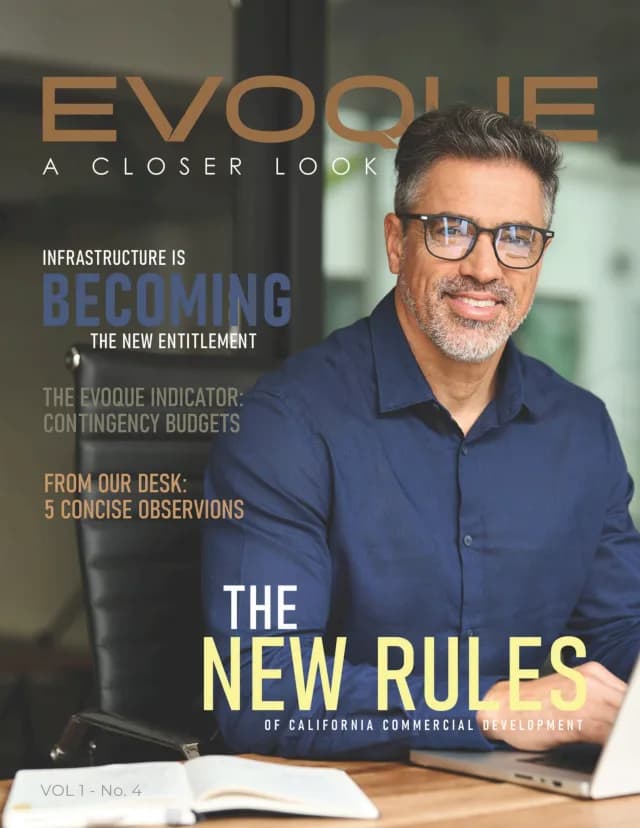
A Closer Look Magazine · Vol. 1, No. 4
Issue 4: The New Rules of California Commercial Development
Sixteen pages for developers: six working rules for California development, why infrastructure now behaves like a second entitlement, this quarter's Evoque Indicator on contingency budgets, and five observations from our desk on how capital partners are reading deals.
Published by Evoque Lending, the parent of Evoque Commercial. Sixteen pages.
Issue 4 of A Closer Look reads the way a good site walk feels: less theory, more of what is actually happening on the ground. The cover story collects six working rules for California commercial development in this cycle, drawn from projects where the old assumptions stopped paying rent.
Around the cover story sits the issue's regular architecture. The Evoque Indicator takes one signal per quarter and explains it in a page; this quarter it tracks the quiet rise of the contingency budget from a line item nobody discussed to a topic capital partners raise on the first call. From Our Desk to Yours gathers five short observations from recent deal conversations. A feature on infrastructure explains why utility capacity is starting to behave like a second entitlement in many California markets, and what that means for financing timelines.
The issue closes with a letter from a longtime trust-deed investor, a client story about finishing a project after its bank reached a ceiling, a crossword for the terminology-inclined, and an overview of the Evoque Fund for accredited investors.
Read it in the viewer below. It's free, and no registration is asked of you. If you'd like the next issue when it publishes, the subscription form sits right after the viewer.
The issue
Read Vol. 1, No. 4 in the viewer
Trouble with the embedded viewer? Open it in a new tab.
Subscribe to A Closer Look Magazine
In this issue
Table of contents
- CoverThe New Rules of California Commercial Development
- PG 1A Word From Our CEOWhy this publication exists and the standard each issue is held to.
- PG 2The Evoque Indicator: Contingency BudgetsThis quarter's indicator, its direction, and what to watch next.
- PG 3From Our Desk to YoursFive observations from recent conversations with developers and capital partners.
- PG 5The New Rules of California Commercial DevelopmentThe cover story. Six working rules experienced developers are applying now.
- PG 8Capital StackA one-page map of senior, subordinate, equity, and timing structures.
- PG 9Infrastructure Is Becoming the New EntitlementPower, water, and utility capacity as a project gate of its own.
- PG 11A Letter From a Longtime InvestorA trust-deed investor's note on nearly two decades of working with Eddie.
- PG 12When the Bank Reached Its LimitA client story about finishing a project after the original lender hit its ceiling.
- PG 14The Commercial Real Estate CrosswordSixteen clues for the terminology the industry runs on.
- BackEvoque FundAn overview of the fund for accredited investors, with a note from Eddie.
Selected articles
What this issue covers
The New Rules of California Commercial Development
The market hasn't stopped moving; it has changed the rules. The cover story lays out six of them: flexibility now outranks certainty, time has become one of the most expensive line items, liquidity carries more weight than it did, infrastructure can't be an afterthought, capital has grown more selective, and relationships still decide more than technology does. Each rule comes with the practical questions experienced developers are asking before they commit.
Infrastructure Is Becoming the New Entitlement
For many California projects, securing approvals is no longer the final hurdle. Access to power, water, and supporting infrastructure increasingly determines whether an approved project can actually move forward. The piece walks through why utility timelines are stretching, the early warning signs developers should not ignore, and the practical steps worth taking before an acquisition closes.
The Evoque Indicator: Contingency Budgets
A recurring one-page read on a single signal from our desk. This quarter: contingency budgets are getting far more attention than they did a few years ago, capital providers are evaluating reserve levels more carefully, and the open question is whether larger reserves become an expectation rather than a recommendation.
From Our Desk to Yours
Five patterns from recent months: equity partners are asking more questions before committing, sponsor liquidity is under a brighter light, contingency planning has moved into the underwriting conversation itself, pre-development timelines keep lengthening, and phased development is drawing new attention as a way to keep flexibility without giving up momentum.
Contributors
Behind the issue
Eddie Luhrassebi
Founder & CEO, Evoque Lending
Writes the CEO letter and leads the editorial perspective across the issue.
The Evoque team
Research, market observations, and production across the issue's departments.
Keep going
Related developer-financing resources
Related resources
A Closer Look Magazine
Development financing, market insight, project strategy, and practical information for builders, developers, and real estate sponsors. Published by Evoque Lending; read the current issue free, no registration.
Resource
The Developer's Guide to Development Financing
The long-form reference for how residential development capital gets structured: lifecycle, sizing measurements, the stack, draw mechanics, guaranties, and exit planning.
Developer Insights
Working knowledge for developers and builders: how construction loans are sized, how capital stacks are assembled, and how project problems actually get solved.
Development Capital. Precisely Structured.
Evoque Commercial structures construction, bridge, and structured capital for residential developers and builders, from $3 million to $250 million-plus.
Financing
Bridge Acquisition Financing
Bridge financing for acquisitions and transitions, when the timeline is fixed, the asset is between stages, and the permanent answer comes later.
Financing
Construction-to-Bridge Financing
The planned handoff from construction loan to stabilization: retiring construction debt at completion and carrying lease-up to a permanent exit.