
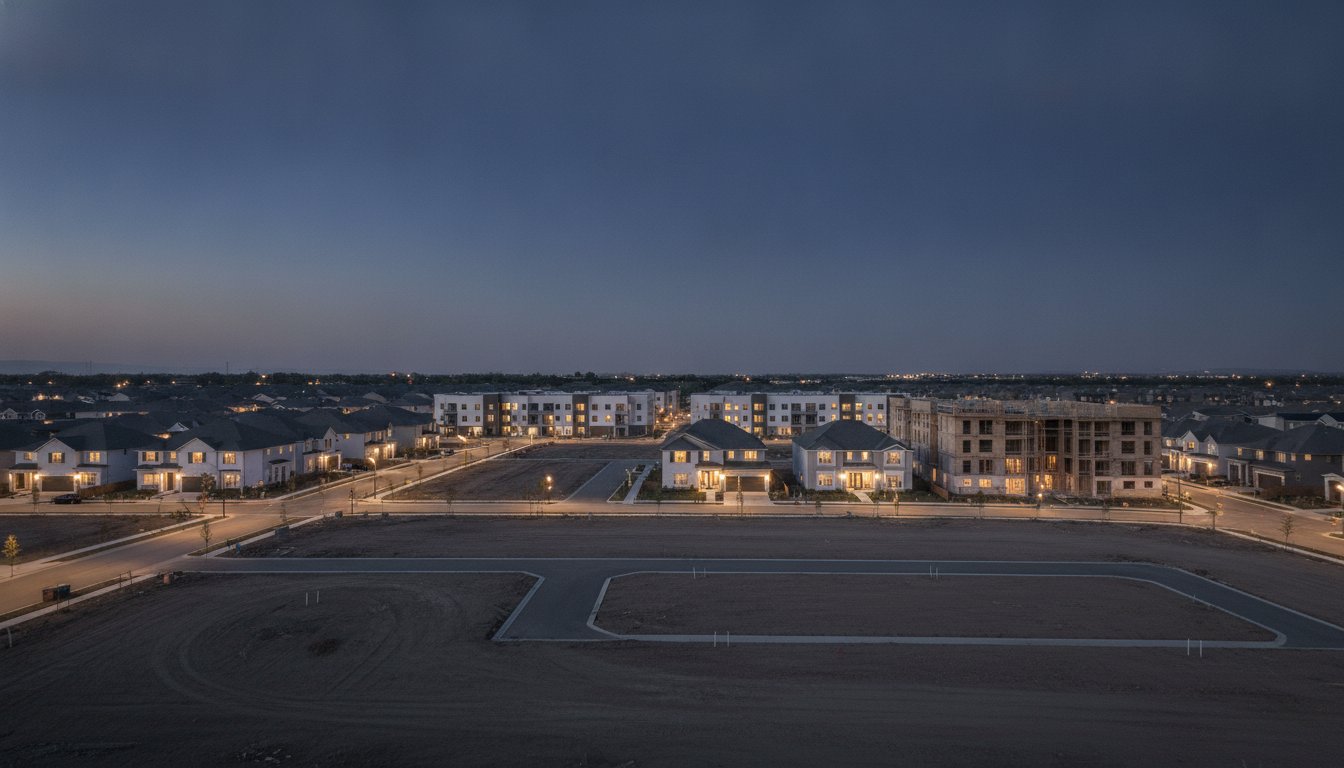
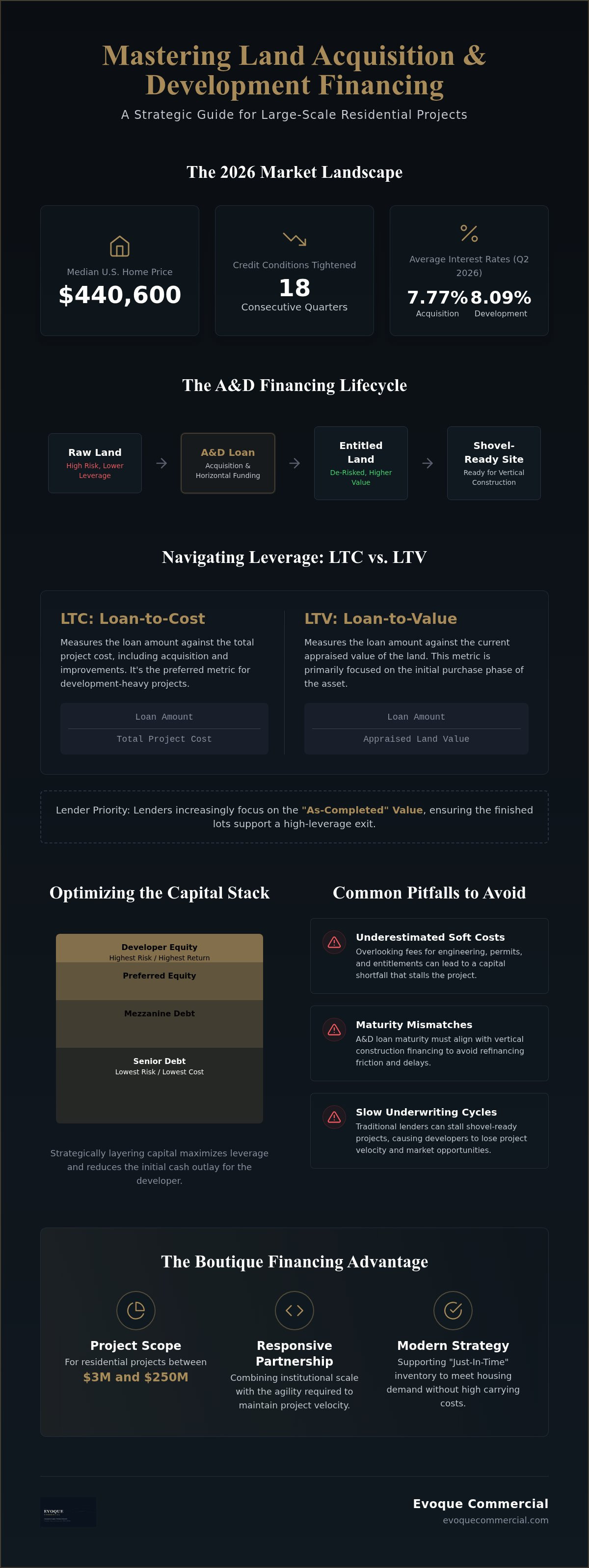
While the median U.S. home price has reached $440,600, credit conditions for land acquisition and development loans have tightened for 18 consecutive quarters as of mid-2026. If you've felt the impact of rigid bank LTV limits or slow underwriting cycles that stall your shovel-ready projects, you aren't alone. Many developers find themselves trapped by a misalignment between land loan maturity and the reality of modern entitlement timelines. It's a frustrating bottleneck that forces you to choose between project velocity and capital efficiency.
This guide will help you master the complexities of A&D financing to secure the high-leverage capital required for large-scale residential projects. We'll show you how to structure a strategic capital stack that balances current interest rates, which averaged 7.77% for acquisition and 8.09% for development in the second quarter of 2026, with the agility your project demands. You'll learn how to ensure a seamless transition to vertical construction financing by partnering with responsive lenders like Evoque Lending who understand the full lifecycle of a subdivision or multifamily development. From navigating the 21st Century ROAD to Housing Act to optimizing your loan-to-cost ratios, we're providing the roadmap to move from raw land to stabilized exit without the traditional friction.
Understanding Land Acquisition and Development (A&D) Loans
A&D financing serves as the critical bridge between raw acreage and a shovel-ready site. Unlike a standard acquisition loan, land acquisition and development loans address two distinct phases of the project lifecycle. The acquisition phase provides the capital to secure the real estate, while the development phase funds the horizontal improvements necessary to prepare the land for vertical construction. In the current market, the role of a Land development bank or similar institutional lender has shifted toward supporting "just-in-time" supply strategies. Developers are moving away from long-term land banking to avoid the carrying costs of idle assets, preferring to acquire and entitle land in rapid succession to meet immediate housing demand.
The distinction between raw land and entitled land is central to risk management. Raw land lacks the permits and zoning required for development, making it a high-risk asset that typically commands lower leverage. Entitled land has already cleared the regulatory hurdles, significantly increasing its value and its appeal to lenders. By securing financing that covers both phases, builders can maintain project momentum and avoid the friction of refinancing between the purchase and the commencement of horizontal work.
The Components of a Land Development Loan
A well-structured loan must account for every dollar spent before the first foundation is poured. This includes the purchase price allocation for the tract, but the real complexity lies in the horizontal improvement budget. Lenders look for detailed line items covering grading, utility installation, and road construction. Beyond physical labor, soft costs represent a substantial portion of the budget. Engineering fees, environmental permits, and entitlement costs must be meticulously documented. If these soft costs are underestimated, the resulting capital shortfall can stall a project before it even begins.
LTC vs. LTV: Navigating Leverage in 2026
Leverage in 2026 is defined by two primary metrics: Loan-to-Cost (LTC) and Loan-to-Value (LTV). LTC is the preferred metric for development-heavy projects. It measures the loan amount against the total cost of the acquisition and improvements. Conversely, LTV focuses on the current appraised value of the land during the initial purchase phase. Institutional lenders increasingly prioritize the "as-completed" value. They want to see that the finished, entitled, and improved lots will support a high-leverage exit. Balancing these two ratios is essential for maximizing your return on equity while maintaining a healthy debt-service coverage profile.
Strategic Structuring: Optimizing the Real Estate Capital Stack
Optimizing the capital stack is a strategic necessity for developers aiming for large-scale residential growth. It's about more than just securing a senior loan. It involves a precise layering of debt and equity to minimize the cost of capital while maximizing your leverage. For multifamily projects, integrating senior debt with mezzanine loans allows builders to stretch their equity further, reducing the initial cash outlay while maintaining control over the development timeline. This structure is often explored in detail within the Forbes Advisor guide to commercial real estate loans, which highlights how different tranches of debt interact. By utilizing preferred equity instead of common equity, developers can often preserve more of the project's upside, ensuring that the rewards for successful entitlement remain with the firm.
Structuring pre-development financing requires a focus on project velocity. Builders need capital that moves at the speed of the market, particularly during the site identification and grading phases. High-leverage land acquisition and development loans provide the foundation for this agility, allowing for a seamless transition from horizontal work to vertical construction. Managing draw schedules for horizontal milestones is critical; lenders require proof of grading, utility installation, and road completion before releasing subsequent funds.
Horizontal Development Loans and Site Identification
Securing the right site is the first hurdle. Financing for residential site identification often requires bridge capital that can close quickly. Once the site is secured, horizontal development loans fund the heavy lifting of land preparation. These loans are structured to support the grading and infrastructure work that transforms raw acreage into buildable lots. To move your project forward, it's vital to learn more about horizontal development loans and how they fit into your broader timeline.
Inventory Financing for Home Builders
As subdivisions move toward completion, inventory financing becomes a powerful tool for recapitalization. Builder inventory credit lines allow developers to release equity from completed lots or standing inventory, providing the liquidity needed for the next acquisition. This is particularly relevant for the growing Build-to-Rent (BTR) sector, where entire communities are held for long-term income rather than immediate sale. If your project has stalled or you're looking to recapitalize a slow-moving subdivision, a structured capital solution can provide the necessary breathing room to reach stabilization.
Underwriting Criteria: What Lenders Look for in Large-Scale A&D
Underwriting for large-scale land acquisition and development loans involves a rigorous analysis of both the physical asset and the operator's execution capability. Unlike simple bridge loans, these facilities require a deep dive into the developer's track record. Institutional lenders prioritize partners who've demonstrated the ability to navigate complex zoning, environmental mitigation, and infrastructure phases. Your history of successful exits on similar residential projects is the most persuasive evidence of project viability in a boutique lending environment.
Lenders evaluate project feasibility through a dual lens: "As-Is" value versus "As-Developed" market demand. They're looking for a clear sensitivity analysis and a pro forma that accounts for current market volatility when underwriting land acquisition and development loans. A robust exit strategy is mandatory. Whether you intend to transition into vertical construction or sell finished lots to a merchant builder, the path to repayment must be concrete and supported by durable absorption data from 2026 market reports.
Managing Entitlement Risk in Residential Markets
Entitlement risk is the primary variable in loan pricing. Acquiring unentitled parcels offers higher potential returns but carries significant regulatory uncertainty, often resulting in lower leverage and higher interest spreads. Conversely, financing an entitled land acquisition is viewed as a lower-risk transaction because the path to construction is clear. Zoning compliance and environmental due diligence are non-negotiable hurdles that determine the final structure of the debt. Shovel-ready status serves as the primary trigger for developers to transition from high-cost horizontal capital to more efficient, lower-cost vertical construction debt.
Collateral and Personal Guarantees
The structure of the guarantee often distinguishes boutique financing from rigid, traditional bank products. For high-net-worth developers with significant liquidity, non-recourse construction loans are increasingly available. These institutional-grade structures typically include "Bad Boy" carve-outs, which limit the lender's recourse to specific acts of fraud, intentional misrepresentation, or gross negligence. Cross-collateralization strategies are also common in multi-phase subdivisions. By pledging multiple project phases as security, developers can often unlock higher overall leverage and more flexible draw schedules across the entire development lifecycle.
Common Pitfalls in Land Construction Loans and How to Avoid Them
Even experienced builders often find their margins eroded by structural flaws in their financing. Underestimating soft costs is a frequent misstep. Engineering, environmental studies, and permit fees often fluctuate, yet many horizontal budgets fail to include a sufficient contingency reserve. In a market where land acquisition and development loans are under heavy scrutiny, a 15% reserve isn't a luxury; it's a requirement for project survival. Failing to account for these "invisible" costs early in the underwriting process can deplete your capital before the first road is even paved.
Another critical failure is mismatching loan maturity with the vertical construction start date. Many A&D facilities are structured to expire upon lot completion, but vertical debt can take months to close. This gap creates a liquidity vacuum that can stall a project at its most vulnerable point. Pure-play land speculation without a defined vertical exit is equally dangerous. Holding entitled land while carrying costs accumulate can quickly turn a profitable subdivision into a liability if you don't have a "Bridge-to-Stabilization" path secured early in the process. You've got to ensure your debt structure accounts for the reality of 2026 entitlement timelines.
Managing Absorption Risk and Phased Takedowns
Structuring phased takedowns is the most effective way to align your debt with market absorption rates. By taking down lots in smaller tranches, you reduce the interest carry and preserve your capital for vertical activity. If a project stalls due to market shifts, rescue capital can provide the necessary lifeline to reach the next milestone. Inventory financing also plays a vital role here. It allows you to release equity from completed lots, maintaining the liquidity needed to fund ongoing operations without diluting your position or losing project control.
The Importance of Vertical Continuity
The transition from horizontal improvements to ground-up construction must be seamless. Avoiding the "gap" between these phases requires an A&D lender capable of scaling with your project. When your lender understands the full lifecycle of the development, they're more likely to provide the continuity needed to move from raw land to a finished community. It's essential to explore ground-up construction financing for builders well before your horizontal milestones are met. This foresight prevents the momentum-killing delays that occur when switching lenders mid-stream.
Ensure your project maintains its momentum by choosing a strategic partner for residential development who understands the nuances of the full capital stack and the importance of vertical continuity.
The Evoque Approach: Boutique Financing for Large-Scale Development
Evoque Lending operates at the intersection of institutional depth and boutique agility. We bridge the gap between massive institutional capital and the middle-market responsiveness that developers require to maintain project velocity. For residential projects ranging from $3M to $250M, we provide the structured capital necessary to move from raw acreage to a stabilized asset. Our national reach allows us to support luxury residential developments and multifamily subdivisions across the country, ensuring that high-leverage land acquisition and development loans are available where the demand is highest. We understand that large-scale developers often feel underserved by rigid bank limits; our model is designed to solve that specific friction point.
Our streamlined project review process is built for rapid execution. We recognize that in the development world, time is a literal cost. By maintaining deep institutional capital relationships, we're able to offer the scale of a major bank with the personal oversight of a boutique firm. This dual approach ensures your project receives the strategic attention it deserves, regardless of its complexity or the specific stage of the development lifecycle.
Why Developers Choose Evoque Lending for Acquisition and Development
Specialized expertise in both horizontal development and vertical integration sets our team apart. We don't just provide a loan; we structure a partnership-first model that prioritizes your long-term exit. Whether you're navigating the initial grading of a single-family subdivision or managing the final phases of a luxury multifamily project, our land acquisition and development loans are tailored to your specific capital stack needs. We offer the flexibility to recapitalize slow-moving phases or scale into ground-up construction as lot absorption dictates. Our goal is to ensure your project remains liquid and agile from the first site identification to the final unit sale.
Getting Started with Your Project Review
Starting a project review with Evoque Lending is a disciplined, chronological process designed to provide clarity quickly. To begin an initial commercial loan review, developers should prepare a detailed project summary, including a pro forma, a track record of similar completed projects, and a clear entitlement status report. Once a submission is received, our team moves methodically from review to term sheet, typically providing a response within a timeframe that respects your project's momentum. We're ready to evaluate your next residential venture with the precision and professionalism your work demands. You can request a project review for your next residential development to see how our structured solutions can optimize your capital stack.
Structuring Your Path to Residential Success
Successful residential development requires more than just a viable site; it demands a capital structure that respects the project's timeline and the developer's equity. By mastering the nuances of land acquisition and development loans, you can navigate the shift from horizontal grading to vertical construction without the friction of traditional bank limits. We've explored the importance of optimizing your capital stack and the necessity of rigorous pre-development due diligence to avoid common pitfalls like maturity mismatches and soft cost overruns.
Realizing a large-scale project depends on a partner who balances institutional capital relationships with boutique responsiveness. With financing available from $3M to $250M and national coverage for residential developers, Evoque Lending provides the strategic support needed for every phase of the development lifecycle. Your vision deserves a financing strategy that is as disciplined and ambitious as the projects you build. We're ready to help you move from raw land to a stabilized exit with precision and confidence.
Secure your project’s foundation with Evoque Lending’s A&D financing solutions.
Frequently Asked Questions
What is the typical LTV for a land acquisition and development loan?
Typical Loan-to-Value (LTV) ratios for raw land usually range from 50% to 60%. However, lenders often focus on Loan-to-Cost (LTC) when horizontal improvements are involved. For development-heavy projects, institutional lenders may provide up to 75% or 80% LTC. These ratios depend on the project's "as-completed" value and the developer's equity contribution. Higher leverage is generally reserved for entitled sites with a clear path to vertical construction.
Can I get a non-recourse loan for a land development project?
Non-recourse options are available, particularly for high-net-worth developers or institutional-grade assets. These loans limit the lender's recovery to the collateral itself, though they almost always include "Bad Boy" carve-outs for fraud or gross negligence. While recourse is standard for many middle-market land acquisition and development loans, strong track records and significant equity positions can unlock non-recourse structures that protect the developer's personal balance sheet.
What is the difference between horizontal and vertical construction financing?
Horizontal financing covers the infrastructure phase, including grading, road construction, and utility installation. It transforms raw acreage into buildable lots. Vertical construction financing, on the other hand, funds the actual building of structures like homes or apartments. Most land acquisition and development loans focus on the horizontal phase, providing the necessary foundation for vertical debt to take over once the site reaches shovel-ready status.
How does entitlement status affect land loan interest rates?
Entitlement status is a primary driver of interest rates because it represents the regulatory risk of the project. Fully entitled land has already secured the necessary zoning and permits, making it a lower-risk asset for lenders. This clarity often leads to more competitive interest spreads. Conversely, unentitled parcels are viewed as speculative, resulting in higher rates and lower leverage until the developer clears the necessary environmental and municipal hurdles.
Does Evoque Lending provide financing for Build-to-Rent (BTR) communities?
Yes, Evoque Lending specializes in Build-to-Rent (BTR) community financing. We support the entire lifecycle of BTR projects, from the initial horizontal development to the vertical construction and eventual stabilization. As the demand for rental housing continues to grow, our structured capital solutions provide the flexibility needed to hold these assets for long-term income. This approach allows developers to maintain liquidity while building high-quality, professionally managed residential communities.
What happens if my project stalls and I need rescue capital?
If a project stalls, rescue capital or bridge-to-stabilization loans can provide the liquidity needed to reach the next milestone. These structured solutions are designed to recapitalize a subdivision or multifamily project that has faced absorption delays or cost overruns. By securing additional capital, developers can avoid default and maintain project control. This strategic intervention allows you to stabilize the asset before seeking permanent financing or a vertical construction exit.
Is a personal guarantee always required for A&D loans?
Personal guarantees aren't always a requirement, though they're common for middle-market projects. Lenders may waive recourse for developers with substantial liquid assets, a proven track record, and significant project equity. In these cases, the loan is secured primarily by the real estate and the project's projected cash flow. Institutional-grade financing often utilizes non-recourse structures with specific carve-outs, allowing experienced builders to limit their personal liability while pursuing large-scale developments.
How long does it take to close a land acquisition loan?
Closing a land acquisition loan typically takes between 30 and 60 days. This timeline depends heavily on the depth of the due diligence required and the clarity of the land's entitlement status. Projects with completed environmental reports, surveys, and zoning approvals move through the underwriting process more quickly. A streamlined review process and a responsive lender are essential for meeting tight closing deadlines in a competitive residential market.