
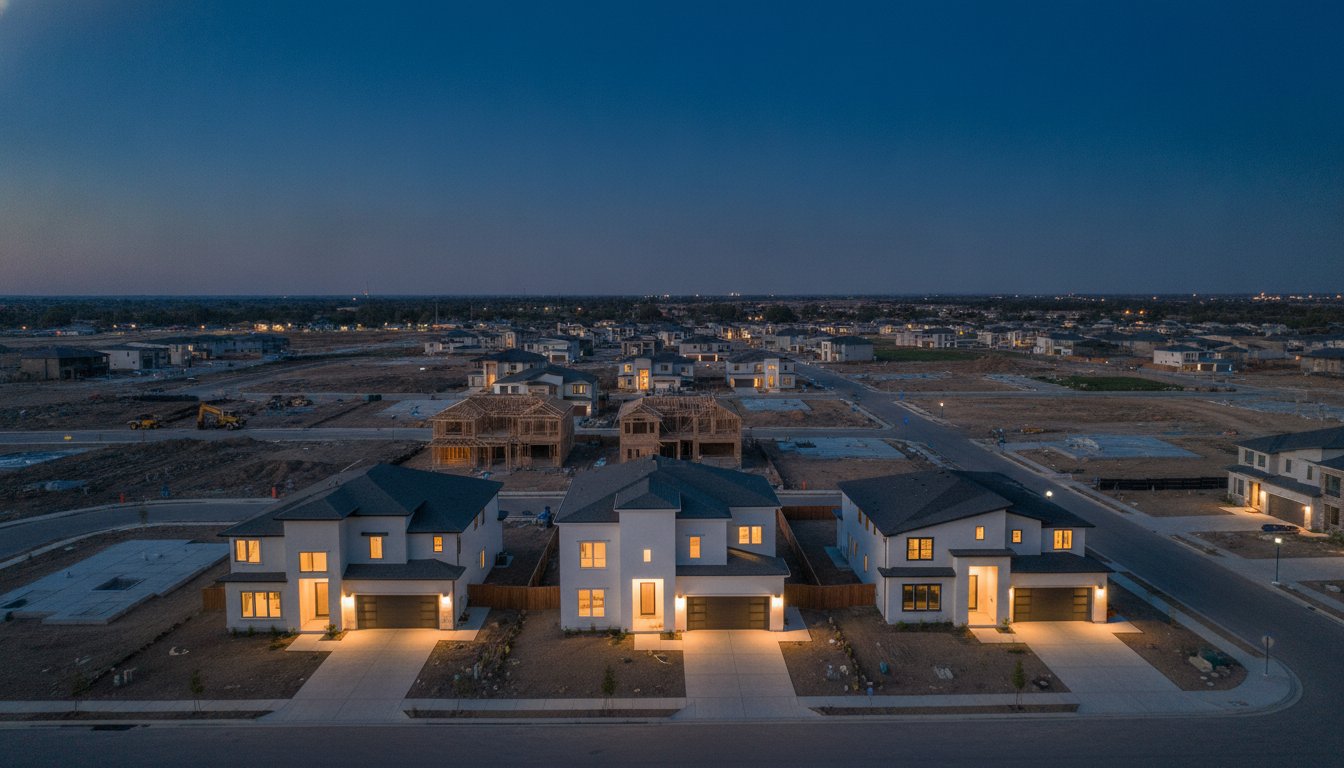
A single-family subdivision is not a single project; it is a series of distinct financial evolutions that most traditional lenders fail to bridge. You likely understand that the gap between horizontal land development and vertical construction is where many developers lose their momentum. Whether it's high entitlement risk delaying your initial funding or an inflexible draw schedule that ignores the reality of site work, the conventional lending model often feels like it's working against your timeline rather than supporting it. Lenders who don't grasp the nuances of spec home absorption can leave your project stalled just as market demand peaks.
This guide provides the strategic framework to master single family subdivision financing by utilizing institutional-grade structured capital. We'll show you how to move beyond static loan products to create a capital stack that evolves with your project's lifecycle. You'll learn how to leverage mezzanine debt and preferred equity to optimize your position, ensure a seamless transition from land acquisition to the first vertical build, and secure responsive underwriting that understands market-specific demographics. From navigating the implications of the 21st Century Road to Housing Act to securing rescue capital for stalled sites, we're outlining the path to a more disciplined and profitable development process.
Beyond the Basics: Navigating Single-Family Subdivision Financing
Single-family subdivision financing is far more than a simple land loan. It represents a comprehensive capital lifecycle designed to move a project from raw acreage to a thriving residential community. For the middle-market developer, this financing serves as the engine for large-scale residential tracts; it provides the liquidity needed to manage the high-risk phases of entitlement and infrastructure. In 2026, the complexity of these projects requires a partner who views capital as a strategic tool rather than a static product.
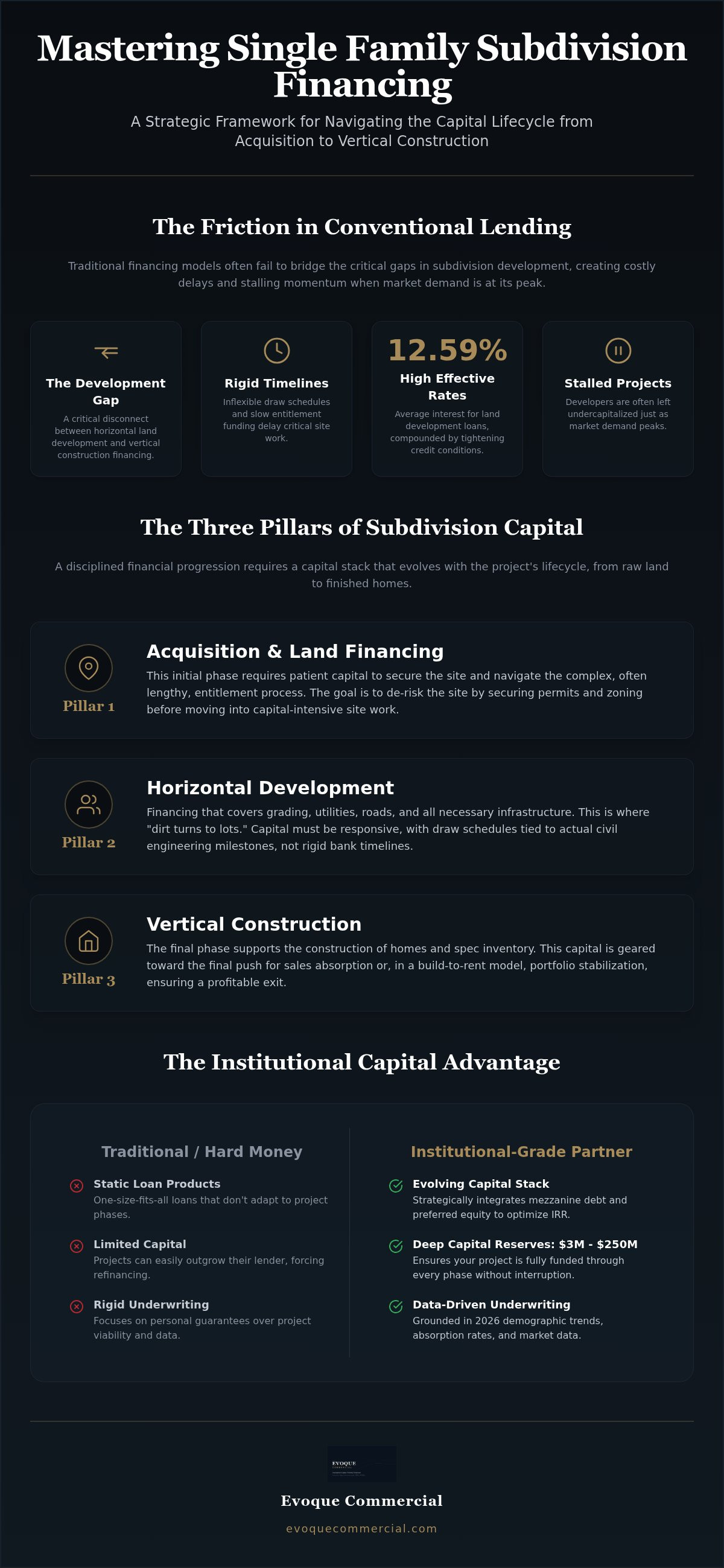
Traditional bank financing often fails the developer in the current market. Recent data from the second quarter of 2026 indicates that effective interest rates for land development loans averaged 12.59% when accounting for initial points. Combined with tightening credit conditions and increased requirements for personal guarantees, many developers find conventional lenders too rigid. Successfully navigating single family subdivision financing requires a partner who understands these pressures. This is where bridge capital becomes essential. It allows you to navigate the pre-development phase without sacrificing your equity or stalling your timeline. Institutional-grade projects typically require a capital partner capable of scaling from $3M to $250M to match the project's total volume.
The Three Pillars of Subdivision Capital
Managing the financial progression of a project requires a disciplined approach to three distinct phases:
- Acquisition and Land Financing: This phase focuses on securing the site and managing the entitlement process. It requires patient capital that understands the timelines of local municipalities.
- Horizontal Development: Financing here covers grading, utilities, and road infrastructure. It's the point where "dirt turns to lots," and draw schedules must be responsive to site conditions.
- Vertical Construction: This pillar supports the actual home builds and spec inventory. It's the final push toward sales absorption or stabilization.
Why Institutional Quality Matters for Middle-Market Projects
Sophisticated developers are moving away from the high-cost hard money market. They're seeking structured debt that offers more than just high interest rates. Institutional-grade financing provides deep capital reserves up to $250M; this ensures your project won't outgrow its lender. The underwriting is grounded in 2026 demographic trends and absorption data. It's about having a partner who understands the impact of the 21st Century Road to Housing Act on local supply. This level of sophistication ensures your single family subdivision financing is optimized for the highest possible IRR by utilizing a capital stack that evolves as the project matures.
The Subdivision Lifecycle: From Acquisition to Horizontal Development
A disciplined progression from raw land to a shovel-ready site is the foundation of any successful project. Single family subdivision financing must be sequenced to match your actual engineering timeline. If the capital is too rigid, the project stalls during permitting. If it's too short-term, you face refinancing pressure before the first road is even paved. Aligning your capital partner with your civil engineering milestones is the only way to avoid the liquidity traps that catch many middle-market developers.
Step 1: Land Acquisition and Entitlement Funding
Land acquisition is only the start of the journey. The real work involves zoning changes, environmental assessments, and the long road to permit approval. Entitlement risk is the primary barrier to early-stage funding; it encompasses the legal and regulatory uncertainty of whether a project can proceed as designed. While some developers rely on seller-carry arrangements, these often lack the scale needed for multi-phase tracts. Institutional bridge loans offer a more robust alternative. They provide the necessary capital to close on the dirt while allowing the entitlement process the time it needs to reach completion. This strategic debt de-risks the site before you move into the more capital-intensive infrastructure phase.
Step 2: Horizontal Infrastructure and Site Work
When entitlements are secured, the focus moves to physical site work. Horizontal development loans function differently than vertical debt because they are tied to specific civil milestones. This capital funds the grading, sewers, utility connections, and road networks that transform raw land into finished lots. Managing the draw schedule is vital here. In the second quarter of 2026, land development loans carried an average effective interest rate of 12.59% when accounting for points. Efficient draw management ensures you aren't paying interest on capital that isn't yet deployed. It keeps the project liquid while moving toward lot completion.
Transitioning to the vertical build happens once the plat is recorded. At this point, developers often use inventory financing to release equity from their initial phases. This strategy allows you to pull capital out of finished lots to fund your next acquisition. If you need a partner who understands these technical transitions, Evoque Lending structured capital solutions provide the responsiveness required to keep your civil teams moving. By matching the debt structure to the engineering timeline, you maintain liquidity from the first survey to the final home sale.
Optimizing the Capital Stack for Large-Scale Subdivisions
High-volume residential projects require more than a simple senior loan. Relying on a single source of capital often results in a lower IRR because the developer's equity remains tied up for the duration of the build cycle. Strategic single family subdivision financing utilizes multiple layers of capital to maximize leverage and preserve liquidity for future acquisitions. For projects exceeding $50M, a well-optimized capital stack becomes the primary differentiator between a project that scales and one that plateaus. It's about finding the balance between the cost of capital and the dilution of the sponsor's equity.
Senior Debt vs. Mezzanine Financing
Senior debt provides the essential foundation for any subdivision project, typically occupying the first-lien position. However, senior lenders rarely provide enough proceeds to cover the full development cost, especially as credit conditions tighten in 2026. Mezzanine debt fills the critical gap between that senior layer and the developer's equity. Mezzanine debt is secured by ownership interests rather than the real estate itself. This structure allows developers to reach a higher total LTC without disturbing the senior lender’s primary security. It's a disciplined way to increase leverage while maintaining full operational control of the project's direction.
Preferred Equity: The Flexible Alternative
Preferred equity offers another level of sophistication for developers who want to reduce their cash-in-deal requirement. By bringing in a preferred equity partner, you can diversify your risk across multiple projects instead of concentrating all your capital into a single tract. Unlike mezzanine debt, preferred equity is often structured with a "waterfall" distribution model. This system aligns the interests of the capital partner and the builder by prioritizing returns based on specific project milestones.
When evaluating single family subdivision financing, the choice between these two layers often depends on your specific exit strategy. Mezzanine debt is often preferred for traditional sell-out subdivisions where individual lot releases are frequent. In contrast, preferred equity’s flexibility is often better suited for build-to-rent communities where long-term stabilization is the goal. Structured capital solutions provide the leverage needed for institutional-grade projects without the rigid constraints of traditional banking; they allow you to move forward with confidence even in a shifting market.
Strategic Underwriting: Mitigating Entitlement and Absorption Risks
Underwriting for single family subdivision financing has evolved significantly by August 2026. Lenders no longer evaluate a project solely on the value of the dirt; they prioritize the developer's ability to maintain sales velocity. A pro forma must reflect the current reality of record-high home prices, which reached a median of $440,600 in June 2026. Institutional lenders scrutinize how your project will compete in a market with a 4.6-month supply of inventory. They're looking for a disciplined approach to risk that accounts for both market saturation and shifting buyer demand.
Exit strategies must be clearly defined before the first draw is ever requested. Whether you're targeting traditional home sales or transitioning into a Build-to-Rent (BTR) community, the capital structure must remain flexible enough to accommodate either path. Lenders often manage their exposure by setting strict limits on spec home inventory within the loan agreement. This prevents developers from over-extending their vertical construction during periods where absorption rates might fluctuate. It's a strategic safeguard that ensures the project remains liquid throughout its lifecycle.
Evaluating Market Absorption and Demographics
Velocity is the primary metric for institutional underwriting. Lenders analyze the specific speed at which finished homes will sell to ensure the debt is repaid on schedule. Middle-market responsiveness is critical here. Developers must demonstrate they can adjust to shifting interest rates and local supply-demand imbalances. For instance, if a region sees a 2.4% rise in new listings, your vertical financing terms must reflect that increased competition. Sophisticated lenders look for underwriting that understands these market-specific demographics to ensure the project remains viable even if the local pace of sales cools.
Rescue Capital and Project Completion
Even the most well-planned subdivisions can face hurdles that stall progress. Identifying the signs of a project in need of recapitalization early is essential for protecting your equity. Bridge-to-stabilization loans are designed to rescue developments where the original lender is unable to continue or where entitlement delays have exhausted the initial budget. Construction completion financing provides the tactical reset required to bring a project to the finish line. If your development has lost momentum due to inflexible draw schedules or unexpected site costs, securing construction completion financing can provide the necessary capital to finish the build and begin the sales phase. This type of rescue capital ensures that the investment isn't lost to a temporary liquidity crunch.
Boutique Capital Execution: The Evoque Lending Advantage
Evoque Lending occupies a unique position in the capital markets by combining the deep liquidity of institutional funding with the agile, responsive service of a boutique firm. For developers managing single family subdivision financing, this means your project isn't just a file in a queue; it's a complex engineering and financial puzzle that we solve through structured capital. Our ability to scale from $3M to $250M allows us to support middle-market developers as they transition from local builders to regional powerhouses. We focus on the entire lifecycle of the development, providing the stability needed to move from the first acquisition draw to the final inventory release without the friction common in traditional banking.
The Evoque Project Review Process
Efficiency is the cornerstone of our review process. We move from your initial inquiry to a structured term sheet with a speed that respects the realities of your site work schedule. You'll have direct access to decision-makers who understand the technical aspects of horizontal development and vertical construction. We don't just look at credit scores; we analyze the civil engineering milestones and market absorption data that define your project's success. This technical depth allows us to bridge the gaps between acquisition, project completion, and your ultimate exit strategy. Whether you need inventory financing to release equity or rescue capital for a stalled site, our underwriting is designed to be as responsive as your timeline requires. We take pride in our ability to handle complex capital stacks that include mezzanine debt or preferred equity, ensuring your project remains liquid even when site conditions change.
A Strategic Partner for National Growth
Our expertise extends across the United States. Our national coverage for single family subdivision financing allows us to support developers with a single, reliable capital source regardless of the market. By leveraging deep institutional relationships, we bring sophisticated structured capital solutions to middle-market projects that are often overlooked by larger firms. We understand that your reputation is built on your ability to deliver finished lots and quality homes; our goal is to provide the financial stability to make that possible. We specialize in providing the construction completion financing and bridge-to-stabilization loans that keep projects moving when traditional lenders pull back. If you are ready to move forward, partner with a lender who understands the lifecycle of your subdivision and can provide the responsive execution your project deserves.
Securing Your Project's Financial Lifecycle
Mastering the complexities of single family subdivision financing requires a shift away from static, one-size-fits-all lending models. You've seen how a structured capital stack, utilizing mezzanine debt or preferred equity, can protect your project's IRR while bridging the gap between horizontal development and vertical construction. By prioritizing disciplined underwriting and understanding market-specific absorption rates, you ensure that your development remains resilient against shifting economic conditions. Your project deserves a partner who understands that every lot release is a critical milestone in the larger development cycle.
Evoque Lending provides the national coverage and institutional capital relationships necessary for residential projects ranging from $3M to $250M. We combine this scale with a boutique responsiveness that respects your timeline and technical expertise. Our team acts as a strategic partner, offering the precision and stability required to bring large-scale residential tracts to completion. We're ready to help you optimize your next development's capital structure with a focus on long-term project viability.
Request a project review for your single-family subdivision project today. We look forward to supporting your vision with the professional discipline and structured capital your project deserves.
Frequently Asked Questions
What is the typical loan-to-cost (LTC) for a subdivision development loan?
Senior loan-to-cost ratios typically range from 65% to 80% depending on the project's risk profile and entitlement status. However, by utilizing structured layers such as mezzanine debt, developers can often achieve a total LTC of 90% or higher. This high leverage is usually reserved for sponsors with a proven track record and projects in markets with strong demographic demand. It allows you to preserve your own liquidity while maintaining momentum across multiple development phases.
How does horizontal development financing differ from a vertical construction loan?
Horizontal financing focuses on the civil engineering phase, covering infrastructure like roads, sewers, and utility connections. These draws are tied to engineering milestones rather than building completions. Vertical construction loans fund the actual home builds and are managed through inspections of the physical structures. Successful single family subdivision financing requires a seamless transition between these two distinct phases to avoid costly delays in your delivery schedule and maintain your project's internal rate of return.
Can I get financing for a subdivision project that is already stalled?
Stalled projects can be recapitalized through specialized construction completion financing or rescue capital. These loans are designed to replace a previous lender who is unable to continue or to provide the liquidity needed to finish a project after unexpected delays. Lenders evaluate the remaining cost-to-complete against the projected exit value of the finished lots. This strategic reset allows developers to protect their existing equity and bring the subdivision to a successful market entry even after a temporary pause.
What are the requirements for non-recourse subdivision financing?
Non-recourse options typically require a lower loan-to-cost ratio and a sponsor with significant experience in large-scale residential tracts. Lenders look for high-quality entitled land and a robust pro forma that demonstrates strong absorption velocity in the current market. While standard "bad boy" carve-outs still apply, the primary security is the project itself. This structure is often preferred for institutional-grade projects where developers want to limit personal liability across a national portfolio while scaling their operations.
How does mezzanine debt work in a residential development capital stack?
Mezzanine debt sits between the senior loan and the developer's equity in the capital stack. It is secured by a pledge of ownership interests in the project entity rather than a mortgage on the real estate. This layer is essential for single family subdivision financing when the senior lender limits their exposure. It allows you to increase your total leverage while keeping the senior debt's lower interest rate as the foundation of your funding, effectively reducing your cash-in-deal requirement.
What is the minimum project size for Evoque Lending subdivision loans?
Evoque Lending provides financing solutions starting at a minimum of $3M per project. Our capacity scales up to $250M, allowing us to support both boutique luxury developments and massive master-planned communities. This range ensures that middle-market developers have access to the same institutional-grade capital typically reserved for the largest national firms. We focus on projects where our structured approach can add the most strategic value to the developer's lifecycle from acquisition to stabilization.
Do you provide bridge loans for entitled land acquisition?
We provide bridge loans specifically designed for entitled land acquisition. These loans allow for a quick closing on a site while you finalize the remaining horizontal development permits or prepare for vertical construction. Bridge capital is a tactical tool for securing prime locations in competitive markets where sellers require fast execution. It provides the necessary liquidity to lock in the land without waiting for the longer underwriting cycles of traditional banks, ensuring you don't lose a high-value opportunity.
How do lenders evaluate absorption risk for spec home subdivisions?
Lenders evaluate absorption risk by analyzing the sales velocity of comparable homes in the local submarket. They scrutinize the number of units expected to sell per month against the current inventory levels, such as the 4.6-month supply noted in June 2026. Underwriters also consider the impact of the 21st Century Road to Housing Act on local supply and density. A clear exit strategy, backed by market-specific demographic data and current median home prices, is required to mitigate these risks.