
Your personal net worth shouldn't be the collateral for every foundation you pour. In a 2026 market where traditional bank liquidity continues to tighten, many developers feel pressured to sign personal guarantees just to keep their pipeline moving. It's a high-stakes gamble that ties your family's financial security to the volatile cycles of large-scale residential construction. You've worked hard to build your reputation and your assets, so it's only natural to want a financing structure that respects those boundaries and limits your personal exposure.
This strategic guide will help you master the complexities of non-recourse construction loans for developers, allowing you to protect your personal balance sheet while scaling your most ambitious projects. We'll break down the current shifts in institutional debt, from navigating complex carve-out negotiations to optimizing your capital stack with debt funds and life companies. You'll learn how to position your multifamily or build-to-rent developments to attract recourse-free capital, ensuring your growth is defined by your professional expertise rather than your personal liability.
What are Non-Recourse Construction Loans for Developers?
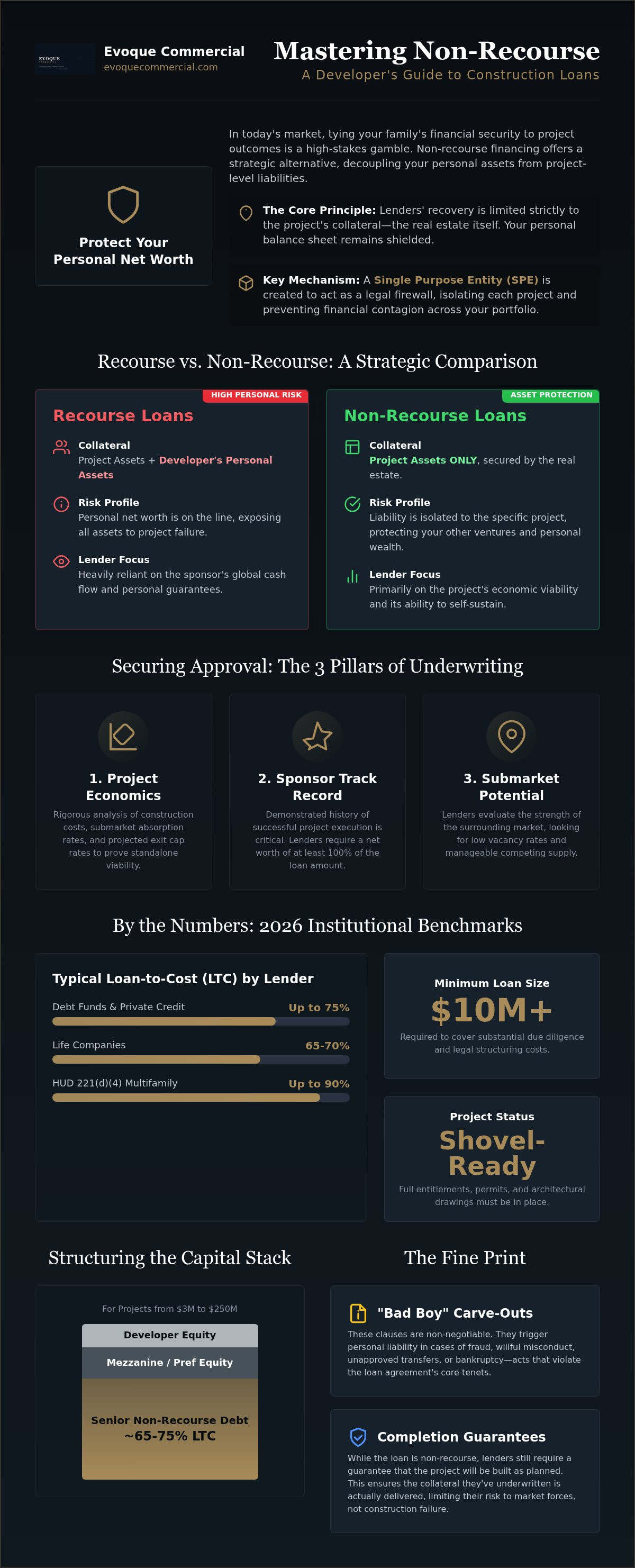
At its foundation, a non-recourse loan is a debt obligation where the lender's only source of repayment is the specific asset pledged as collateral. To understand What are Non-Recourse Construction Loans, one must look at how the debt is isolated. For large scale residential builds, this means the lender cannot pursue the developer's personal assets or other business interests if the project fails to meet its obligations. Instead, the recovery is limited strictly to the real estate, the permits, and the projected cash flows of the development itself.
Structuring these deals requires the creation of a Single Purpose Entity (SPE). This legal framework acts as a firewall. It separates the specific project from the developer’s broader holding company. For those managing multi phase residential developments, this isolation is a prerequisite for scaling. It ensures that a challenge on one site doesn't jeopardize the liquidity of the entire organization. In the current 2026 market, non-recourse construction loans for developers have moved from a luxury for the elite few to a standard requirement for institutional grade projects.
The Core Mechanism of Limited Liability
Lenders providing non-recourse capital prioritize the viability of the asset over the global cash flow of the sponsor. They conduct deep dives into submarket absorption rates, construction costs, and exit cap rates. This shift in focus provides significant psychological and financial freedom for serial developers. You aren't betting your entire career on a single interest rate hike or a supply chain delay. Non-recourse debt represents a project-centric rather than a sponsor-centric credit decision. While the sponsor's track record remains vital, the project's own merits carry the heavy lifting during the underwriting process.
Why 2026
is the Year of Structured Non-Recourse Debt
The financing landscape has changed dramatically this year. Regional banks have pulled back on recourse free debt due to tightening liquidity and regulatory pressure. This has created a vacuum that private credit and institutional debt funds are eager to fill. These non bank lenders offer the flexibility that traditional institutions currently lack. They are more comfortable with higher leverage and complex capital stacks. Evoque Commercial acts as the bridge to these institutional pools. We provide middle market developers with the same non-recourse construction loans for developers that were once reserved for the nation's largest firms. In a volatile economy, decoupling personal liability from project performance isn't just a preference; it’s a disciplined strategy for long term survival.
Eligibility and Underwriting: What Lenders Require
Non-recourse underwriting is a rigorous assessment of risk isolation. Unlike recourse debt, which leans on personal guarantees, non-recourse construction loans for developers rely on the "Three Pillars": the project's economics, the sponsor's execution history, and the submarket's absorption potential. Lenders need to see that the asset can stand on its own. They evaluate the market pillar by looking at submarket vacancy rates and competing supply. If the surrounding area is oversaturated, even a strong sponsor will struggle to find non-recourse terms.
In 2026, leverage varies significantly by lender type. Debt funds typically offer up to 75% LTC, while life companies remain more conservative at 65% to 70%. For those qualifying for HUD 221(d)(4) multifamily programs, leverage can reach 90% LTC. These benchmarks align with the federal definition of construction loans, ensuring that the capital stack remains compliant with institutional risk standards. These ratios are strictly enforced to protect the lender's position in a project-centric credit environment.
Most institutional non-recourse pools start at the $10 million mark. This threshold exists because the legal and due diligence costs for structuring complex non-recourse debt are substantial. Projects must also be "shovel-ready" with full entitlements. Lenders don't want to take on zoning or permitting risk; they want to fund the vertical execution. Having a complete set of architectural drawings and a clear timeline for the certificate of occupancy is essential for a smooth closing.
Sponsor Track Record and Liquidity
Experience is the primary currency in this space. Securing non-recourse construction loans for developers often hinges on the strength of the development team. Lenders generally require a sponsor's net worth to be at least 100% of the loan amount. Additionally, about 10% of that net worth should be in liquid assets. This liquidity ensures the developer can cover unexpected cost overruns without jeopardizing the project’s completion. If you're looking to bridge the gap between middle-market development and institutional capital, Evoque Commercial provides the structural expertise needed to present your track record effectively.
Project Viability and Exit Strategy
The underwriting doesn't end at the certificate of occupancy. Lenders scrutinize the "bridge-to-stabilization" plan. You must prove demand through rigorous market feasibility studies, especially in the multifamily and build-to-rent (BTR) sectors. A vetted General Contractor (GC) with a proven history of finishing projects on time is a requirement. Most lenders insist on fixed-price contracts to mitigate inflationary pressures. They want to see a clear path to permanent financing or a sale that covers the debt service with a healthy margin, ensuring the project remains profitable even if interest rates fluctuate.
Recourse vs. Non-Recourse: A Strategic Comparison
Choosing between these two structures isn't just a math problem; it's a fundamental risk management decision. While a recourse loan from a regional bank might offer a lower headline interest rate, it requires the developer to sign a personal guarantee. This means the lender can pursue your personal bank accounts, other real estate holdings, and future earnings if the project fails. Conversely, Recourse vs. Non-Recourse Loans differ most in how they treat the sponsor's personal balance sheet during a market downturn.
The "Non-Recourse Premium" typically manifests as a higher interest rate, often 50 to 150 basis points above standard recourse debt. However, this cost is offset by the flexibility found in covenants and reporting. Non-recourse lenders, particularly debt funds, are often more pragmatic regarding draw schedules and lease-up requirements. They prioritize the project's success over rigid banking regulations. For developers managing multiple sites, non-recourse construction loans for developers ensure that a single project's delay doesn't trigger a "cross-default" across an entire portfolio.
Impact on future borrowing power is another critical factor. Recourse debt appears as a direct liability on your Personal Financial Statement (PFS), which can negatively impact your debt-to-income ratio for future projects. Non-recourse debt is generally treated as a contingent liability. This distinction allows you to maintain a cleaner balance sheet, preserving your capacity to secure financing for subsequent phases or new acquisitions without being capped by a single project's leverage.
The Cost of Capital vs. The Cost of Risk
Calculating the true ROI of asset protection requires looking beyond the monthly interest payment. A 50 to 150 basis point premium on interest rates often pales in comparison to the strategic value of absolute asset insulation. If a project faces a 12 month delivery delay, recourse debt puts your entire net worth at risk. Non-recourse debt limits that risk to the equity already invested in the SPE. You should accept recourse only when the pricing difference is extreme and the project’s execution risk is virtually zero, such as a pre-leased build-to-suit for a credit tenant.
Leverage Limits and Equity Requirements
Strategic developers must also balance leverage with liability. Recourse loans from credit unions or banks often allow for 75% to 80% LTC, while non-recourse construction loans for developers from life companies might cap at 65% to 70%. To maximize yield without signing a guarantee, many developers use structured capital solutions. Integrating preferred equity can fill the gap between a conservative 65% non-recourse senior loan and the total project cost. This structure optimizes the developer's cash-on-cash return while maintaining the protective barrier of a non-recourse framework.
The Fine Print: Bad Boy Carve-outs and Completion Guarantees
Non-recourse debt is better described as "conditional recourse" debt. While it shields your personal assets from a standard project default, that protection is contingent upon your adherence to specific ethical and operational standards. These are known as bad boy carve-outs. If you violate these terms, the lender's ability to pursue your personal assets is triggered, effectively stripping away the non-recourse status. It's a mechanism designed to ensure the sponsor acts in good faith throughout the development lifecycle.
Environmental indemnities represent another standard exception. Regardless of the loan's non-recourse nature, lenders typically require the sponsor to remain personally liable for any environmental contamination or remediation costs. This is an industry-wide standard in commercial real estate. Negotiating the scope of these indemnities is a key part of the closing process. You should strive for loss-only recourse where possible. This ensures that if a minor violation occurs, you're only liable for the specific financial loss the lender suffered, rather than the entire loan balance.
Springing recourse is the more aggressive alternative. Under this structure, certain actions, most notably filing for voluntary bankruptcy, cause the entire loan balance to spring into a full personal guarantee. This is designed to prevent developers from using bankruptcy as a strategic tool to delay foreclosure. Understanding these triggers is essential when securing non-recourse construction loans for developers. If you're navigating these complex legal nuances, Evoque Lending provides the expert guidance needed to structure these guarantees safely.
Standard Carve-out Triggers
Most triggers involve acts of bad faith. This includes fraud, intentional misrepresentation during the application, or the misappropriation of project funds. For instance, using insurance proceeds for anything other than repairs or failing to hand over tenant security deposits upon default will trigger personal liability. You should aim to limit these triggers to the borrowing entity. However, most institutional debt funds will still require a personal signature from a high-net-worth individual to ensure accountability.
The Completion Guarantee Nuance
A common misconception is that non-recourse means the developer can walk away mid-build. This isn't true. In the world of non-recourse construction loans for developers, you are still on the hook to finish the building. Lenders require a completion guarantee, which is distinct from a repayment guarantee. You are legally obligated to finish the project on time and within the approved budget. If costs exceed the loan amount, the developer is responsible for the overruns. Mitigating this risk requires a vetted General Contractor and robust payment and performance bonds. This protection ensures the lender isn't left with a half-finished shell.
Structuring the Capital Stack with Evoque Commercial
A successful development relies on a capital stack that balances cost with safety. While non-recourse construction loans for developers provide the necessary foundation, they rarely cover 100% of the project's costs. Institutional lenders typically cap senior debt at 65% or 70% LTC to maintain a disciplined risk profile. This leaves a capital gap that can stall a developer’s growth if it isn't managed with a strategic approach.
We specialize in layering these senior positions with mezzanine debt and preferred equity. This structured approach allows you to achieve higher total leverage while keeping the core non-recourse protections intact. By decoupling your personal assets from the project’s performance, you maintain the liquidity needed to pursue subsequent opportunities without being constrained by a single project’s liabilities.
Our boutique advantage means we don't apply a one-size-fits-all model. Whether your project requires $3 million for a luxury build or $250 million for a massive multifamily subdivision, we tailor the financing path to your specific timeline. We understand that middle-market developers need the same sophisticated tools as institutional giants.
Maximizing Leverage Without Personal Risk
Consider the logic of a layered stack. A developer might secure a 65% non-recourse senior loan and supplement it with 20% preferred equity. This results in an 85% total leverage position. The sponsor's personal risk remains limited to the "bad boy" carve-outs, yet the cash-on-cash return is significantly enhanced. This capital stack optimization framework is essential for modern multifamily and BTR developments. It provides the fuel for vertical construction without the suffocating weight of personal repayment guarantees. You can explore how Mezzanine Debt for Residential Development Projects serves as a flexible alternative to preferred equity in these scenarios.
Institutional Reach, Middle-Market Responsiveness
Evoque Commercial acts as a strategic partner that bridges the gap between boutique developers and massive institutional capital pools. We leverage our national reach and deep relationships with debt funds and life companies to find terms that aren't available on the retail market. This is particularly valuable for shovel-ready projects where speed-to-market is a competitive advantage. We move with the agility of a boutique firm while delivering the horsepower of an institutional lender. We don't waste time. Securing non-recourse construction loans for developers requires this blend of high-level access and personal responsiveness.
Navigating the transition from construction to bridge-to-stabilization loans requires a partner who understands the full lifecycle of a project. We provide the continuity needed to see a development through from land acquisition to final lease-up. If you're ready to scale your portfolio without compromising your personal financial security, the next step is a comprehensive project review. Partner with Evoque for your next non-recourse development loan and experience a disciplined, strategic approach to construction financing.
Scaling Your Portfolio with Disciplined Risk Management
The landscape of 2026 demands a shift from traditional personal guarantees to sophisticated, asset-centric debt. Protecting your personal net worth while managing large-scale builds isn't just a defensive move; it's a strategic necessity for long-term growth. Successfully navigating non-recourse construction loans for developers requires a deep understanding of carve-out triggers and the ability to layer senior debt with preferred equity. By decoupling your personal assets from project-level liabilities, you maintain the agility needed to capture new market opportunities as they arise.
Evoque Commercial provides the institutional capital relationships and boutique responsiveness required to move your project from ground-up construction to stabilized occupancy. We offer national coverage for residential developers and provide tailored financing paths ranging from $3M to $250M. Our team understands the nuances of complex residential developments and works as your strategic partner to optimize your capital stack for maximum yield.
If you're ready to secure financing that respects your professional boundaries and protects your future, it's time to take the next step. Request a Project Review for Non-Recourse Financing today. We're here to help you scale your portfolio with the precision and discipline your projects deserve.
Frequently Asked Questions
Is a non-recourse construction loan truly 100% risk-free for the developer?
No, non-recourse debt isn't 100% risk-free. You're still obligated to provide a completion guarantee, ensuring the project reaches its certificate of occupancy. Additionally, bad boy carve-outs can trigger full personal liability if fraud or specific criminal acts occur. While your personal balance sheet is shielded from market-driven project failures, your professional conduct and the completion of the physical structure remain your responsibility. It's a strategic shield, not a total absence of obligation.
What are the typical interest rates for non-recourse construction financing in 2026?
Interest rates for non-recourse construction loans for developers in 2026 vary based on the lender type. Spreads typically range from 3.00% to 6.50% over the 30 to 90 day LIBOR rate. Debt funds often see rates starting at 8% or higher, while HUD 221(d)(4) loans settle in the mid to high 5% range. These rates reflect the premium paid for asset insulation and the increased risk assumed by the institutional lender.
Can middle-market developers qualify for non-recourse debt, or is it for institutional firms only?
Middle market developers can absolutely qualify for non-recourse construction loans for developers, though institutional lenders typically look for a minimum loan size of $10 million. Smaller projects may face higher costs relative to the loan size due to legal and structuring requirements. Evoque Commercial specializes in bridging this gap, providing developers access to institutional capital pools previously reserved for the nation's largest firms. Shovel ready status and a strong track record are essential.
What happens if a project goes into default on a non-recourse loan?
If a project defaults, the lender's recovery is limited strictly to the collateral, which includes the real estate and project cash flows. They can't pursue your personal assets, bank accounts, or other business holdings to satisfy the debt. This protection remains in place as long as no bad boy carve-outs were triggered. The lender will typically foreclose on the property and take over the development through the Single Purpose Entity structure to recover their investment.
Do non-recourse loans require a higher equity contribution (LTC) than recourse loans?
Non-recourse loans generally require a higher equity contribution compared to traditional recourse debt. While bank recourse loans might reach higher leverage, non-recourse debt funds usually cap at 75% LTC. Life companies are even more conservative, often limiting their exposure to 65% or 70% LTC. Developers often fill this gap using preferred equity or mezzanine debt to reach their desired leverage without reintroducing personal repayment guarantees to the senior lender.
What is a 'Bad Boy Carve-out' and how can I negotiate its terms?
A Bad Boy Carve-out is a clause that converts non-recourse debt into full recourse if the sponsor commits prohibited acts. These acts include fraud, intentional misrepresentation, or filing for voluntary bankruptcy. You can negotiate these terms by requesting loss-only recourse. This ensures you're only liable for the actual financial damage caused by the violation, rather than the entire loan balance. It's a critical point of negotiation in structured finance for large scale projects.
Does Evoque Commercial provide non-recourse financing for luxury spec homes?
Yes, Evoque Commercial provides financing for luxury residential development loans, including high end spec projects. We evaluate these developments based on the submarket's absorption rates and the sponsor's specific experience in the luxury tier. While these projects often carry higher risk profiles, our access to structured capital solutions allows us to provide non-recourse options for well capitalized developers. We focus on projects that demonstrate clear demand and a disciplined exit strategy.
How long does it take to close a non-recourse construction loan compared to a bank loan?
Closing a non-recourse loan typically takes longer than a standard bank loan, often ranging from 45 to 90 days. This extended timeline is due to the rigorous due diligence required for project-centric underwriting. Lenders must scrutinize the Single Purpose Entity structure, environmental indemnities, and market feasibility studies in great detail. While traditional banks might move faster for existing clients, the asset protection and flexibility of non-recourse debt are worth the additional preparation time.