
Did you know that credit conditions for residential AD&C loans have tightened for eighteen consecutive quarters as of the second quarter of 2026? This persistent contraction has left many developers struggling to secure the single family subdivision financing necessary to address a nationwide housing shortage of 1.2 million units. You've likely felt the friction of effective interest rates on land development climbing above 12.5%, or perhaps you've watched a project stall because a lender didn't understand the nuances of your entitlement process. It's frustrating to have a viable site but a rigid capital partner who treats your draw schedule like a static document rather than a living development plan.
We believe that subdivision success isn't found in the loan itself; it's found in the capital structure's agility across the project lifecycle. This guide will show you how to master the complexities of both horizontal and vertical development capital to scale your residential projects efficiently. We'll examine strategies to maximize your loan-to-cost (LTC) to preserve equity and ensure a seamless transition from the first shovel in the ground to the final home sale.
The Landscape of Single-Family Subdivision Financing in 2026
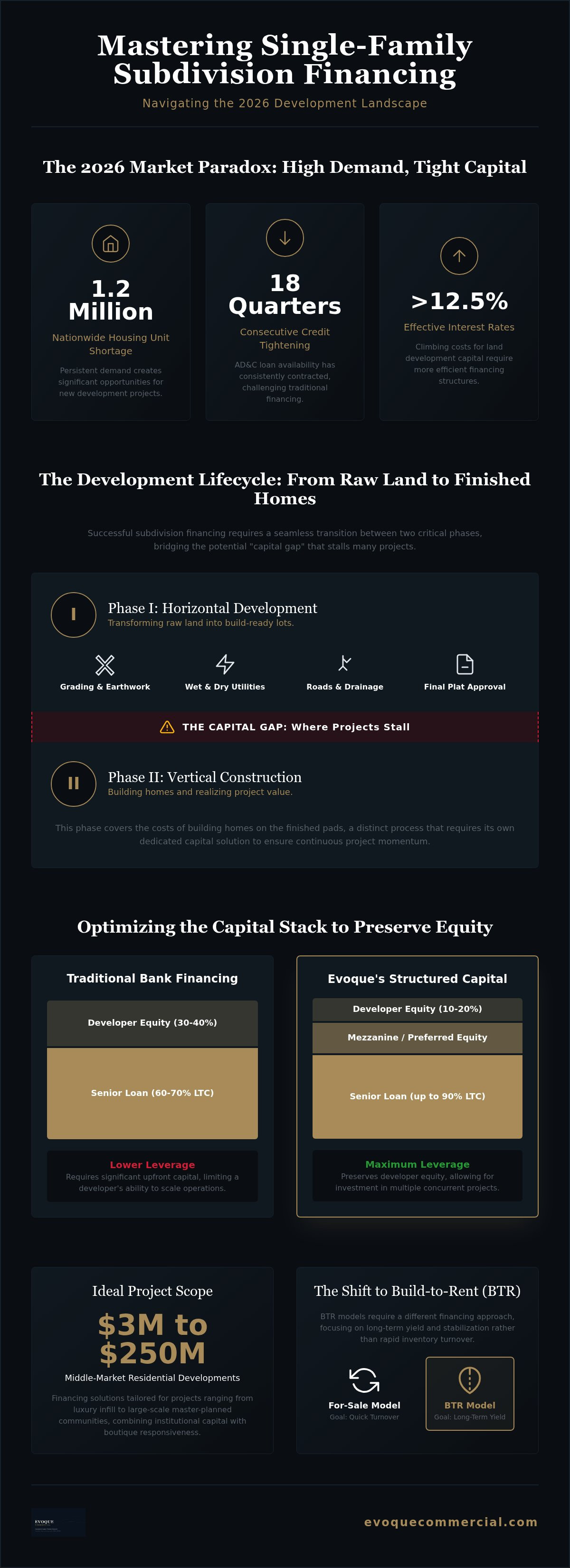
Single family subdivision financing is no longer a simple, one-size-fits-all loan. It's a sophisticated, multi-stage capital solution that must adapt as a project moves from raw dirt to a finished neighborhood. In 2026, the residential development sector faces a significant paradox. While the U.S. remains gripped by a shortage of roughly 1.2 million housing units, the capital required to build them is increasingly difficult to secure. Credit conditions for residential AD&C loans have tightened for eighteen consecutive quarters. This contraction means traditional banks are often capping their participation, leaving a void that only agile, private boutique firms can fill. These firms offer the speed and specialized knowledge that rigid institutional lenders lack.
Navigating the Real estate development process requires a capital partner who understands the three core phases of a project. First, land acquisition financing secures the site. Next, horizontal development capital funds the critical infrastructure, including grading, utilities, and roads. Finally, vertical construction loans allow for the actual building of the homes. Each phase carries distinct risks and requires a specific type of financial structuring to ensure the project doesn't stall between milestones. Developers who fail to align their capital stack with these phases often find themselves over-leveraged or under-funded at the exact moment they need to scale.
Defining the Project Scope: $3M to $250M Projects
The middle-market segment is the engine of modern residential growth. Projects in the $3M to $250M range require a unique financing approach that combines institutional-grade capital with boutique responsiveness. This scale covers everything from high-end luxury infill projects to large-scale master-planned communities. At this level, developers need more than a lender; they need a strategic partner. Traditional banks often struggle with the complexity of these mid-sized developments, but structured capital solutions can provide the high LTC ratios necessary to preserve developer equity. It's about finding the right balance between volume and personal attention to detail.
The Shift Toward Build-to-Rent (BTR) Subdivisions
Build-to-Rent (BTR) models have transformed the way we think about single family subdivision financing. Unlike traditional for-sale subdivisions where the goal is quick inventory turnover, BTR projects are designed for long-term yield. Investor appetite for stabilized rental portfolios remains strong, even as interest rates fluctuate. Structuring financing for a BTR community requires a different set of metrics, focusing on debt service coverage and bridge-to-stabilization options. This shift allows developers to capitalize on the housing shortage while creating a durable asset class that appeals to institutional exit partners.
Horizontal vs. Vertical Development: Managing the Lifecycle
Success in single family subdivision financing depends on the seamless transition between horizontal infrastructure and vertical construction. Many developers encounter a "capital gap" where land is developed but vertical funding isn't yet secured. This pause can be fatal to project IRRs. Understanding the distinction between raw land and entitled lots is the first step in bridging this divide. While raw land is a speculative asset, entitled lots with approved site plans represent a significantly lower risk profile for lenders. Managing this lifecycle requires a capital partner who recognizes that value is created long before the first frame goes up.
Phase I: Horizontal Infrastructure and Site Work
Horizontal development focuses on the "invisible" costs of a project. This includes grading, sewer lines, water mains, and paved roads. These improvements transform raw acreage into finished pads ready for building permits. Lenders typically require disciplined draw schedules that align with municipal sign-offs and engineering milestones. Valuation shifts significantly during this period; improved land often commands a much higher loan-to-value (LTV) than unimproved dirt. For developers seeking to optimize their capital stack, Single-Family Subdivision Financing provides the structure to cover these early-stage costs without depleting equity reserves.
- Grading and earthwork to meet topographical requirements.
- Installation of wet and dry utilities to each lot line.
- Construction of internal road networks and drainage systems.
- Securing final plat approval from local jurisdictions.
Phase II: Vertical Ground-Up Construction
Once lots are platted and utilities are in place, the project enters the vertical phase. This involves managing the build-out of individual homes. Financing structures differ based on whether you are building spec homes or pre-sold units. A critical component of these loan agreements is the "release price." This is the specific amount of the loan that must be repaid to the lender from each home sale to release that specific lot from the master lien. Developers must also account for interest carry during the sales absorption period, which can fluctuate based on market velocity.
Effective risk management during this transition is vital for project continuity. The Office of the Comptroller of the Currency provides detailed guidance on Mitigating Risk in Large-Scale Residential Developments, emphasizing the need for prudent underwriting in ADC (Acquisition, Development, and Construction) lending. To avoid a stall, developers should seek integrated financing solutions that cover both phases. If horizontal and vertical lenders are different, intercreditor agreements must be ironclad. This ensures the vertical lender can step in as soon as the first pad is ready, maintaining the project's momentum and profitability.
Optimizing the Capital Stack for Maximum Leverage
A sophisticated capital stack serves as the financial architecture of a successful development. While senior debt remains the foundation of most single family subdivision financing, relying solely on traditional bank loans often leaves significant equity trapped in the project. Modern developers utilize structured capital solutions to layer different tiers of debt and equity. This approach minimizes the initial cash outlay and maximizes the internal rate of return. By layering mezzanine debt or preferred equity on top of a senior construction loan, developers can often reach 85% or even higher loan-to-cost (LTC) thresholds. This strategy preserves liquidity, allowing the firm to deploy capital into new acquisitions while the current project is still in the absorption phase.
Senior debt typically accounts for 60% to 75% of the total project cost. It's the most cost-effective layer of the stack, yet it's also the most restrictive. Traditional institutional lenders often impose rigid covenants and draw schedules that can hamper a fast-moving development. By integrating mezzanine debt, a developer can fill the gap between this senior layer and their own equity. This structured approach ensures that the project remains fully funded even if unexpected site costs arise during the horizontal phase. Given that credit conditions for residential AD&C loans have tightened for eighteen consecutive quarters, these creative layers have become essential for project viability.
Maximizing Loan-to-Cost (LTC) Ratios
Lenders look for several key indicators when pushing leverage limits beyond standard bank caps. They prioritize experienced sponsors with a track record of successful exits and projects located in markets with a housing shortage of at least 1.2 million units. Loan-to-Cost (LTC) in ground-up development represents the ratio of the total loan amount to the cumulative costs of land acquisition, site improvements, and vertical construction. There's a natural trade-off here. Higher leverage typically carries wider interest spreads. However, the cost of this structured capital is usually lower than the cost of bringing in outside equity partners who demand a significant share of the project's upside.
Bridge Loans and Recapitalization Strategies
Strategic recapitalization is a powerful tool for maintaining momentum across the project lifecycle. Many developers start with expensive land acquisition loans, which currently carry effective interest rates between 10.43% and 12.59%. Once entitlements are secured or horizontal work begins, transitioning to a lower-cost construction facility is essential. In some cases, a mid-construction recapitalization can release a portion of the developer's initial equity before the first home sale. For projects with completed but unsold units, inventory financing provides a bridge-to-stabilization. This allows the developer to pay off the construction loan and move on to the next project without being forced into fire-sale pricing on the remaining homes.
Mitigating Risk in Large-Scale Residential Developments
Risk management in 2026 isn't about avoiding challenges; it's about structuring your capital to withstand them. Large-scale projects face a unique set of pressures, from volatile material costs to a persistent labor shortage with nearly 300,000 job openings across the industry. To protect personal assets and maintain corporate agility, experienced developers increasingly prioritize non-recourse single family subdivision financing. This structure ensures that the lender's primary recourse is the asset itself. It requires a disciplined development plan and a sponsor with a proven track record, but it provides the necessary shield for the developer's broader portfolio.
Market timing remains the most difficult variable to control. Developers must decide early whether to structure for an immediate sell-out or long-term stabilization through a Build-to-Rent (BTR) model. While the BTR sector experienced a slight slowdown in the first quarter of 2026 due to policy uncertainty, the underlying demand for rental housing remains a powerful exit strategy. A flexible capital partner allows you to pivot between these strategies as market conditions evolve during the multi-year build-out process.
Entitlement and Pre-Development Financing
Securing capital for land that is still "in-process" for zoning is one of the steepest hurdles in the development lifecycle. Many traditional lenders won't step in until a project is fully entitled, yet the pre-development phase is where the most significant capital is often required. As of 2026, government regulations and municipal impact fees account for 26.4% of the final price of a new single-family home. This amounts to over $131,000 in regulatory costs for an average-priced unit. Financing must be structured to cover these heavy front-end expenses while the project moves toward a shovel-ready status.
Construction Completion and Rescue Capital
Projects often stall mid-stream because of rigid draw schedules or unexpected cost overruns that exceed the original contingency. When a traditional bank refuses to fund further draws, the project risks total failure. Rescue capital provides the liquidity needed to pay off existing liens and complete the build-out. Boutique firms offer a significant advantage here; they can underwrite distressed situations with a speed that institutional banks can't match. If your development has hit a mid-construction hurdle, Construction Completion Financing can bridge the gap to a successful exit or stabilization.
The Evoque Advantage: Boutique Service, Institutional Capital
The middle-market development space requires a financier that operates with the precision of a global institution and the agility of a boutique firm. Evoque Lending specializes in $3M to $250M residential projects, providing the structured capital solutions necessary to navigate today's complex lending environment. While traditional banks have scaled back their exposure to single family subdivision financing over the last 18 quarters, we maintain the deep institutional relationships required to fund large-scale developments from acquisition through to final inventory sales. We don't just provide debt; we offer a strategic perspective on the entire project lifecycle.
Speed to close is a critical differentiator in a competitive acquisition landscape. A stalled project often results from a lender who doesn't understand the nuances of horizontal work or the entitlement process. Our team provides responsive underwriting that prioritizes the developer's timeline. This ensures that your capital is ready when the site is, preventing the costly gaps between infrastructure completion and vertical starts discussed in previous sections. We bridge the gap between institutional certainty and the personal attention your project deserves.
Partnering for the Long Term
We move beyond transactional lending to build long-term strategic partnerships. Our national reach allows us to support developers across various markets, providing consistent execution for both luxury infill and mid-market subdivisions. By combining institutional capital with a supportive, solution-oriented attitude, we help our clients scale their operations without the friction typical of large commercial banks. This approach has led to a track record of success in complex residential developments where traditional financing fell short. We value your time and respect the significance of your project, regardless of its volume.
Getting Started with Your Next Subdivision
A successful project review begins with a clear understanding of the sponsor's vision and experience. Our underwriters prioritize developers with a documented track record and a realistic pro forma that accounts for 2026 market realities, including regulatory costs and labor constraints. When you're ready to move forward, we require a comprehensive project package including site plans, entitlement status, and a detailed budget. To begin the process, you can Request a Strategic Project Review with our senior team. We'll evaluate your project's specific structural needs to determine the most efficient path to closing.
Scaling Your Development Pipeline in 2026
The 2026 residential market presents a distinct paradox: a nationwide housing shortage met with the tightest credit conditions in nearly five years. Navigating this landscape requires more than just a loan; it demands a strategic alignment of capital across the entire project lifecycle. By mastering the transition from horizontal infrastructure to vertical construction and optimizing your capital stack for maximum leverage, you can preserve equity and maintain the momentum necessary for a successful exit. Utilizing non-recourse single family subdivision financing is a critical step in shielding your broader portfolio from the inherent risks of large-scale development.
Efficient execution depends on a capital partner who understands that subdivision development is a living process, not a static balance sheet. Evoque Commercial offers institutional-grade underwriting and national coverage, providing capital solutions up to $250M with the responsiveness of a boutique firm. We're committed to helping you navigate the complexities of the current market with precision and discipline. Partner with Evoque for your next subdivision project to secure the structured capital your development requires. Let's build the next generation of American housing together.
Frequently Asked Questions
What is the typical LTC for single-family subdivision financing?
Typical loan-to-cost (LTC) ratios for senior debt generally range from 65% to 75% depending on the project's risk profile and developer experience. However, by utilizing structured capital solutions that include mezzanine debt or preferred equity, developers can often achieve 85% LTC or higher. This allows for significant equity preservation. We evaluate each project's structure based on market demand and the specific phase of the development lifecycle to optimize these ratios for our clients.
Do you offer non-recourse loans for large-scale developments?
We provide non-recourse options for well-capitalized projects and experienced sponsors, particularly within our large-scale single family subdivision financing programs. These structures limit the lender's recovery to the project assets themselves rather than the developer's personal holdings. Non-recourse financing is common for projects exceeding $10 million; it requires a disciplined development plan and strong market fundamentals to mitigate the increased risk for the capital provider. This protection is vital for maintaining developer agility.
Can subdivision financing cover both horizontal and vertical costs?
Yes, a comprehensive financing strategy often integrates both horizontal infrastructure and vertical construction costs into a single structured facility. This approach eliminates the capital gap that occurs when switching lenders between the site work and home building phases. By securing a facility that covers grading, utilities, and roads alongside ground-up construction, developers ensure seamless funding draws and maintain project momentum throughout the entire development lifecycle. It's the most efficient way to scale residential operations.
How does build-to-rent (BTR) financing differ from traditional subdivision loans?
Build-to-rent financing is structured around long-term yield and debt service coverage rather than the quick inventory turnover seen in traditional for-sale subdivisions. While traditional loans focus on release prices for individual home sales, BTR loans often transition into bridge-to-stabilization facilities once construction is complete. This allows the developer to hold the asset as a rental portfolio, appealing to institutional investors seeking stabilized single-family cash flows in markets with a housing shortage of 1.2 million units.
What is the minimum loan amount for a residential development project?
Our focus is on the middle-market segment, with a minimum loan amount typically starting at $3 million for residential development projects. This threshold ensures we can provide the institutional-grade underwriting and boutique responsiveness required for sophisticated subdivisions. We handle projects up to $250 million, covering everything from luxury infill developments to large-scale master-planned communities across the nation. This range allows us to support developers as they scale their residential pipelines while maintaining personal attention to detail.
How long does the underwriting process take for a ground-up construction loan?
The underwriting process typically takes between 30 and 45 days from the receipt of a complete project package to final closing. Our boutique approach allows for a more agile review than traditional institutional banks, which often take 60 to 90 days. We prioritize speed to close because we understand that land acquisition and construction milestones are time-sensitive. A clear documentation package including entitlements and site plans significantly accelerates this strategic review and your path to funding.
Can I get financing for a project that has already started construction?
We specialize in construction completion financing for projects that have already broken ground but require a new capital partner to finish. This is often necessary when a project faces cost overruns or a previous lender's rigid draw schedule stalls progress. Our underwriters quickly evaluate the remaining budget and work completed to structure a rescue capital solution. This allows the developer to pay off existing liens and move toward a successful exit without facing a total loss.
What are the requirements for land acquisition and development loans?
Requirements for land acquisition and development loans center on the project's entitlement status and the sponsor's track record. Lenders look for sites that are in-process for zoning or already shovel-ready with approved site plans. You'll need a detailed pro forma that accounts for 2026 market realities, including municipal impact fees which now average $131,734 per unit. A clear path to vertical construction is essential for securing the most favorable interest rates and terms during the horizontal phase.