

The real value of a development project isn't found in the dirt; it's found in the approvals. While raw land often carries prohibitive interest rates and restrictive terms, entitled land acquisition loans allow developers to unlock the equity they've built during the pre-development phase. Most traditional lenders fail to recognize the massive risk reduction that comes with a shovel-ready site, forcing you to bridge the gap to vertical construction with expensive, inefficient capital.
We understand that securing the right financing at this stage is about more than just a transaction. It's a strategic move to protect your liquidity and set the foundation for a successful build. This guide will show you how to leverage your project's entitlement status to secure high-leverage acquisition financing and optimize your entire capital stack. We'll examine strategies to maximize your LTV based on the as-entitled value, establish a clear path toward construction financing, and structure your debt to minimize personal recourse. You'll gain a roadmap for transitioning from land holder to active developer with the most competitive terms available in the $3M to $250M market.
Understanding Entitled Land Acquisition Loans in 2026
Entitled land acquisition loans serve as a critical bridge for developers who've navigated the initial regulatory hurdles but aren't yet ready to pull building permits. In the 2026 credit market, these loans focus on land that has secured specific government approvals for a designated use. This status transforms the asset from a speculative holding into a predictable development project. By securing entitlements, you've effectively removed the execution risk that prevents traditional banks from offering high-leverage terms. For projects in the $3M to $250M range, this specialized financing allows you to recapitalize your equity or acquire new sites with the confidence that the capital stack is optimized for the next phase of the real estate development process.
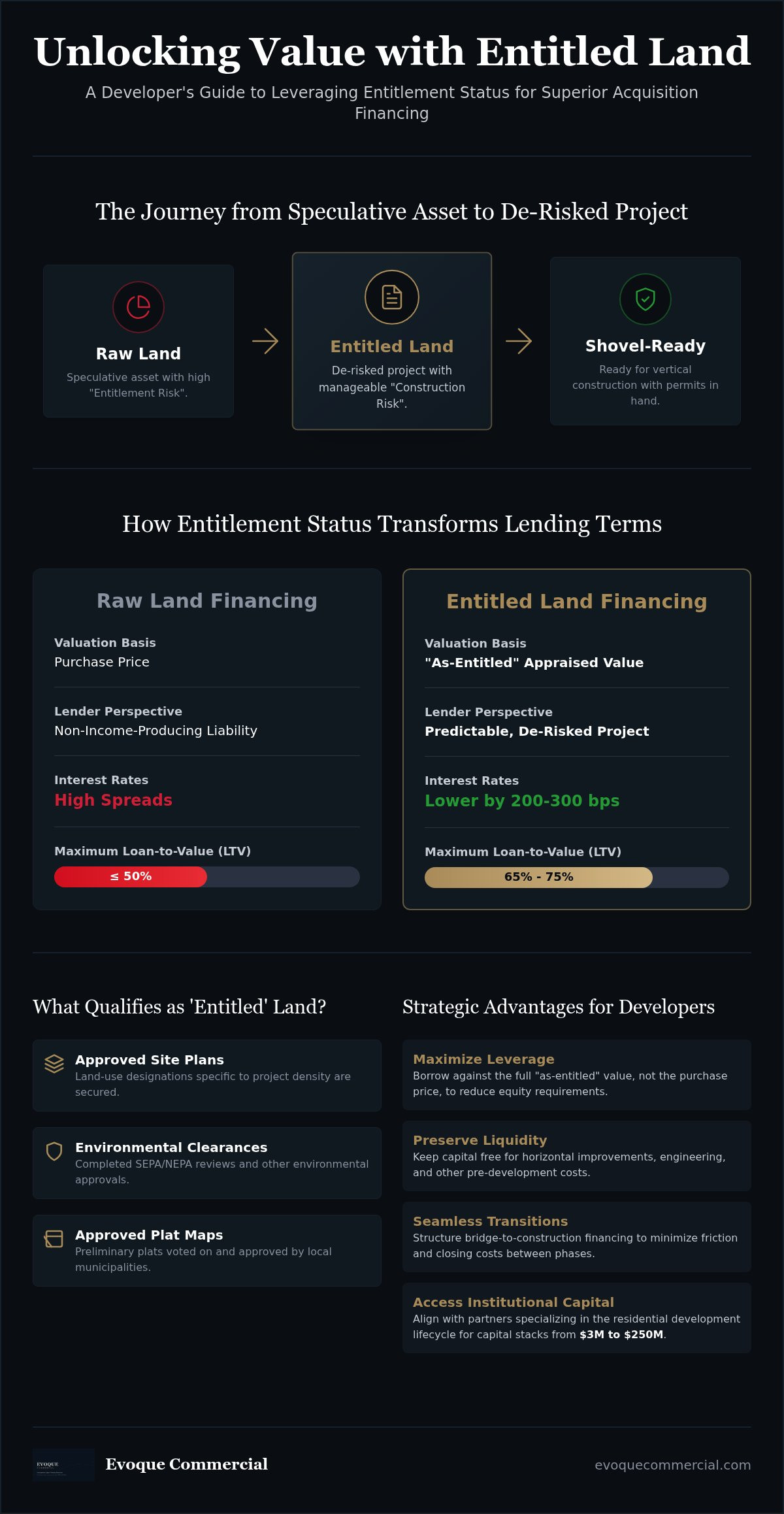
What Qualifies as 'Entitled' Land?
Lenders define entitlement by the presence of enforceable land-use rights. To qualify for entitled land acquisition loans, your project typically needs more than just a favorable zoning designation. We look for a comprehensive package that includes:
- Approved site plans and land-use designations specific to the project's density.
- Environmental clearances and completed SEPA/NEPA reviews where applicable.
- Preliminary plat maps that have been voted on and approved by local municipalities.
It's vital to distinguish between entitled land and shovel-ready sites. Entitlement grants you the legal right to use the land for a specific purpose, such as a multifamily complex or a single-family subdivision. Shovel-ready status implies that building permits are in hand and horizontal work can begin immediately. Entitlement financing bridges this exact gap, providing capital while you finalize the technical construction documents and engineering requirements.
Why Developers Seek Specialized Entitlement Financing
Speed and leverage are the primary drivers for this type of capital. Traditional commercial banks often view land as a non-income-producing liability, leading to low loan-to-value (LTV) ratios based on the original purchase price. Specialized entitled land acquisition loans allow you to borrow against the "as-entitled" value. This recognizes the massive value creation that occurs during the permitting process, often allowing you to recoup initial pursuit costs or minimize the cash equity required for the land purchase.
Liquidity preservation is another strategic advantage. By securing a high-leverage acquisition loan, you keep your balance sheet flexible for horizontal improvements and pre-development engineering. This approach ensures you aren't over-leveraged in the wrong areas of the capital stack before vertical construction begins. Our approach combines institutional-grade capital with the responsiveness of a boutique partner, ensuring your project moves from site control to closing without the delays typical of larger, more rigid lending institutions.
The Impact of Entitlement Status on Lending Risk and Terms
Lenders categorize risk into distinct silos, and the transition from raw land to an entitled site is the most significant pivot point in the credit committee's eyes. Raw land carries "entitlement risk," a binary uncertainty where a project's viability depends entirely on municipal whims. Once approvals are secured, the focus shifts to "construction risk," which is far more manageable through disciplined underwriting. For entitled land acquisition loans, this shift allows lenders to move away from conservative, asset-based lending and toward project-based underwriting. In 2026, we see this reflected in pricing; entitled projects command spreads that are often 200 to 300 basis points lower than their raw land counterparts because the primary regulatory hurdle has been cleared.
Standard lender evaluation criteria for land development prioritize the certainty of the exit. When a developer presents an entitled site, the lender can accurately model the project's future cash flows and absorption rates. This clarity pushes Loan-to-Value (LTV) ratios higher, often reaching 65% to 75% of the "as-entitled" value. In contrast, raw land rarely exceeds 50% of the purchase price. This increase in leverage is a direct result of the reduced execution risk, making entitled sites the preferred collateral for institutional bridge lenders and debt funds.
Valuation Arbitrage: Raw Cost vs. Entitled Value
The true power of entitled land acquisition loans lies in valuation arbitrage. A developer may have purchased a site for its raw value and spent two years securing approvals. The "as-entitled" appraisal recognizes the value added during this pre-development phase, which can be significantly higher than the original cost basis. The land residual appraisal method calculates the maximum loan proceeds by subtracting all anticipated development costs and required profit margins from the projected gross sell-out value of the completed residential units. This approach allows you to leverage the equity created through the permitting process, often reducing the need for additional cash at the closing table.
Mitigating Lender Concerns in Pre-Development
Even with approvals in hand, lenders remain vigilant about specific pre-development risks. Sunset clauses are a primary concern; if entitlements expire before construction begins, the asset's value reverts to its raw state. We work with developers to ensure the loan term provides a sufficient buffer for final engineering and permit issuance. Lenders also place heavy weight on the developer's horizontal track record. If you are looking to optimize your project's capital stack, our acquisition and land financing solutions are designed to bridge the gap between initial site control and the first construction draw. Structuring a robust interest reserve is another essential step, ensuring the project can carry itself through the final months of pre-development without straining your firm's operational liquidity.
Comparing Land Status: Raw, Entitled, and Shovel-Ready Financing
Optimizing your capital stack requires a clear understanding of how land status dictates loan terms. Land development exists on a risk-reward spectrum, where the regulatory milestones achieved directly correlate to the cost and availability of capital. Raw land represents the highest level of execution risk; lenders view it as a speculative asset with no immediate path to revenue. Consequently, financing for raw land is often limited to 35% to 50% LTV, requiring significant equity and carrying higher interest rates. The path to ROI is long and fraught with municipal uncertainty.
In contrast, entitled land acquisition loans represent the strategic sweet spot for developers and lenders alike. Once the land use is approved, the binary risk of project viability is replaced by the manageable risk of timing. This certainty allows for more aggressive leverage, often reaching 65% to 75% of the as-entitled value. Shovel-ready status is the final evolution, where all building permits are secured. At this stage, the project typically transitions into ground-up construction financing, where the focus shifts from land value to project completion and absorption.
Financing Ratios Across the Development Spectrum
Leverage expectations shift dramatically as you move through each stage of site readiness. Lenders evaluate the carry cost factor differently for entitled land because the duration of the bridge period is predictable. Since these projects lack current cash flow, debt service coverage (DSCR) is rarely a primary underwriting factor during the acquisition phase. Instead, we structure these loans with capitalized interest reserves. This ensures the project remains current while you finalize engineering or clear the final hurdles before vertical construction begins. The increased LTV on entitled sites allows you to preserve liquidity for the more intensive phases of the project lifecycle.
Strategic Entry Points for Residential Builders
Experienced developers often choose to enter the lifecycle at the entitlement stage to shorten their time-to-vertical window. This entry point avoids the multi-year permitting grind while still capturing the value appreciation that occurs between acquisition and completion. For those focused on residential growth, utilizing single family subdivision financing for horizontal improvements can further optimize the transition. This capital covers the installation of roads, utilities, and grading, increasing the site's value before permanent construction debt is placed. Identifying stalled projects where a previous developer secured entitlements but lacks the capital to proceed offers a high-value opportunity to acquire de-risked assets at a competitive basis.
Structuring Entitled Land Loans for Seamless Construction Transitions
Securing the land is merely the first milestone; the true challenge lies in the "roll" from acquisition debt to vertical construction capital. A well-structured entitled land acquisition loan functions as a bridge that anticipates the requirements of the future construction lender. By utilizing a Bridge-to-Construction model, you minimize closing costs and administrative friction that often occur when switching between unrelated financial institutions. We focus on coordinating the payoff of the acquisition facility with the first construction draw, ensuring that your project's momentum isn't stalled by a liquidity gap during the transition from horizontal improvements to vertical build-out.
For single-family subdivisions or phased multifamily projects, release prices are a critical structural component. These are the specific dollar amounts that must be paid to the lender from the proceeds of each lot or unit sale to release the lien on that portion of the property. We typically structure release prices between 110% and 125% of the pro-rata loan amount. This protects the lender's collateral position while providing the developer with enough residual cash flow to cover ongoing operational costs. If you're ready to optimize your project's lifecycle, explore our structured capital solutions to see how we bridge these complex phases.
The Role of Mezzanine Debt and Preferred Equity
When senior entitled land acquisition loans don't fully cover the capital requirement, subordinate capital becomes essential. Entitled status makes a project significantly more attractive to mezzanine lenders and preferred equity partners because the binary permitting risk has been removed. This capital fills the gap between the senior debt and your own equity, often allowing you to scale larger projects without over-leveraging your firm's balance sheet. Balancing the cost of this subordinate capital against the speed of acquisition is a strategic decision that we help our partners navigate through disciplined financial modeling.
Exit Strategies: Beyond the Construction Loan
Every acquisition loan needs a defined exit strategy that aligns with the project's ultimate goal. For multifamily developers, this often means refinancing the land debt into a bridge-to-stabilization loan once the certificate of occupancy is issued. For subdivision developers, the exit might involve an outright sale of the entitled or platted lots to a national homebuilder. In cases where you intend to hold the improved lots, transitioning into inventory financing allows you to recapitalize the horizontal costs once the lots are platted. This flexibility ensures that your capital remains productive throughout the entire development lifecycle, from the initial purchase to the final disposition.
Leveraging Institutional Capital for Large-Scale Land Acquisitions
Middle-market developers often find themselves at a crossroads when a project's scale exceeds the lending limits of local commercial banks. For transactions between $3M and $250M, institutional capital relationships become the primary driver of success. Unlike retail lenders, institutional partners evaluate entitled land acquisition loans through a lens of project viability and long-term asset performance. We bridge this gap by providing the certainty of institutional-grade funding alongside the responsiveness of a boutique firm. This approach ensures that your project receives the strategic attention it deserves, regardless of whether you're developing a single luxury subdivision or a nationwide portfolio of multifamily assets.
Presenting an entitled project for institutional underwriting requires a shift in focus from the collateral's history to its future utility. Lenders in this space aren't looking for a passive land hold; they're looking for a shovel-ready project that's ready to absorb capital and produce residential units. Our national coverage provides a significant advantage for developers managing diversified portfolios across different states, offering a consistent underwriting standard and a single point of contact for complex, multi-phase developments.
The Evoque Lending Advantage for Developers
Our expertise is rooted deeply in the residential development lifecycle. We specialize in financing luxury residential projects, multifamily developments, and Build-to-Rent (BTR) communities. While generic commercial lenders often struggle to underwrite the nuances of residential absorption or horizontal improvement costs, our team understands the specific milestones that drive value in these sectors. We don't just offer acquisition debt; we provide a tailored financing path that anticipates your exit strategy, whether that's a construction loan roll or a bridge-to-stabilization facility. This specialization ensures that your capital structure remains aligned with the project's physical progress.
Next Steps: Requesting a Project Review
To secure a rapid institutional quote, the quality of your project presentation is paramount. We look for a comprehensive package that includes the final municipal approval letters, an "as-entitled" appraisal, and a detailed breakdown of your horizontal development budget. A clear developer track record in similar asset classes also speeds up the credit committee's decision. Once we receive these essential documents, our team moves through the initial review and term sheet issuance with a focus on precision. We understand that in the world of entitled land acquisition loans, timing is often the difference between a successful closing and a missed opportunity. You can Explore tailored financing paths for your next acquisition at Evoque Lending to begin your project's review and secure the capital necessary for your next large-scale development.
Strategic Capital for the Shovel-Ready Milestone
Securing your permits is a significant achievement. It transforms speculative land into a bankable residential asset. By leveraging entitled land acquisition loans, you've seen how developers recapitalize pursuit costs and maximize LTV based on the project's enhanced "as-entitled" value. This strategic use of debt doesn't just bridge a gap; it sets the stage for a seamless transition into vertical construction while protecting your firm's liquidity.
We provide the institutional capital necessary for projects ranging from $3M to $250M, combined with the boutique responsiveness that middle-market developers require. Our national footprint ensures that your luxury residential, multifamily, or BTR project receives expert underwriting regardless of the jurisdiction. We're here to act as your strategic partner from the initial site purchase through the final project exit. You can Request a Project Review for Your Entitled Land Acquisition today to see how our structured solutions can optimize your next development. We look forward to helping you move your vision from the planning board to the construction site.
Frequently Asked Questions
What is the typical LTV for an entitled land acquisition loan?
Typical Loan-to-Value (LTV) ratios for these loans generally range from 65% to 75% of the appraised "as-entitled" value. This is significantly higher than raw land financing because the municipal approvals reduce execution risk. Lenders focus on the land residual appraisal method to determine the project's future viability. By using the value created during the permitting phase, developers can often minimize their cash equity requirements while securing the site for future vertical construction.
Can I use an entitled land loan for horizontal development like grading and utilities?
Yes, these loans are frequently structured to include funds for horizontal development such as grading, road installation, and utility hookups. This is common in single-family subdivision financing where the site's value increases as lots become finished. Coordinating horizontal improvements through the acquisition facility ensures that the project is physically prepared for vertical construction. This structure helps maintain project momentum while you finalize building permits and technical engineering documents.
How does entitled land financing differ from a standard construction loan?
Entitled land financing serves as a strategic bridge to vertical construction by focusing on the acquisition and site preparation phases. While a standard construction loan funds the bricks and mortar of the build, an acquisition loan focuses on securing the land and its entitlements. These loans often have shorter terms and may include capitalized interest reserves to cover the carry period while building permits are finalized. They eventually roll into a construction facility once the project is shovel-ready.
Is personal recourse required for large-scale land acquisition loans?
Recourse requirements depend on the project's leverage and the developer's track record; however, many institutional-grade loans offer limited or non-recourse structures with standard bad boy carve-outs. For large-scale acquisitions in the $3M to $250M range, lenders often prioritize the project's as-entitled value and the strength of the exit strategy over personal guarantees. We work with developers to structure debt that minimizes personal exposure while maintaining the necessary leverage to execute the project.
What is the minimum loan amount for entitled land financing at Evoque Commercial?
The minimum loan amount for entitled land acquisition loans at Evoque Commercial is $3M. We focus on the middle-market and institutional sectors, providing capital solutions that reach up to $250M for large-scale residential developments. This threshold ensures that our team can provide the high-touch, boutique responsiveness required for complex capital stacks. We specialize in luxury residential, multifamily, and build-to-rent communities that require sophisticated financing structures to move from acquisition to completion.
How long does it take to close an entitled land acquisition loan?
Most entitled land acquisition loans close within 30 to 45 days, depending on the complexity of the entitlement package and the speed of the appraisal process. Because the regulatory approvals are already in place, the underwriting process is more streamlined than raw land financing. We prioritize efficiency to ensure developers don't miss acquisition windows. Having a complete document package, including municipal approval letters and site plans, is essential for meeting these expedited timelines.
Can I refinance raw land into an entitled land loan once approvals are secured?
Yes, refinancing raw land into an entitled land loan is a common strategy used to recapitalize pursuit costs once approvals are secured. This allows you to leverage the as-entitled value, which is typically much higher than the original raw land purchase price. By doing so, you can pull equity out of the project or secure the necessary capital for horizontal improvements. This pivot de-risks the asset and prepares the capital stack for the transition to vertical construction debt.
Do entitled land loans cover the cost of final permitting and architectural fees?
These loans can be structured to cover pre-development costs, including final permitting, architectural fees, and engineering expenses. By including these soft costs in the loan budget, you preserve your firm's liquidity for the vertical build-out. Lenders often view these expenditures as value-adding milestones; they further de-risk the project. It's vital to present a detailed budget during underwriting to ensure these costs are properly allocated within the total loan-to-cost calculation.