

For high-volume residential developers, the local bank's credit committee isn't just a hurdle; it's often the primary bottleneck strangling project ROI. You've likely felt the frustration of a project stalling for months while waiting for a conservative underwriter to approve a low-leverage loan that leaves too much of your equity sidelined. In an environment where timing is everything, these delays don't just cost interest. They cost opportunities. Learning how to get a construction loan without a bank is no longer a fallback plan for distressed projects. It's a strategic move for professionals who require institutional-grade speed and flexibility.
We understand that your business scales when your capital works harder. This guide explores how private institutional capital serves as a powerful accelerator for ground-up developments and large-scale subdivisions. We'll examine the mechanics of high-leverage financing, the transition from land acquisition to stabilization, and the nuances of structured capital solutions. By the end, you'll know how to optimize your capital stack to maximize returns and find a partner that respects the complexity of your development cycle. The goal is simple: move from site preparation to exit with a capital partner that matches your momentum.
Beyond Traditional Lending: Why Developers Seek Non-Bank Construction Loans
Traditional banking institutions often operate on a legacy model that prioritizes risk avoidance over project momentum. For a professional developer, this creates a structural mismatch. While you need to deploy capital quickly to capture market demand, banks are often bogged down by multi-layered credit committees and rigid regulatory frameworks. This friction is why many established firms now prioritize institutional private credit as their primary funding source. Understanding how to get a construction loan without a bank isn't just about finding an alternative; it's about selecting a partner that understands the high-stakes nature of commercial development.
Speed is the most quantifiable advantage. A typical bank underwriting cycle can stretch beyond 90 days, often requiring extensive documentation that has little to do with the actual project's viability. In contrast, private institutional capital can often close within 30 days. This 60-day delta can be the difference between securing a prime land parcel and losing it to a more agile competitor. Private lenders also tend to offer higher Loan-to-Cost (LTC) ratios. While a bank might cap leverage at 60%, a private partner may provide 75% or 80% LTC. This allows developers to preserve their own equity for other projects, significantly improving the overall return on equity across their entire portfolio.
The Inflexibility of Bank Underwriting
Banks frequently employ a "relationship banking" model that serves as a trap for growing developers. They may require you to move your entire operating accounts, payroll, and personal deposits to their institution before considering a loan. These rigid deposit requirements tie up liquidity that should be working in the field. Federal regulatory oversight also forces banks to use broad-brush risk assessments. They might pull back from new construction entirely during minor market fluctuations, regardless of your project's specific merits or the local demand for multifamily housing. This makes banks unreliable partners for shovel-ready projects that require rapid deployment.
The Strategic Advantage of Private Capital
Private institutional lenders operate with a boutique responsiveness that banks cannot replicate. You deal directly with decision-makers who understand the nuances of project finance and the specific challenges of vertical construction. Instead of following a standardized checklist, these partners evaluate the intrinsic value and projected cash flow of the asset. This approach allows for customized draw schedules that align with your actual construction milestones rather than arbitrary calendar dates. By focusing on project merit over simple borrower credit scores, private capital provides a more disciplined, yet flexible, framework for large-scale residential success. It's a method designed for developers who have outgrown the limitations of the retail banking system.
Primary Non-Bank Financing Structures for Large-Scale Projects
Institutional private construction financing represents a sophisticated alternative to the rigid structures of depository institutions. While small-scale investors often rely on local hard money lenders for single-family flips, professional developers require a more robust framework. This is where Commercial Real Estate Lending from private institutional sources becomes essential. These structures are built to handle projects ranging from $3 million to $250 million, offering the scale and reliability that traditional banks often lack in volatile markets.
Institutional Debt Funds and Private Credit
Debt funds serve as the backbone of the non-bank sector. They aggregate capital from institutional investors, such as pension funds and insurance companies, to provide senior debt for large-scale residential projects. Unlike banks, which rely on a fluctuating deposit base, debt funds operate with committed capital. This makes them significantly more resilient to the liquidity crunches that often paralyze retail banks. If you're researching how to get a construction loan without a bank, understanding these funds is vital. They provide institutional-grade private credit that focuses on the project's long-term feasibility rather than just the borrower's personal liquidity.
Bridge Loans for Residential Development
A critical component of the development lifecycle is the gap between land acquisition and ground-up construction. Bridge loans provide the necessary capital to secure a site while entitlements, permits, and final construction drawings are finalized. This transition is often where projects fail due to bank delays. Bridge capital acts as a stabilizer, allowing a developer to move quickly on a land opportunity before shifting into a long-term construction facility. In many cases, bridge financing has saved stalled projects by providing the liquidity needed to reach shovel-ready status when bank underwriting has slowed to a crawl.
For projects requiring even more precision, structured capital solutions integrate mezzanine debt or preferred equity into the stack. This optimization reduces the developer's cash outlay while maintaining project momentum. If your current pipeline requires this level of financial engineering, exploring structured capital solutions can provide the leverage needed to scale without compromise. By blending different layers of debt and equity, developers can achieve an optimal capital structure that supports the entire project lifecycle from acquisition to stabilization.
Comparing Bank Financing vs. Private Institutional Capital
Traditional banks focus heavily on the borrower's personal financial statement (PFS). They often require high liquidity and a massive net worth before they'll even consider the merits of the site itself. Private institutional capital flips this script. While your experience as a developer is vital, the primary underwriting focus is the project's feasibility and the strength of the exit strategy. If you're evaluating how to get a construction loan without a bank, you'll find that the conversation moves away from your personal tax returns and toward the precision of your pro forma.
The cost of capital is naturally higher with private debt, but this is a strategic trade-off for speed and flexibility. A bank's committee-driven process can take 90 days or longer, which often leads to missed opportunities. Boutique institutional firms operate with leaner decision-making structures. They can often issue a term sheet within 48 hours and reach a closing within 30 days. In a competitive acquisition environment, this speed of execution is often more valuable than a lower interest rate.
Leverage and Loan-to-Cost (LTC) Ratios
Banks typically cap their leverage at 60% or 65% of cost. This conservative approach forces developers to lock up significant amounts of cash in a single asset, which limits their ability to scale. Private lenders regularly provide 75% to 80% LTC. This higher leverage isn't just about borrowing more; it's about optimizing your equity multiple. By reducing the initial capital requirement, you can often double your Internal Rate of Return (IRR) across a portfolio. It's a calculated move for firms that have the deal flow but don't want to over-leverage their own liquidity.
The Non-Recourse Advantage
The recourse structure is perhaps the most significant differentiator. Most bank loans for new construction require a full personal guarantee. This means your personal assets are at risk if the project faces a market downturn or unforeseen delays. For a $10 million or $50 million project, this level of personal exposure is often unacceptable for professional developers. Private institutional debt frequently offers non-recourse structures. These loans typically only include "bad boy" carve-outs for specific acts like fraud or gross negligence. This protects your personal balance sheet and allows you to scale multiple large-scale residential projects simultaneously without compounding your personal liability. It's a fundamental shift in risk management that banks rarely offer to anyone but the largest national builders.
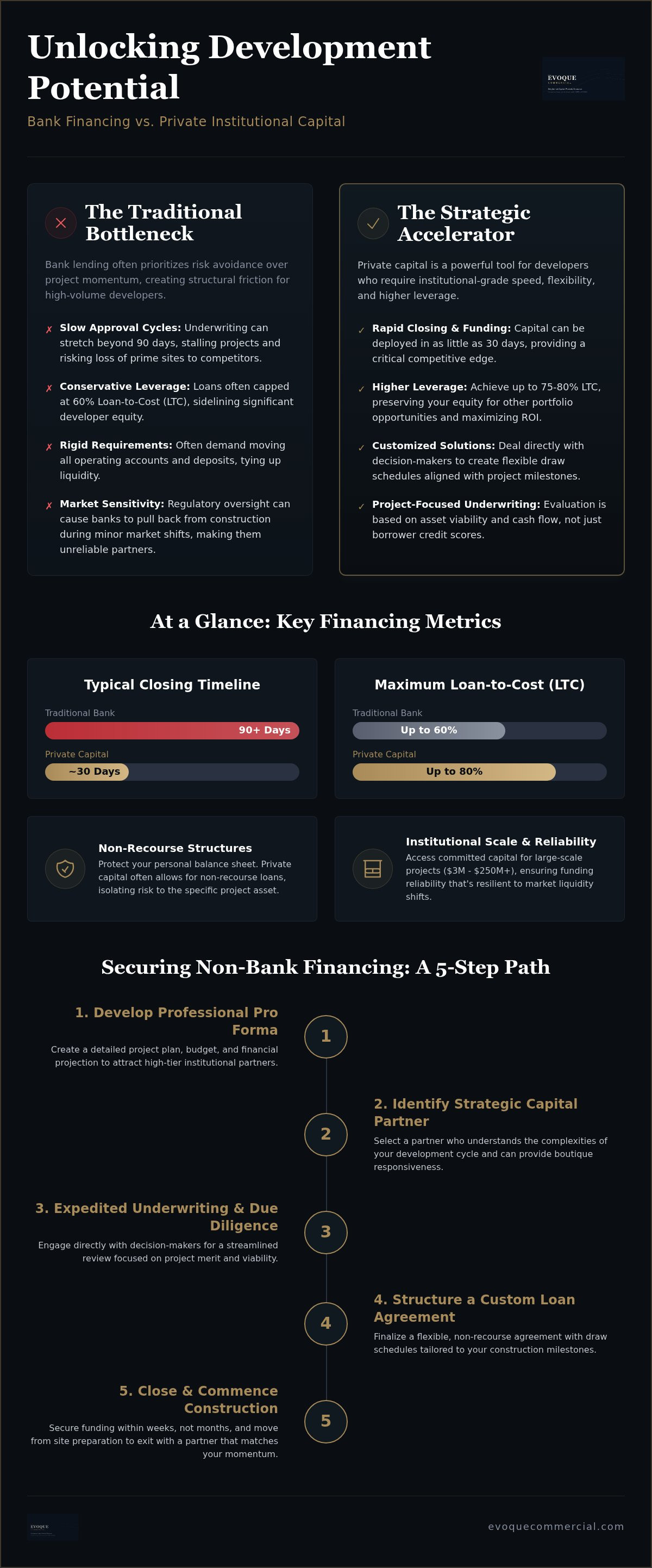
How to Secure Non-Bank Construction Financing: A 5-Step Process
Securing capital outside the traditional banking system requires a shift in presentation and precision. While a bank might focus on your personal relationship, an institutional private lender prioritizes the structural integrity of the deal. If you're exploring how to get a construction loan without a bank, the process follows a methodical path from initial data aggregation to project commencement. This sequence ensures that the capital partner understands every risk mitigant and vertical milestone before the first draw occurs.
- Step 1: Project Pro Forma. Build a comprehensive financial model that accounts for hard costs, soft costs, and contingency reserves.
- Step 2: Partner Identification. Match your project with a lender specializing in your specific asset class, whether it's luxury residential or multifamily.
- Step 3: Underwriting. Engage in a rigorous review of market absorption and project feasibility.
- Step 4: Structuring. Finalize the draw schedule and any necessary intercreditor agreements for complex capital stacks.
- Step 5: Closing. Execute the loan documents and transition into the active construction phase.
Assembling the Project Package
The strength of your initial package determines the speed of the term sheet. You must provide clear documentation including finalized site plans, detailed cost breakdowns, and a thorough resume of the development team's past performance. A project is considered shovel-ready when all entitlements are secured, construction drawings are finalized, and the site is prepared for immediate vertical commencement. Institutional lenders look for this level of readiness to ensure that capital is deployed efficiently and project timelines are met without administrative delays. This streamlined approach is the most effective way for professionals to understand how to get a construction loan without a bank while maintaining project momentum.
Underwriting and Due Diligence
Private lenders move with a level of agility that retail banks cannot match. They evaluate market demand and local absorption rates to verify the project's exit strategy. This phase involves coordinating third-party reports, such as appraisals and environmental assessments, with a focus on technical accuracy rather than bureaucratic box-ticking. By working with a responsive team, you can streamline this process to reach the closing table in weeks instead of the months required by traditional committees. If you're ready to accelerate your next project, you can apply for construction financing today to begin the underwriting process.
Strategic Capital Solutions with Evoque Lending
Evoque Lending occupies a unique position within the capital markets. We bridge the gap between the rigid bureaucracy of traditional institutions and the high-speed requirements of modern development. For professionals determining how to get a construction loan without a bank, we provide a disciplined framework that prioritizes project velocity and capital efficiency. Our focus remains on high-impact residential projects with financing requirements ranging from $3 million to $250 million. We don't just act as a lender; we function as a strategic partner that understands every technical milestone of your vertical development cycle.
Tailored Financing Paths
Every residential project carries a distinct risk profile and a specific exit strategy. We structure our facilities to align with those realities. Whether your goal is a rapid inventory sale or a long-term bridge-to-stabilization hold, the capital stack must reflect your intent. We manage the entire lifecycle from land acquisition to the final certificate of occupancy. For those in the early stages of site selection, our Land Acquisition & Development Loans: Developer’s Guide provides deeper insights into pre-development financing. This seamless transition between phases reduces the friction typically found when switching between acquisition and construction lenders.
The Evoque Lending Advantage for Developers
Our expertise spans the full spectrum of modern residential development. We maintain a national reach that supports multifamily complexes, luxury spec homes, and large-scale subdivisions. We also provide specialized solutions for construction completion financing and "rescue capital" for projects that have stalled due to bank underwriting failures or shifting market conditions. If you're scaling a residential community, our Single-Family Subdivision Financing: The Developer’s Guide to Structured Capital outlines the strategies necessary for high-leverage success. We understand that your reputation is built on delivery, and our capital is structured to ensure that delivery remains on schedule without compromising your equity position.
To initiate a project review, our team requires a comprehensive project package. We evaluate each deal with a focus on technical merit and market demand. This methodical approach ensures that when we issue a term sheet, it's backed by a firm commitment to your project's success. It's the most reliable path for developers who need to know how to get a construction loan without a bank while maintaining institutional standards. We value your time and respect the complexity of your project, regardless of its volume or location within the United States.
Accelerating Your Residential Development Pipeline
The transition from traditional banking to private institutional capital is a strategic move for developers who value execution speed over bureaucratic delays. By prioritizing project feasibility and non-recourse structures, you protect your personal balance sheet while maximizing your equity multiple. This guide has detailed the methodical steps for how to get a construction loan without a bank, focusing on the precision of your pro forma and the strength of your exit strategy. Scaling a large-scale residential portfolio requires a partner that understands the technical milestones of vertical construction from site preparation to final stabilization.
Evoque Lending provides the expertise needed for complex residential structures with financing available from $3M to $250M. Our institutional capital relationships allow us to offer boutique responsiveness without sacrificing the scale your projects demand. We're ready to evaluate your next development and provide the structured capital solutions necessary for your success. Request a Project Review with Evoque Lending to ensure your capital stack is as robust as your vision. Your project momentum is our primary objective, and we look forward to supporting your growth.
Frequently Asked Questions
Can I get a construction loan without a traditional bank?
Yes, you can secure financing through institutional debt funds and private credit firms that specialize in ground-up development. These entities operate with committed capital rather than a deposit base, allowing for more flexible underwriting. Learning how to get a construction loan without a bank often involves shifting your focus toward these institutional partners who prioritize project feasibility and market demand over the rigid credit committee requirements typical of retail banking institutions.
What is the minimum loan amount for a non-bank commercial construction loan?
Most institutional private lenders focus on projects requiring at least $3 million in capital. This threshold ensures the project has the scale necessary to support the sophisticated underwriting and structured capital solutions provided by private credit firms. For larger developments, these facilities can scale up to $250 million, covering everything from luxury residential spec builds to massive multifamily complexes that have outgrown the lending limits of local or regional banks.
Are private construction loans always non-recourse?
Non-recourse structures are a hallmark of institutional private credit, but they aren't universal. Many lenders offer non-recourse debt for experienced developers on high-impact projects, typically including standard "bad boy" carve-outs for fraud or negligence. This structure protects the developer's personal assets and allows for greater portfolio scaling. It contrasts sharply with traditional bank loans, which almost always require a full personal guarantee regardless of the project's intrinsic value or the developer's track record.
How fast can a private construction lender close a loan?
Speed of execution is a primary advantage of the non-bank sector. While a traditional bank might require 90 days or more to navigate multiple committees, a boutique institutional lender can often reach a closing within 30 days. This accelerated timeline is possible because you're dealing directly with decision-makers who understand complex residential structures. Term sheets are frequently issued within 48 hours of receiving a complete project pro forma and site plan package.
Do non-bank lenders require a specific amount of developer equity?
Non-bank lenders generally require a developer to maintain meaningful "skin in the game," typically ranging from 20% to 25% of the total project cost. This allows for Loan-to-Cost (LTC) ratios as high as 75% or 80%, which is significantly higher than the 60% cap often seen at banks. By requiring less equity than traditional institutions, private capital allows developers to optimize their capital stack and increase their overall Internal Rate of Return across multiple active sites.
Can non-bank financing be used for land acquisition and horizontal development?
Yes, private institutional capital is frequently deployed for land acquisition and horizontal development. These bridge-to-construction loans allow developers to secure a site and begin site preparation while final entitlements or vertical construction drawings are completed. This seamless transition from acquisition to ground-up financing prevents the momentum loss that occurs when switching lenders. It's a strategic way for developers to understand how to get a construction loan without a bank while managing the entire project lifecycle.
What happens if my construction project is already stalled?
Stalled projects can often be revitalized through construction completion financing or rescue capital. Institutional lenders evaluate the remaining work and the projected exit value to provide the liquidity necessary to reach a certificate of occupancy. If a project has stopped due to a bank pulling back or a cost overrun, private credit can step in to stabilize the capital stack. This expertise in complex residential structures ensures that the project can move toward completion without further administrative bottlenecks.
How do interest rates compare between banks and institutional private credit?
Interest rates for institutional private credit are generally higher than those offered by traditional banks. However, the true cost of capital should be measured against the speed of execution and the higher leverage provided. By securing an extra 15% in leverage and closing 60 days faster, developers often find that the increased project ROI far outweighs the higher interest expense. It's a strategic trade-off that prioritizes project velocity and the preservation of developer equity.