
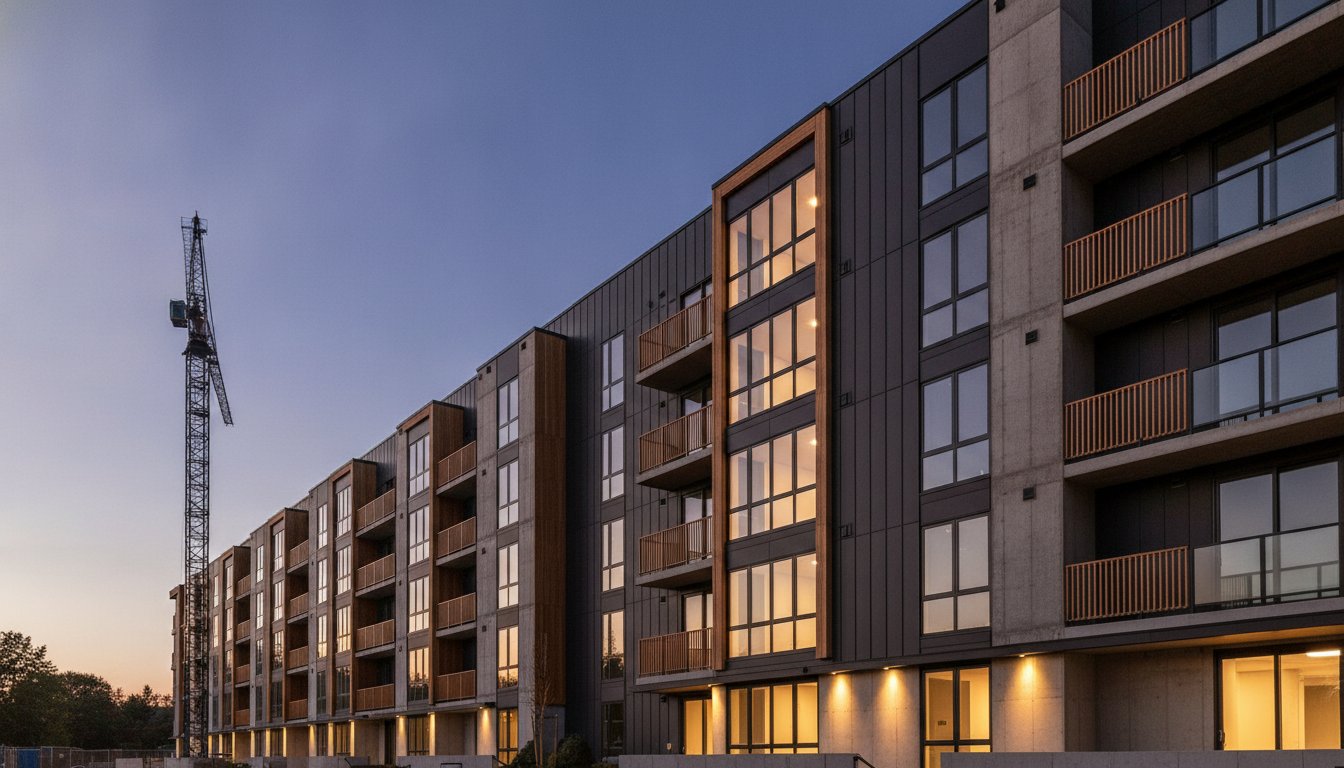
In 2026, the $162 billion wall of maturing debt isn't just a market challenge; it's the ultimate filter for developer survival. You've likely felt the friction already. Major banks are tightening their grip with sluggish underwriting cycles and equity requirements that can stall even the most promising ground-up projects. It's frustrating to watch a viable development sit idle because the traditional capital stack no longer fits the reality of 39% higher construction costs.
You deserve a financing structure that respects your project's timeline and your firm's balance sheet. Evoque Lending provides a strategic framework to secure high LTC financing and minimize personal recourse while managing the specific interest rate volatility defining this year. We'll show you how to master the interplay between senior debt, mezzanine capital, and private multifamily construction loans. From rescuing stalled developments with completion capital to establishing a seamless path from land acquisition to exit, we'll outline the exact steps to build a capital stack that delivers both speed and long-term stability.
The Multifamily Construction Financing Landscape in 2026
Multifamily construction loans are specialized, short-term debt instruments designed to fund the vertical development of residential projects with five or more units. These high-leverage vehicles provide the capital necessary for vertical construction, site improvements, and soft costs. In the current market, they serve as a strategic tool for developers to capitalize on the housing shortage while managing the 39% rise in construction costs observed since 2020. A multifamily construction loan acts as the critical bridge between land acquisition and permanent financing.
The 2026 landscape is defined by a shift toward high-density luxury developments and Build-to-Rent (BTR) communities. While national apartment vacancy rates reached 8.6% in early 2026, demand remains robust for premium assets in specific submarkets. Primary participants in this space include debt funds, national banks, and institutional lenders, each offering different levels of leverage and speed. While banks often provide lower rates, debt funds have become essential for developers seeking higher Loan-to-Cost (LTC) ratios and the boutique-level responsiveness offered by firms like Evoque Lending.
Why Ground-Up Financing Differs from Acquisition Loans
Financing a new build is significantly more complex than securing a standard commercial mortgage for an existing asset. Acquisition loans focus on current cash flow, whereas ground-up financing relies on future projections and the developer's ability to execute a strict timeline. This involves intricate draw schedules, where funds are released as construction milestones are met, and the management of interest reserves to cover debt service before the project generates income. Lenders also require robust construction completion guarantees to mitigate the risk of stalled projects. For projects still in the entitlement or site preparation phase, developers often utilize Land Acquisition & Development Loans before transitioning into a full construction facility.
Asset Classes Covered Under Multifamily Debt
Multifamily debt structures are versatile, covering a wide range of residential and mixed-use projects. The most common asset classes targeted by institutional capital in 2026 include:
- Market-rate apartment buildings and high-density mixed-use developments.
- Luxury condominiums and high-end infill projects in constrained urban cores.
- Purpose-built student housing and modern senior living facilities.
- Build-to-Rent subdivisions designed for long-term stabilization and institutional exit.
Each asset class requires a tailored approach to leverage and recourse. Understanding these distinctions is the first step in building a capital stack that balances risk with maximum project ROI.
Comparing the 3 Core Multifamily Loan Vehicles
Choosing the right vehicle for multifamily construction loans requires balancing the cost of capital against the necessity of speed. In 2026, the gap between a bank's institutional depth and a debt fund's agility has widened significantly. Evoque Lending acts as a strategic hybrid, providing institutional capacity for projects up to $250 million, while investors seeking fast, asset-backed commercial loans can also leverage the expertise of JGL Capital LLC. This focus on boutique responsiveness is essential for middle-market developments starting at $3 million.
Commercial Banks vs. Private Debt Funds
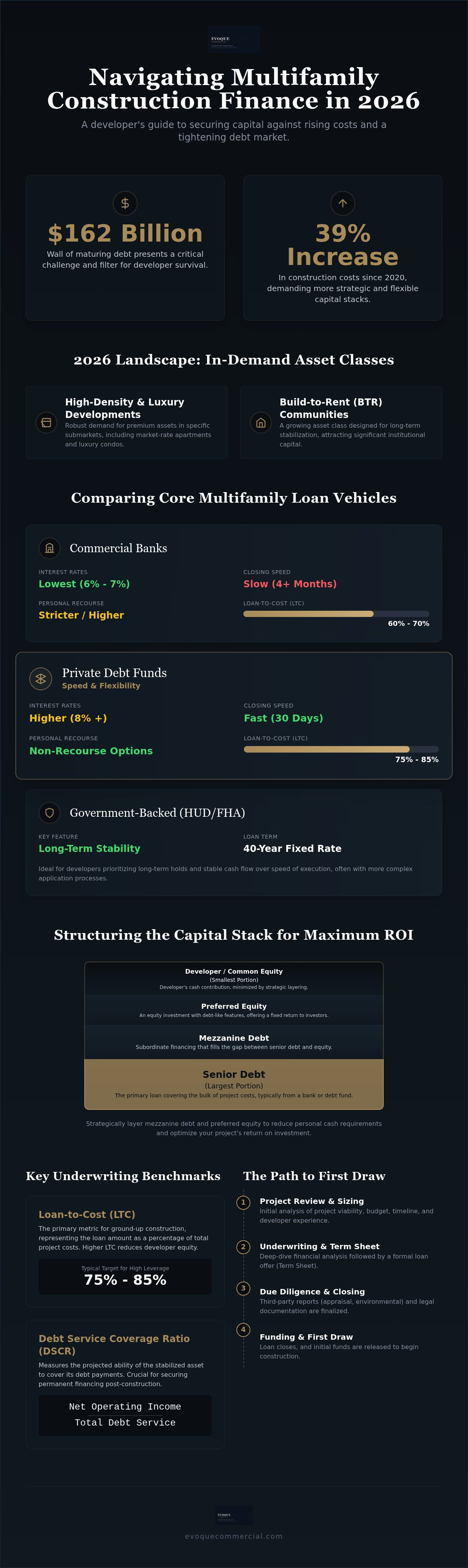
Commercial banks remain the traditional choice for developers with robust balance sheets and high liquidity. They offer the lowest interest rates, typically ranging from 6% to 7%, but they demand significant trade-offs. You'll face stricter personal recourse and lower leverage, often capped at 60% to 70% Loan-to-Cost (LTC). For many developers, the high equity requirement is a barrier to scaling multiple projects simultaneously.
Private debt funds offer a more flexible path. While their rates are higher, often exceeding 8%, they provide non-recourse options and leverage reaching 75% to 85% LTC. In the current interest rate environment, speed often outweighs the spread. If a bank's underwriting takes four months while a debt fund closes in 30 days, the fund's higher interest cost is frequently offset by reduced carry costs and an earlier stabilization date. For developers targeting specific regional markets, specialized investment and lending firms like KC Home Offers LLC can provide the localized agility needed to secure opportunities. Choosing speed over spread allows you to break ground while your competitors are still stuck in a committee review.
Similarly, for investors looking to scale their rental portfolios with minimal documentation hurdles, you can check out Simplified Commercial Lending for loan products that do not require tax returns.
HUD 221(d)(4) loans are often cited as the gold standard for long-term stability because they offer 40-year fixed rates and a non-recourse structure that's impossible to find elsewhere. However, they aren't a tool for rapid execution. The process involves significant friction, including Davis-Bacon wage requirements and environmental reviews that extend closing times to 18 months. Underwriters also rely heavily on data points like HUD Fair Market Rents to determine the maximum loan amount based on project income potential.
For most developers, the strategic move is to use a private construction loan for the build phase and then refinance into a HUD product after stabilization. This approach avoids the construction-phase delays that can kill a project's IRR while locking in long-term debt once the asset is de-risked. If you're navigating these complex capital structures, a strategic partnership with a responsive lender can help you identify the vehicle that best preserves your equity and accelerates your timeline.
Key Underwriting Metrics for Multifamily Loans
Underwriting for multifamily construction loans in 2026 has evolved into a rigorous stress-test of both the project and the sponsor. Lenders aren't just looking at the bricks and mortar. They're analyzing how a project aligns with broader economic shifts, such as those highlighted in the Emerging Trends in Real Estate® 2026 report. Primary metrics like Loan-to-Cost (LTC) and the stabilized Debt Service Coverage Ratio (DSCR) remain the bedrock of any deal, but the "As-Stabilized" appraisal value now carries more weight as cap rates for 4 and 5 Star assets settle in the 5.0% to 5.5% range.
Beyond the numbers, your track record is a primary underwriting pillar. Institutional lenders prioritize developers with a history of delivering similar ground-up projects on time and within budget. Liquidity is equally vital; you'll need to demonstrate sufficient cash reserves to handle the 39% increase in construction costs seen since 2020. Lenders want to see that you have the staying power to reach stabilization even if the lease-up phase takes longer than anticipated. A minimum DSCR of 1.20x to 1.25x at stabilization is the standard benchmark most lenders use to ensure the project can support permanent financing once construction is complete.
Navigating Loan-to-Cost (LTC) Requirements
In 2026, LTC ranges vary significantly by lender type. National banks typically cap their exposure at 60% to 65% LTC, while private debt funds can push leverage toward 75% or even 85% in high-demand submarkets. Lenders define cost as the sum of hard costs, soft costs, and land carry. To maximize leverage without over-leveraging, successful developers often use a layered approach. This involves combining a lower-leverage senior loan with mezzanine debt to fill the capital gap, allowing you to move forward with less cash out of pocket. To explore specialized funding options for your next project, you can learn more about Black Onyx Corporation, LLC and their commercial financing solutions.
The choice between recourse and non-recourse debt is often a choice between cost and personal security. Non-recourse financing protects your personal assets but typically comes with a higher interest rate premium. These loans still include "Bad Boy" carve-outs, which trigger personal liability in cases of fraud, environmental negligence, or unauthorized bankruptcy filings. Evoque structures capital solutions to help developers mitigate personal liability, providing non-recourse options that allow you to scale your portfolio without putting your entire net worth at risk for a single project. Outside of project-specific financing, individuals looking to maintain liquidity for other ventures can use Personal Loans to quickly find flexible funding options.
In 2026, the success of a development depends as much on financial engineering as it does on vertical construction. The capital stack represents the total funds required for your project, organized by repayment priority and risk level. For most multifamily construction loans, the senior debt typically covers the first 60% to 70% of the cost. However, leaving the remaining 30% to 40% as pure developer equity can severely limit your ability to scale. A sophisticated capital stack uses multiple layers of debt and equity to fill this gap, protecting your liquidity and maximizing your return on investment.
Structuring a modern capital stack requires a strategic blend of senior debt, mezzanine capital, and preferred equity. This hierarchy ensures that each dollar is working at its highest efficiency. By layering these instruments, you can push total leverage to 90%, significantly reducing your cash-on-cash requirement. This disciplined approach allows you to de-risk your personal balance sheet while maintaining control over the project's execution.
Integrating Mezzanine Debt and Preferred Equity
Mezzanine debt acts as a bridge between the senior loan and the developer's equity. It sits behind the senior lender in priority but ahead of the equity holders. Preferred equity works similarly but is technically an equity position with a fixed return. Using these tools allows you to reach much higher leverage than a bank would typically allow on its own. When calculating your Weighted Average Cost of Capital (WACC), it's important to look at the blended rate of the entire stack. While mezzanine debt carries a higher interest rate than senior debt, its impact on your overall cost is often minimal compared to the value of preserving your own capital for the next deal. For developers seeking more sophisticated structures, The Federal Group serves as an international property finance partner and developer specializing in private equity and development finance.
The 2026 market has seen a massive surge in "horizontal multifamily," or Build-to-Rent communities. These projects are increasingly financed using the same structures as traditional high-rise multifamily construction loans. Lenders have become comfortable with the BTR model because it combines the operational efficiency of an apartment building with the consumer demand for single-family living. Phased townhome or cottage-style developments require a loan structure that allows for flexible draws and partial releases as units reach completion.
If your project involves large-scale residential tracts, you might also consider the nuances of Single-Family Subdivision Financing to ensure your land development costs are fully covered before vertical construction begins. Whether your exit strategy involves a portfolio sale to an institutional buyer or individual unit sales, your capital stack must be resilient enough to handle the transition from construction to stabilization. If you're ready to optimize your project's debt structure, contact Evoque Commercial to discuss a customized capital stack for your next multifamily development.
The Path to Closing: From Project Review to First Draw
Closing a $10M+ facility requires more than just a strong balance sheet. It demands a synchronized effort between your development team and the lender's underwriting desk. In 2026, the standard timeline for private multifamily construction loans has stabilized between 60 and 90 days. This speed is a competitive necessity for developers aiming to break ground before market conditions shift. At Evoque Commercial, we initiate this process with a comprehensive Project Review. This phase is designed to ensure your capital structure is fully optimized before we move into formal due diligence.
Managing the transition from a term sheet to a funded loan involves high stakes and tight deadlines. You'll need to coordinate with third-party inspectors who verify construction progress and approve draw requests. A strategic lender doesn't just provide capital; they provide the administrative framework to ensure your general contractor stays paid and your project stays on schedule. To understand the operational standards behind these processes, visit Orchestrate. This methodical approach is what separates successful 2026 developments from those that stall during the vertical phase.
Efficiency during underwriting depends on the "Big Three" documents: a granular construction budget, a realistic 10-year pro forma, and a verified developer track record. These items provide the roadmap for the entire transaction. Lenders also require a Phase I Environmental Site Assessment and a current Geotechnical report to identify subsurface risks before the first shovel hits the dirt. Beyond risk mitigation, developers seeking to optimize their project's marketability should discover Ekocentric for specialized consulting on green building certifications. During this critical window, Evoque values middle-market responsiveness, ensuring that technical questions are resolved in days rather than weeks. This agility prevents the sluggish underwriting cycles typical of major national banks, allowing you to maintain your entitlement timeline.
Finalizing the loan involves setting up the interest reserve and contingency funds. These accounts act as a safety net, covering debt service during the build and providing a buffer for unexpected cost overruns. For developers seeking to institutionalize their risk management, VULPIN Capital offers a governance-first approach to contingency planning that ensures long-term asset survivability. The first draw is often a pivotal moment for the project's liquidity. It typically covers land acquisition costs or provides a reimbursement for equity you've already deployed into site preparation. As construction nears completion, the focus shifts toward the exit. We help developers transition from multifamily construction loans into bridge-to-stabilization facilities, providing a seamless path toward permanent debt once the asset is de-risked. If you're ready to secure a tailored financing path for your next project, contact our team to start your project review.
Success in today's development environment requires more than just basic funding. It demands a sophisticated understanding of how to layer senior debt with mezzanine capital and private multifamily construction loans to preserve liquidity. The path from project review to the first draw is defined by precision and speed. By aligning your project with the right underwriting metrics and choosing a vehicle that matches your timeline, you can navigate the 2026 market with confidence.
Evoque Commercial serves as your strategic partner, offering tailored financing paths for ground-up and luxury developments up to $250 million. We provide national coverage and bridge the gap between institutional capital relationships and boutique responsiveness. Our team is ready to help you structure a capital stack that minimizes personal recourse and maximizes your project's return on investment. Don't let sluggish underwriting cycles at major banks stall your progress. Take the next step toward breaking ground and Request a Project Review for Your Multifamily Development today. Your vision deserves a financing structure as ambitious as the project itself.
Frequently Asked Questions
What is the typical interest rate for a multifamily construction loan in 2026?
Interest rates for multifamily construction loans in 2026 vary by lender type and project risk profile. HUD 221(d)(4) loans are currently in the mid-to-high 5% range, while commercial banks typically offer rates between 6% and 7%. Private debt funds and non-bank lenders usually start at 8% and can go higher depending on leverage. These rates reflect the Federal Funds Rate stabilizing between 3.50% and 3.75%, providing a more predictable cost of capital.
How much equity do I need for a ground-up multifamily project?
Equity requirements depend on your chosen leverage and the lender's risk appetite. For bank-financed ground-up projects, developers typically need 35% to 40% of the total project cost in cash or land equity. Private debt funds often lower this requirement to 25%. If you utilize structured capital like mezzanine debt or preferred equity, you can potentially reduce your direct cash contribution to 10% or 15%, provided the total capital stack remains within limits.
Can I get a non-recourse multifamily construction loan?
Yes, non-recourse options are available, primarily through HUD programs and private debt funds. While commercial banks usually require full personal recourse, debt funds offer non-recourse structures in exchange for a higher interest rate or lower leverage. These loans still include "Bad Boy" carve-outs, which trigger personal liability in the event of fraud, gross negligence, or unauthorized bankruptcy filings. This structure allows developers to protect personal assets while scaling their portfolios.
How long does it take to close a multifamily construction loan?
The timeline to close depends on the lender's agility and the complexity of the deal. Private debt funds and boutique lenders can typically close within 60 to 90 days once a full package is received. In contrast, institutional banks may take four to six months due to lengthy committee reviews. Government-backed programs like HUD require a much longer lead time, often stretching between 12 and 18 months from initial application to funding.
What is the difference between LTC and LTV in construction lending?
Loan-to-Cost (LTC) and Loan-to-Value (LTV) are distinct metrics used at different stages. LTC is the primary metric for construction lending, representing the loan amount relative to the total cost of building the project. LTV refers to the loan amount relative to the appraised value of the asset once it's completed and stabilized. Lenders focus on LTC during the vertical phase to ensure the developer has sufficient "skin in the game" before reaching stabilization.
Does Evoque Commercial provide construction completion or rescue capital?
Evoque Commercial specializes in providing construction completion financing and rescue capital for projects that have stalled due to cost overruns or bank pullbacks. We step in to fund the remaining vertical costs, allowing developers to reach stabilization without losing their equity. Our ability to structure complex capital stacks makes us a strategic partner for projects needing $3M to $250M to cross the finish line when traditional underwriting cycles prove too slow for your timeline.
Are Build-to-Rent (BTR) projects eligible for multifamily financing?
Build-to-Rent (BTR) projects are fully eligible for multifamily construction loans in 2026. Lenders now view horizontal multifamily developments, such as cottage-style communities or townhome subdivisions, with the same institutional appetite as traditional mid-rise apartments. These projects benefit from similar LTC ratios and non-recourse structures. We provide specialized Build-to-Rent financing that accounts for the unique phased delivery and lease-up schedules inherent in horizontal developments, supporting your project from acquisition to exit.
What documents are required for a multifamily loan submission?
A standard submission package includes a detailed construction budget, a 10-year pro forma, and a comprehensive developer track record. You'll also need a Phase I Environmental report, a Geotechnical study, and architectural plans. Lenders use these documents to verify the project's feasibility and the sponsor's liquidity. Having an institutional-grade package ready for review is the most effective way to accelerate the underwriting process and secure a competitive term sheet for your project.