

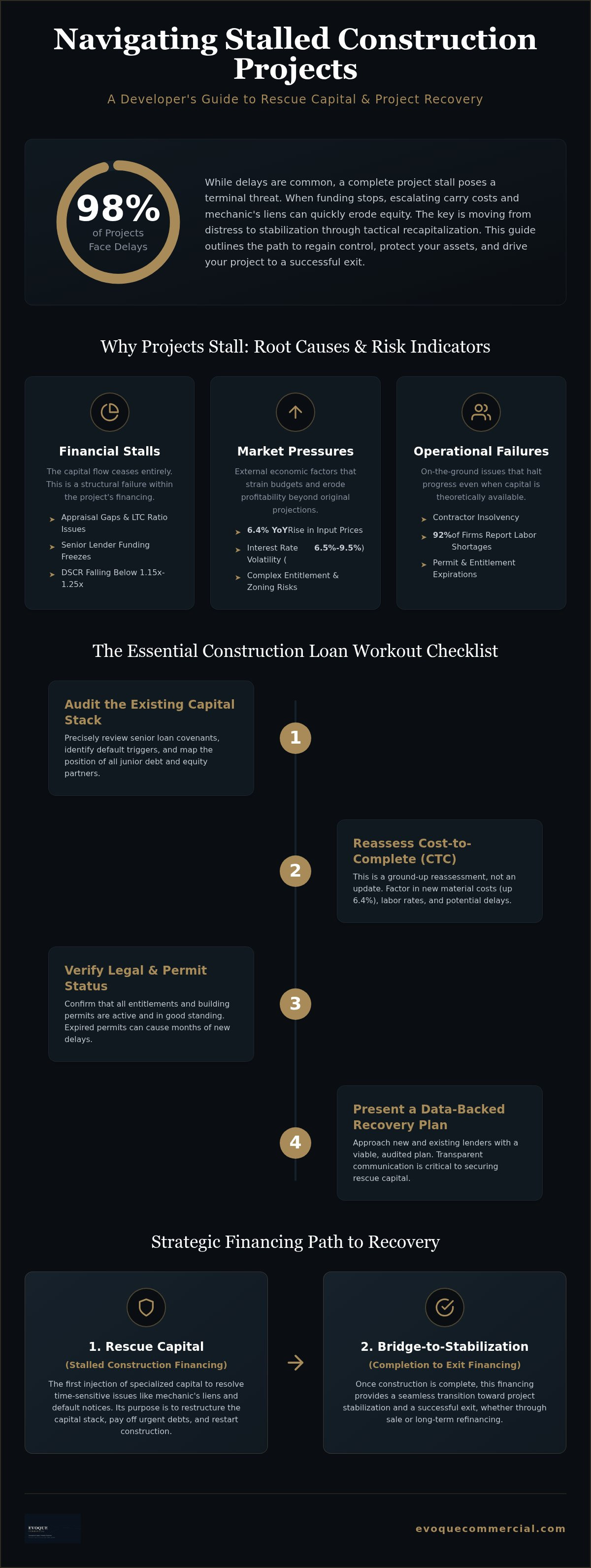
Recent data indicates that 98% of all construction projects experience delays, yet for a developer facing a complete halt, that statistic offers little comfort. When a primary lender stops funding and default notices arrive, the pressure of escalating carry costs and mechanic's liens can feel insurmountable. Securing the right stalled construction project financing isn't merely about filling a budget gap; it's about a tactical recapitalization that protects your remaining interest. You've worked hard to build equity, and watching it erode while the site sits silent is a scenario no professional should face.
You'll learn how to accurately diagnose the root cause of project stalls, evaluate the most effective rescue capital options, and implement structured workout solutions to bring your development to completion. This guide provides a clear path through the complexity of the 2026 financing environment, moving your project from distress toward stabilization and a successful exit. By following this structured checklist, you can regain control of your timeline and protect the long-term value of your assets.
Why Residential Projects Stall: Root Causes and Risk Indicators
Identifying the specific catalyst of a project halt is the first step toward recovery. In 2026, the distinction between a temporary operational delay and a terminal financial stall has become increasingly blurred. While 98% of construction projects experience some form of delay, a true stall occurs when the capital flow ceases entirely. This is often driven by an appraisal gap, where the project's projected value no longer supports the existing loan-to-cost (LTC) ratios. When traditional banks see these gaps, they often trigger a funding freeze, leaving developers to seek specialized stalled construction project financing to prevent a total loss of equity.
A stall often begins with subtle shifts in the project's health. Cost overruns are no longer just an inconvenience; with construction input prices rising 6.4% year-over-year as of mid-2026, budgets are being consumed at an unsustainable rate. Early warning signs include a sudden influx of mechanic's liens, draw request denials from the senior lender, or the expiration of local permits. These indicators suggest that the project has moved beyond simple mismanagement into a phase of lender fatigue, where the original financier no longer has the appetite for the asset's risk profile.
The Impact of Interest Rate Volatility on Vertical Construction
Floating-rate debt has become a significant liability for many developers. As rates for professional builders fluctuated between 6.5% and 9.5% throughout 2026, projects that were feasible at inception now struggle to meet debt-service coverage ratio (DSCR) requirements. If the DSCR falls below the institutional threshold, typically 1.15x to 1.25x, the lender may halt further disbursements. Interest rate caps or swaps often dictate whether a workout is mathematically feasible or if the carry costs will consume all remaining equity.
Operational vs. Financial Stalls: A Diagnostic
Distinguishing between contractor insolvency and a developer capital shortfall is vital for a successful rescue. Contractor issues are rampant, with 92% of firms reporting difficulty filling positions and wages reaching an average of $39.24 per hour. This labor shortage can stop progress even when capital is available. However, a financial stall is a structural issue within the capital stack itself. Understanding project financing fundamentals is essential to determine if the asset's future cash flows can still support a recapitalization. High-end urban developments face additional hurdles, such as complex entitlement risks and zoning challenges. For these sophisticated developments, leveraging luxury infill project loans can provide the necessary structure to navigate high-density requirements while securing the capital needed to restart a silent site.
The Essential Construction Loan Workout Solutions Checklist
When a project halts, the immediate priority is data integrity. You can't fix what you haven't measured. A developer must execute a comprehensive audit before approaching new sources of stalled construction project financing. This checklist serves as the foundation for any successful workout, transforming a chaotic default scenario into a structured path toward completion.
Auditing the Existing Capital Stack
Start by reviewing senior loan covenants with extreme precision. You need to know exactly which default provisions have been triggered and what the cure periods look like. Identifying the position of junior debt and equity partners is equally vital. In many cases, the point of no return for equity preservation is reached when the cost to complete plus the interest carry exceeds 90% of the projected value. Understanding the legal and structural nuances of rescue capital transactions is critical when negotiating with a senior lender who may already be preparing for foreclosure.
Next, evaluate the current Cost-to-Complete (CTC). This isn't a simple update of the original budget; it's a ground-up reassessment. You must account for the 6.4% increase in construction input prices and the rising costs of specialized labor observed throughout 2026. Simultaneously, verify the status of all entitlements and building permits. Expired permits can add months of delays, further eroding your margin and complicating your standing with the city.
Assessing Project Viability and Residual Value
Project viability hinges on an updated Absorption Pro Forma. The residential market of 2026 demands a realistic look at how quickly units will sell or lease upon completion. You must decide between a quick exit via sale or a transition into a bridge-to-stabilization phase. Residual value assessment for luxury spec developments requires a granular analysis of current high-end absorption rates and a comparison of finished-product pricing against the total cost to complete including recapitalization fees.
Finally, identify all outstanding mechanic’s liens and subcontractor claims. These are often the biggest hurdles to bringing in new capital. Clearing these liens is a prerequisite for any meaningful recovery. Developers often find that a structured capital solution provides the necessary liquidity to clear these hurdles while maintaining project momentum. Without a clear plan to address these claims, the project remains un-financeable for most institutional lenders.
Strategic Financing Options: Rescue Capital and Bridge Solutions
Rescue capital operates on a different logic than traditional ground-up funding. While standard lenders focus on the cost basis of a new site, providers of stalled construction project financing prioritize the remaining cost-to-complete and the immediate path to stabilization. This type of capital is designed to be agile, responding to the urgency of default notices and mechanic's liens that often accompany a silent job site. It fills the void when a primary lender's risk appetite has vanished, acting as a strategic intervention rather than a baseline loan. For developers, this capital is the difference between an involuntary foreclosure and a controlled completion.
Construction Completion Financing Mechanisms
Underwriting a stalled project requires a clinical focus on "sunk costs." Completion lenders don't value the capital already spent; instead, they focus on the net value added by the remaining work and the feasibility of the exit. To secure construction completion financing, developers must provide a clean title and negotiate lien subordination agreements with existing subcontractors. This process ensures that the new capital maintains a priority position, which is essential for institutional-grade rescue funds to enter the deal. The goal is to clear the legal and financial clutter so that vertical progress can resume without the threat of immediate litigation or site seizure.
Mezzanine Debt and Preferred Equity Infusions
When the senior lender remains in place but refuses to fund overruns or appraisal gaps, mezzanine debt or preferred equity often fills the void. These structured solutions are frequently organized as "last-in, first-out" (LIFO) capital. This means the rescue funds are the last dollars invested but the first to be repaid upon exit, protecting the new investor's downside while allowing the developer to retain their remaining equity. In the 2026 market, where higher-risk project rates can exceed 12%, these layers are vital for maintaining momentum. The role of structured capital in luxury residential development loans is to provide a buffer against market volatility. By integrating these layers, you can bridge the distance between current debt and the total project cost without being forced into a premature sale at a distressed price. This structure allows the developer to buy the time necessary for project repositioning or a more favorable interest rate environment.
Executing the Recovery: A Step-by-Step Path to Completion
Recovery is a disciplined process of restoration, not just a search for liquidity. The first step requires opening transparent communication with your existing senior lender. Lenders generally loathe surprises; they prefer a developer who proactively presents a solution rather than one who waits for a foreclosure notice. You must present a viable, data-backed completion and exit plan that accounts for current market realities. This plan serves as your primary tool for securing a commitment for stalled construction project financing. Once new capital is committed, you can resolve outstanding mechanic's liens and contractor disputes, clearing the path to execute the recapitalization and restart vertical construction.
Renegotiating with Senior Lenders
Requesting loan extensions or forbearance requires a strategic approach. You aren't asking for a favor; you're offering a path to maximize the asset's value. Foreclosure is a slow, expensive failure for all parties involved. A "friendly" workout allows the senior lender to keep the loan on their books as performing or "substandard but improving" rather than a non-performing asset. Bringing a new capital partner to the table provides the institutional comfort a senior lender needs to grant an extension. It demonstrates that the project has been re-underwritten by a fresh set of eyes and that the remaining 2026 market risks are being mitigated by new, "last-in" capital.
Securing Shovel-Ready Status for Re-entry
Restarting a silent site involves more than just rehiring crews. You must ensure all site inspections, environmental reports, and building permits are current and valid. A project that has sat idle may have structural or weather-related issues that need addressing before vertical progress resumes. Updating the construction schedule is equally critical to reflect the 2026 labor market. With average hourly earnings for construction workers reaching $39.24 in July 2026, your previous labor assumptions are likely obsolete. You must also consider market entry timing; aligning your completion with peak absorption periods is vital. For those developing single-family residences, reviewing the latest strategies for spec home loans can help refine your timeline for a successful market re-entry.
Execution requires a partner who understands the nuances of distressed project dynamics. If your development is currently stalled, you need more than just a lender; you need a strategist who can bridge the gap to completion. Contact us today to discuss how our structured capital solutions can help you regain control of your project and protect your equity.
Leveraging Structured Capital for Project Stabilization
The final phase of a workout isn't just about finishing the building; it's about stabilizing the asset for a clean exit. Once vertical construction restarts using stalled construction project financing, the focus shifts to the bridge-to-stabilization phase. This transition is where many developers lose momentum if they don't have a partner capable of managing the full lifecycle of the recovery. Structured capital allows for a seamless pivot from high-cost rescue funds to more traditional stabilization debt, protecting the equity that was salvaged during the workout. A successful recovery ensures that the project moves from a "distressed" classification to a "performing" asset in the eyes of permanent lenders.
Boutique Responsiveness in Distressed Scenarios
Evoque Lending specializes in this exact transition for residential developments in the $3M to $250M range. Our approach combines the reach of institutional capital with a level of boutique responsiveness that larger banks cannot match. In a distressed scenario, time is the most expensive commodity. Having a direct line to decision-makers ensures that as milestones are met, the next layer of the capital stack is ready to deploy without the bureaucratic delays that often characterize national lenders. Middle-market responsiveness in rescue capital ensures that tactical adjustments can be made in real-time as site conditions or market dynamics shift. Tailored financing paths outperform rigid institutional products because they account for the unique complexities of a previously stalled project.
A project that has been rescued requires a specific narrative to attract permanent financing or a buyer. We ensure the project is prepared for this transition by managing the debt-to-value ratios throughout the completion phase. This methodical approach provides the transparency needed to satisfy future stakeholders and ensures that the stalled construction project financing serves its ultimate purpose: the restoration of project value.
Transitioning from Rescue to Inventory Financing
For projects involving multiple units, such as single-family subdivisions or multifamily developments, inventory financing becomes a vital tool once certificates of occupancy are issued. This allows the developer to release equity and pay down higher-cost completion debt while the units are being sold or leased. It effectively bridges the gap between the end of construction and the final project exit. Managing this lifecycle from acquisition through rescue and into final stabilization requires a partner who understands every technical and financial milestone. If you are ready to move your project toward completion, Request a project review with Evoque Lending to explore our national capital solutions.
Navigating the Path to Project Completion and Stabilization
A stalled project represents a critical junction in a developer's career, but it doesn't have to signal the end of the development. By implementing a disciplined workout checklist, you can move from the pressure of default notices to a structured recovery. Diagnosing the specific financial or operational root causes allows for a tactical recapitalization that protects your remaining equity. Whether you are addressing appraisal gaps or resolving mechanic's liens, the right stalled construction project financing provides the liquidity necessary to restart vertical construction and reach a successful exit.
Evoque Lending provides the institutional capital relationships and specialized residential expertise needed for projects ranging from $3M to $250M. We offer national responsiveness for time-sensitive workouts, ensuring your project receives the boutique attention it requires during a rescue scenario. Secure Rescue Capital for Your Stalled Project with Evoque Lending. Your project’s value can still be realized with the right strategic partner by your side.
Frequently Asked Questions
What is construction completion financing?
Construction completion financing is specialized capital designed to finish a project where the original lender has stopped funding. It focuses on the remaining cost-to-complete rather than the initial land basis. It's used for stalled construction project financing to bridge the gap between distress and stabilization. This funding often involves a new lender taking over the senior position or providing a junior layer to ensure vertical construction resumes immediately.
Can I get financing for a project with existing mechanic’s liens?
Yes, though clearing or subordinating these liens is usually a prerequisite for closing new capital. Lenders require a clean title to protect their priority position. Rescue capital often includes a facility to pay off outstanding subcontractor claims as part of the initial draw. This process ensures that the labor force returns to the site and that the project moves forward without the threat of ongoing legal encumbrances or site seizures.
How does rescue capital differ from a standard construction loan?
Rescue capital prioritizes speed and structural flexibility over the lowest possible interest rate. While standard loans are underwritten on a clean slate basis, rescue capital is underwritten based on sunk costs and the immediate path to project completion. It often takes the form of preferred equity or mezzanine debt. This capital is specifically structured to solve existing defaults and appraisal gaps that traditional banks won't touch in a shifting market.
What is a construction loan workout agreement?
A workout agreement is a negotiated contract between a borrower and a lender to restructure a defaulted loan. It typically involves modified repayment terms, loan extensions, or forbearance on specific covenants. The goal is to avoid foreclosure by providing a viable path to project completion. These agreements often require the developer to bring in new capital or provide updated data-backed exit strategies to restore the senior lender's confidence.
How much equity can I preserve in a project recapitalization?
Equity preservation depends on the project's current loan-to-value ratio and the remaining cost-to-complete. In many 2026 workout scenarios, developers use last-in, first-out capital structures to protect their remaining interest. While some dilution is common when bringing in rescue funds, a successful recapitalization prevents the total loss of equity that occurs in an involuntary foreclosure. The earlier you address the stall, the more equity you can generally protect through structured solutions.
How long does it take to secure funding for a stalled project?
Securing stalled construction project financing typically takes 30 to 45 days, depending on the complexity of the existing capital stack. Boutique firms offer faster responsiveness than traditional institutions by providing direct access to decision-makers. The timeline is often dictated by how quickly a developer can provide an updated audit of liens, entitlements, and the current cost-to-complete. Speed is critical to stop the erosion of value caused by escalating carry costs.
What documents are required for a construction loan workout?
You'll need a comprehensive audit of the project's current status. This includes an updated Cost-to-Complete (CTC) budget, a schedule of all outstanding mechanic's liens, and current appraisal data. Lenders also require proof of valid entitlements and building permits. A detailed exit pro forma reflecting 2026 market conditions is essential to demonstrate how the new capital will be repaid upon project completion or a transition to permanent financing.
Is mezzanine debt a viable solution for stalled residential projects?
Mezzanine debt is a highly effective tool for filling the gap between a capped senior loan and the developer's remaining equity. It allows the project to move forward without forcing a full refinance of the senior debt. This layer of structured capital is often used to fund cost overruns or appraisal gaps. It provides the necessary liquidity to reach completion while allowing the developer to maintain control of the asset's vertical progress.