

Is your liquid equity actually working for you, or is it simply trapped in the dirt of your next project? In the current market, the difference between a high-margin exit and a stalled site often comes down to the agility of your capital stack. You likely already know that traditional institutional lenders often struggle with the pace of modern development. They offer rigid draw schedules that halt vertical progress and impose low LTC limits that require excessive developer equity; this leaves you with little room for strategic maneuvering or new acquisitions. Finding a partner that understands the nuances of the luxury residential market is no longer a luxury, it's a structural necessity.
This guide provides the roadmap to mastering high-leverage spec home loans in 2026. We'll show you how to structure financing for maximum ROI while navigating the complexities of speculative residential projects. You'll discover how to secure LTC ratios as high as 90% and identify lenders that prioritize responsive underwriting over bureaucratic delays. We also examine how new regulations like the 21st Century ROAD to Housing Act are reshaping construction costs and design flexibility. From acquisition through to the final sale, this is how you build with precision and financial discipline.
What are Spec Home Loans? Defining Speculative Construction Financing
A spec home loan is a specialized debt instrument designed to fund the construction of residential properties intended for immediate sale upon completion. Unlike custom builds, these projects lack a pre-identified buyer at the time of closing. In 2026, speculative development remains a critical response to persistent inventory shortages in the luxury and mid-market sectors. It allows developers to capitalize on shifting demographics and localized demand surges without waiting for a client's personal preferences to dictate the timeline. Spec home loans serve as a strategic tool for inventory management within a developer's broader portfolio.
The Developer Perspective: Why Build Spec?
Building on speculation offers a level of market agility that custom contracts cannot match. Developers retain total control over the architectural vision and interior finishes. This autonomy allows for the optimization of neighborhood appraisal values. The developer can select high-end materials that resonate with current market aesthetic trends rather than a single buyer's niche taste. In single-family subdivisions or luxury infill projects, this scalability is vital. It enables a rhythmic construction schedule where trades move efficiently from one unit to the next. This operational flow reduces overhead and shortens the total project lifecycle, which ultimately enhances the return on invested equity.
Lender Risk Perception in 2026
Lenders view spec home loans through the lens of market absorption and liquidity. Because there's no buyer under contract, the primary security is the asset's "as-completed" value and the developer's ability to execute the exit strategy. In 2026, sophisticated lenders prioritize market data that proves a deep pool of qualified buyers for the specific price point. They look for significant "skin in the game," often requiring developers to maintain a substantial equity position to align interests. A developer's track record is equally scrutinized. Success in previous cycles demonstrates the resilience needed to manage unforeseen delays or shifts in material costs.
While custom builds offer the security of a signed contract, they often suffer from delays caused by end-user indecision. Speculative projects bypass this friction. They allow for a leaner, more predictable construction process. By removing the variable of buyer interference, developers can adhere to strict timelines and maintain the momentum required for high-leverage financing. This structural predictability is why many developers prefer the speculative model for their primary growth strategy.
Anatomy of a Spec Home Loan: LTC, LTV, and Capital Structure
Understanding the distinction between Loan-to-Cost (LTC) and Loan-to-Value (LTV) is fundamental to structuring profitable spec home loans. LTC represents the percentage of the total project budget the lender will fund. LTV reflects the loan amount relative to the anticipated final sale price. According to data from the Urban Institute's Housing Finance Policy Center, housing finance trends continue to emphasize risk-adjusted leverage, making these ratios the cornerstone of any term sheet. In the 2026 market, lenders are providing up to 85% or even 90% LTC for experienced developers. LTV caps usually sit at 75% of the as-completed value. These limits ensure that the developer maintains a tangible stake in the project.
Interest reserves are also a standard feature. A portion of the loan is set aside to cover monthly interest payments during the construction phase. This preserves developer cash flow, as interest is effectively capitalized into the loan balance until the property sells. It's a disciplined way to manage debt service without draining operational liquidity.
Leverage and Equity Requirements
High-end spec projects often face a significant equity gap. When a senior lender caps their contribution, the developer must bridge the remaining costs with their own capital. Utilizing structured capital solutions can help reduce the amount of liquid equity locked in a single site. Mezzanine debt or preferred equity can supplement senior spec home loans, allowing developers to maintain a higher velocity of production across multiple projects. This strategic approach to the capital stack ensures that your liquidity isn't exhausted by a single high-value acquisition.
Draw Schedules and Fund Control
The draw process is where vertical construction momentum is either maintained or lost. Lenders release funds based on completed milestones, verified through third-party inspections. Efficient fund control involves several moving parts:
- Monthly inspections: Site visits verify progress before funds are disbursed to ensure the project stays on schedule.
- Lien management: Managing sub-contractor payments is vital to prevent mechanics liens that can cloud the title.
- Speed to draw: For a builder, the time between a draw request and the actual wire is a critical performance metric.
A responsive lender prevents work stoppages and keeps trade partners on-site. If you're looking to optimize your project's leverage, exploring structured capital solutions can provide the flexibility needed for high-margin development.
Spec vs. Pre-Sold vs. Custom: Choosing the Right Financing Path
Construction debt is not a monolithic product. While some institutional lenders treat all residential projects with the same broad strokes, the underwriting for spec home loans requires a significantly higher level of market intelligence. A custom home loan relies on the personal credit and income of a specific end-user. In contrast, speculative financing demands a rigorous macro-level assessment of neighborhood liquidity and price-point stability. Lenders must be convinced that the asset will sell quickly once it hits the market, which is why they scrutinize absorption rates more than individual credit scores.
Cost of capital is the primary differentiator here. Speculative debt often carries a premium compared to pre-sold units. This higher interest rate reflects the "un-contracted" risk the lender assumes. As noted in the Emerging Trends in Real Estate® report, developers who successfully navigate these costs do so by maintaining a flexible capital stack that can adapt to shifting market conditions. This flexibility allows a developer to lead the design process and capture the full upside of a rising market rather than being locked into a fixed-fee custom build contract.
When to Pivot from Spec to Pre-Sold
Market dynamics can change during the vertical phase of a project. If a buyer emerges before the home is completed, savvy developers look for "convertible" loan structures. Some lenders allow you to shift from speculative financing to a permanent mortgage for the buyer mid-project. This transition often triggers lower interest rates because the exit risk has been mitigated by a signed purchase agreement. Recognizing these market signals early helps you preserve margin and reduce the overall carry cost of the project.
Luxury Infill and Custom Estate Nuances
High-end developments in established urban cores require a more nuanced approach than standard suburban subdivisions. These projects often involve unique architectural features and imported materials that standard appraisers might struggle to value. Specialized luxury infill project loans are designed to account for these complexities. Managing the financing for a custom-level spec estate also requires a lender who understands longer absorption timelines. In the luxury tier, properties don't always sell in thirty days; the capital structure must be patient enough to wait for the right buyer without forcing a fire sale. Success in this sector depends on:
- Accurate pro-forma projections for high-end finishes.
- Lenders who recognize the value of unique architectural signatures.
- Capital partners who offer boutique responsiveness for site-specific challenges.
Choosing the right path isn't just about the lowest rate. It's about finding a structure that aligns with your specific development timeline and risk tolerance.
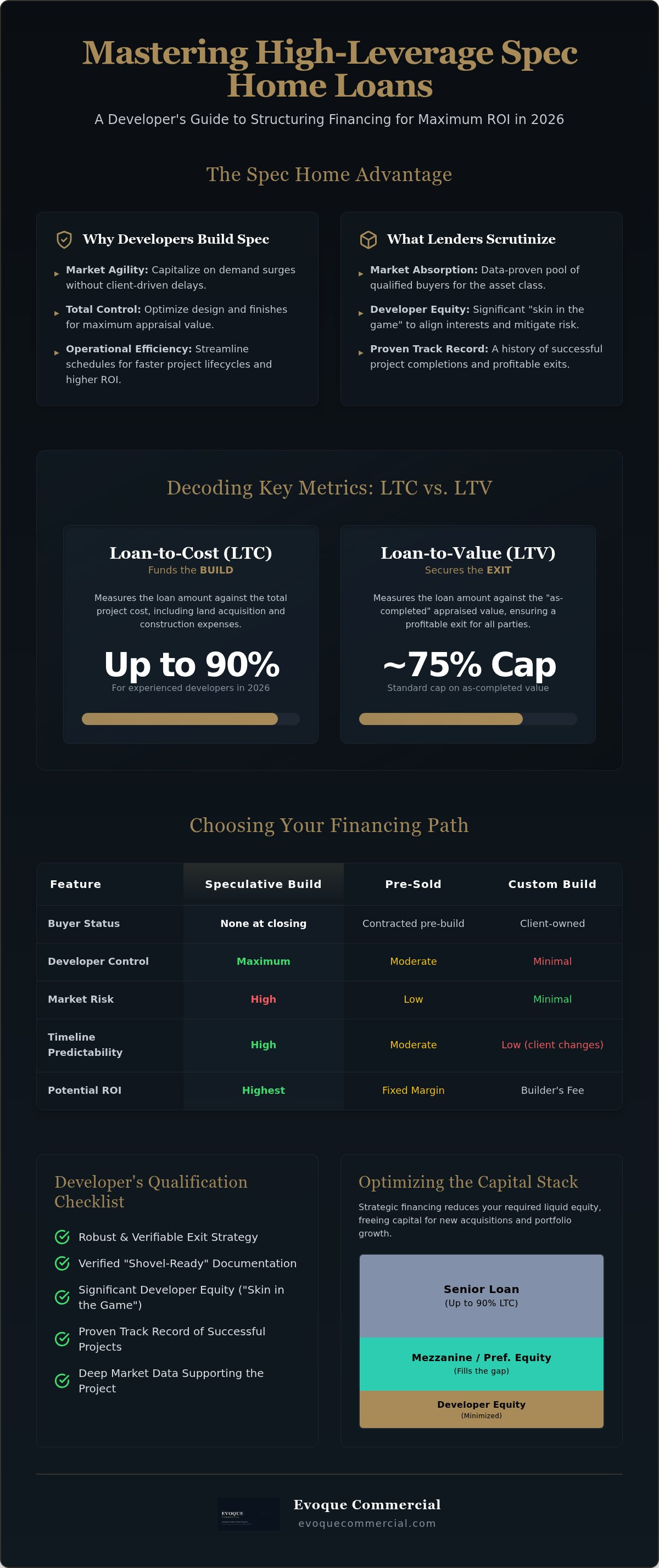
The Developer’s Checklist for Spec Loan Qualification
Lenders in 2026 are moving beyond simple credit checks. To secure spec home loans, you must demonstrate that the project is a viable business venture, not just a physical asset. Your track record serves as the primary hedge against execution risk. Institutional underwriters prioritize developers who have successfully exited similar projects in the same geographic market. This history proves you can manage the complexities of a vertical build without the safety net of a pre-sold contract. Your CV is now as critical as your balance sheet.
A realistic pro-forma is the heart of your application. It must account for the 3.7% increase in building material prices recorded in early 2026 and include a robust contingency for ongoing interest rate volatility. If your budget doesn't reflect these market realities, lenders will likely flag the project as under-capitalized. Precision in your financial forecasting demonstrates the discipline required for high-leverage financing.
Preparing the Project Package
The documentation phase requires meticulous attention to detail. Lenders expect a shovel-ready status, meaning all entitlements and permits are secured before the first draw. A market feasibility study should prove the "exit" by analyzing recent comparable sales and current inventory levels. Many developers utilize land acquisition and development loans to bridge the gap between initial purchase and the start of vertical construction. This ensures the site is fully prepared for the specialized construction financing that follows.
Managing Stalled Projects
Market shifts or supply chain disruptions can sometimes halt progress. When a spec project hits a wall, identifying the need for construction completion financing early is vital. This type of rescue capital allows builders to recapitalize and reach the finish line when original funding sources become rigid or exhausted. Rather than letting an asset sit idle, proactive developers seek workout solutions that protect their equity and maintain their reputation with trade partners.
If your current pipeline requires a more responsive capital partner to avoid these delays, you can explore our structured capital options to keep your projects moving forward. Success in speculative development depends on having a lender that understands the realities of the field as well as the numbers on the page.
Strategic Spec Home Financing with Evoque Lending
Evoque Lending operates at the intersection of institutional capacity and boutique responsiveness. While many local lenders lack the liquidity for substantial projects, we provide structured capital for residential developments ranging from $3M to $250M. Our national reach ensures that developers have access to sophisticated spec home loans regardless of their project's location. We don't just offer debt; we position ourselves as a strategic partner throughout the entire development lifecycle. This support extends from the initial land acquisition phase to the deployment of bridge loans for residential development to stabilize assets post-construction.
Tailored Capital Solutions for Large-Scale Growth
Scaling a development pipeline requires more than a standard term sheet. For single-family subdivisions, we customize the capital stack to align with specific phasing and absorption projections. Developers entering high-end markets can leverage our luxury residential development loans to secure the high-leverage financing necessary for premium materials and architectural excellence. This approach combines the strength of national institutional capital with the local market intelligence required to underwrite complex, high-value projects. We understand that a luxury estate in a coastal market has different structural needs than a build-to-rent community in the sunbelt.
The Evoque Advantage: Speed and Structure
Time is the most expensive variable in any construction project. Our underwriting process is streamlined specifically for experienced developers who require decisive answers and rapid draw approvals. We provide flexible terms that adapt to the natural milestones of a project, from the first shovel in the ground to the final certificate of occupancy. This responsiveness prevents the costly work stoppages often associated with slower, more bureaucratic institutional lenders who struggle with the nuances of spec home loans. We prioritize the continuity of your project to ensure your vertical progress remains uninterrupted.
The Evoque Lending team is ready to analyze your next high-end spec project for a strategic review. Initiating a project review is a straightforward process focused on your pro-forma and development track record. By aligning your vision with our structured capital solutions, you can maximize your ROI while maintaining the agility needed to capture market demand. We invite you to submit your next high-end spec project for a strategic review with our lending team.
Capitalizing on the 2026 Residential Market
Success in speculative development depends on a precise alignment of market timing and financial structure. Managing high-leverage debt requires more than just securing a competitive rate; it demands a partner that understands the nuances of luxury infill and subdivision scalability. By optimizing your LTC ratios and maintaining a disciplined draw schedule, you ensure your project remains liquid and agile through every phase of construction. Securing the right spec home loans is the structural foundation of this strategy. It allows you to capture market demand without the friction of buyer indecision.
Evoque Lending provides the institutional capital relationships and national boutique service required to fund residential projects from $3M to $250M. We don't just provide debt; we offer the strategic oversight and responsiveness needed to keep your vertical progress on schedule. You can Request a Strategic Project Review from Evoque Lending to begin a detailed analysis of your next development. With the right capital partner, you can move from acquisition to exit with total confidence. Let's structure your next project for maximum ROI.
Frequently Asked Questions
What is the maximum LTC for a spec home loan in 2026?
In 2026, lenders are providing up to 85% to 90% Loan-to-Cost (LTC) for experienced residential developers. This high-leverage threshold depends heavily on the project's specific location and the borrower's proven track record. If land subordination is utilized, it is possible to reach 100% LTC in certain scenarios. These limits allow builders to preserve liquid equity while maintaining consistent vertical progress. Leverage remains a function of risk.
Can I get a spec home loan for a single luxury infill project?
Yes, financing for a single luxury infill project is available provided the loan amount meets the $3 million minimum threshold. These high-end builds often require specialized underwriting to account for unique architectural signatures and premium materials. Lenders evaluate the specific neighborhood absorption rates to ensure the project aligns with current luxury demand. This boutique approach ensures that even single-unit developments receive institutional-level capital support. Boutique capital adapts to unique sites.
Do spec home loans require personal guarantees from the developer?
Most speculative construction loans are structured with recourse, requiring a personal guarantee from the developer's principals. However, for larger projects or those with lower leverage, non-recourse options may be available. Lenders use these guarantees to ensure the developer remains committed to the project's completion. The specific terms depend on the capital stack and the developer's financial strength. Commitment drives closing.
How does a spec home loan differ from a standard construction loan?
The primary difference lies in the absence of a pre-identified buyer at the time of financing. Standard construction loans often rely on the end-user's credit, while spec home loans require a rigorous analysis of market liquidity. Because the lender assumes the sales risk, underwriting focuses heavily on the developer's exit strategy and the property's anticipated "as-completed" value. This shift in focus demands a more robust pro-forma.
What happens if my spec home doesn’t sell before the loan matures?
If a property remains unsold at maturity, developers typically transition into inventory financing or bridge-to-stabilization loans. This allows the builder to retire the construction debt and hold the asset until a buyer is secured. Proactive communication with the lender is vital to avoid penalties. These structured solutions provide the necessary breathing room to wait for an optimal market exit. Liquidity preserves your equity.
Is mezzanine debt available for speculative residential projects?
Mezzanine debt is a common component of the capital stack for high-value speculative projects. It sits behind the senior construction loan and helps bridge the gap between the senior debt and the developer's equity. This structured capital solution allows developers to take on larger projects without exhausting their own liquid reserves. It is particularly effective for luxury estates and subdivision developments. Leverage scales your pipeline.
Do I need a pre-sale to qualify for high-leverage spec financing?
A pre-sale is not required to qualify for spec home loans, as the product is specifically designed for un-contracted inventory. However, lenders will place greater emphasis on your previous successful exits and the project's pro-forma accuracy. Without a signed contract, your track record serves as the primary assurance that the project will meet market demand. Experience mitigates speculative risk.
How long does the underwriting process take for a commercial spec loan?
The underwriting process for a commercial spec loan typically ranges from 30 to 45 days. Boutique lenders offer more responsive cycles than traditional banks by focusing on project-level details early in the review. Providing a complete package, including shovel-ready documentation and a detailed budget, can significantly accelerate the timeline. Decisiveness during the due diligence phase is key to achieving a fast closing. Precision accelerates funding.