
Approximately $875 billion in outstanding commercial mortgages are scheduled to mature in 2026. This massive volume of debt highlights the urgent need for a disciplined approach to construction loan exit financing for developers. We understand that the lease-up phase is often the most volatile period for any project. High debt service costs and fluctuating market appraisals create a narrow window for a successful takeout. You've likely felt the pressure of strict DSCR requirements while waiting for occupancy levels to satisfy institutional lenders.
This guide provides a strategic roadmap for your transition to permanent stability. We'll show you how to lower your interest rates and secure non-recourse debt options that protect your personal assets. By following this methodology, you can maximize your cash-out potential upon stabilization. Our analysis covers everything from current SOFR spreads to the specific institutional requirements needed to bridge the gap between physical completion and financial maturity. It's time to move beyond the uncertainty of construction debt and secure the long-term capital structure your project deserves.
What is Bridge to Permanent Financing for Developers?
Bridge-to-permanent financing is a specialized capital structure designed to replace construction debt once a project reaches physical completion but before it achieves full financial stabilization. It's the essential runway that allows a developer to transition from the high-risk build phase to the low-risk permanent phase. In the 2026 market, where institutional lenders demand proven cash flow and seasoned rent rolls, this layer of the capital stack is more critical than ever. It provides the breathing room necessary to optimize an asset's value before locking in long-term debt.
Traditional construction loans often lack the flexibility required for the stabilization period. These facilities are typically rigid, with strict maturity dates tied to the construction schedule rather than the lease-up reality. When a project hits completion, the developer is often forced into a high-pressure situation to find an immediate exit. Utilizing construction loan exit financing for developers removes this immediate pressure. The primary objective is to reach stabilized occupancy, which allows the developer to meet the stringent Permanent Loan-to-Value (LTV) and Debt Service Coverage Ratio (DSCR) targets required by institutional life companies and CMBS lenders.
Bridge vs. Takeout Financing: The Key Differences
The distinction between these two stages lies in the timing and the underlying risk profile of the asset. A bridge loan provides immediate liquidity to retire the initial construction lender, often offering interest-only periods that preserve cash flow during the lease-up phase. If you're evaluating your options, understanding What is a Bridge Loan? helps clarify that it's a temporary facility meant to "season" the asset. The "takeout" is the strategic exit. It represents the transition into long-term, lower-interest debt that replaces the bridge once the property is cash-flow positive and stabilized.
Strategic Scenarios for Bridge-to-Permanent Debt
Developers face several specific scenarios where a direct jump to permanent debt isn't feasible or optimal. We see this frequently in the following areas:
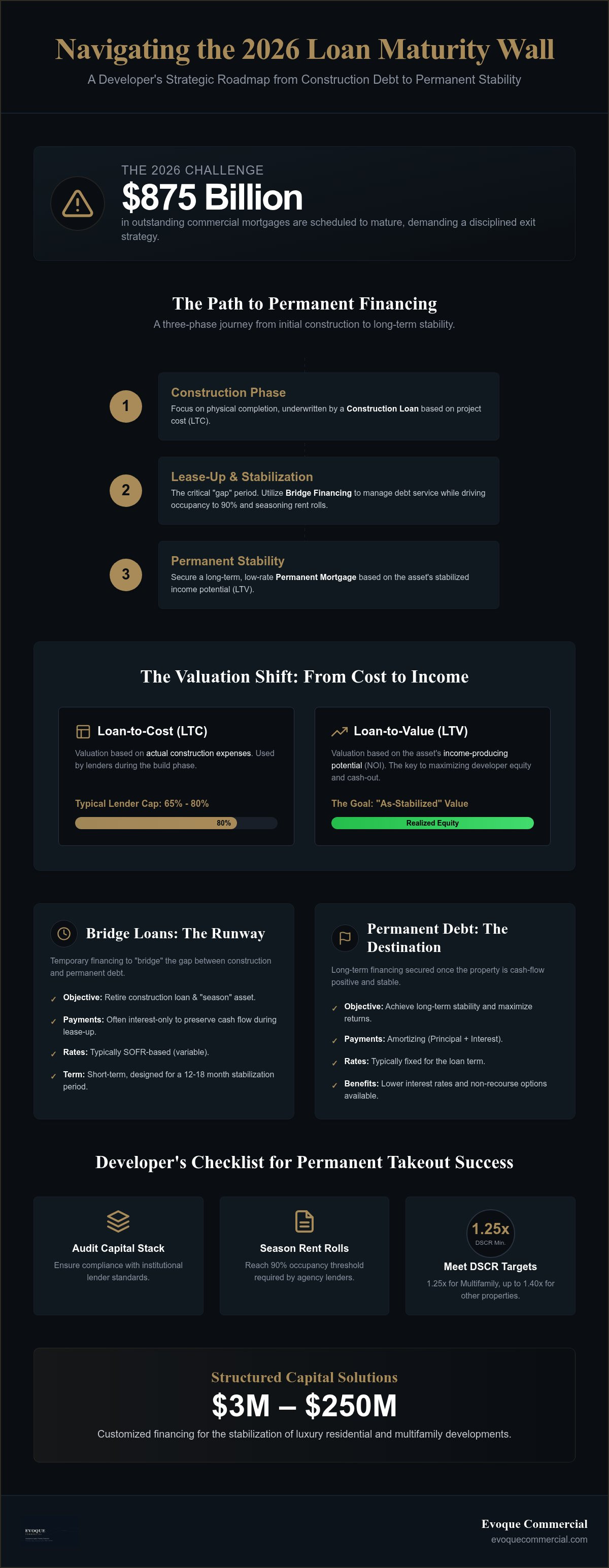
- Multifamily and BTR Lease-Up: Build-to-Rent (BTR) and multifamily projects often require 12 to 18 months to reach the 90% occupancy threshold required by agency lenders.
- Luxury Residential Marketing: High-end projects often require extended marketing windows post-completion to achieve premium pricing without the pressure of a maturing construction loan.
- Capital Stack Normalization: Projects that utilized high-cost "rescue" capital during construction delays use bridge debt to move into a more sustainable, institutional-grade structure.
By employing a bridge-to-permanent strategy, developers protect their equity. They avoid the trap of accepting poor permanent terms during a low-occupancy phase. It's a disciplined approach to project lifecycle management.
The Mechanics of the Takeout: Moving from LTC to LTV
The transition from construction to permanent debt isn't just a change in lenders. It's a fundamental shift in how your project is valued. During the build phase, lenders focus on Loan-to-Cost (LTC), typically capping exposure at 65% to 80% of actual hard and soft costs. Once you reach the Certificate of Occupancy (CO), the focus shifts to Loan-to-Value (LTV). This is where the developer's equity is truly realized, as the asset is now valued based on its income-producing potential rather than its construction budget. Understanding How Construction Loans Work is vital, but mastering the exit requires a focus on the "as-stabilized" appraisal.
Securing effective construction loan exit financing for developers often involves managing a "Gap" between these two valuation methods. If the takeout appraisal comes in lower than projected due to 2026 market volatility, developers must have structured interest reserves in place. These reserves support debt service during the stabilization runway, ensuring the project doesn't face a liquidity crunch before it hits its target Net Operating Income (NOI). It's a disciplined process that requires balancing short-term liquidity with long-term valuation goals.
Meeting Debt Service Coverage Ratio (DSCR) Thresholds
For 2026, permanent lenders have tightened their requirements. Most institutional players now demand a minimum DSCR of 1.25x for multifamily assets and up to 1.40x for other commercial properties. Bridge-to-stabilization loans provide the necessary time to drive aggressive leasing and optimize property management. By increasing the rent roll during this period, you improve the NOI, which directly supports a higher permanent loan size. If you're facing tight margins, consulting with a strategic capital partner can help align your lease-up strategy with these strict permanent metrics.
The Role of Appraisals in 2026 Permanent Financing
The "as-stabilized" value is the ultimate benchmark for permanent loan sizing. In 2026, cap rate fluctuations and a flight to quality have made appraisals more sensitive. Lenders are underwriting to a minimum debt yield of 7% to 10% depending on the asset class. It's essential to begin preparing for the permanent lender audit at least 6 to 12 months before your bridge loan expires. This proactive approach allows you to address any discrepancies in the rent roll or operating expenses before they impact your final takeout amount. Accurate data and a clean lease-up history are your best tools for defending your valuation.
Bridge Loans vs. Permanent Debt: A 2026 Comparison
Choosing between bridge capital and permanent debt requires a disciplined analysis of a project's current financial maturity. In 2026, the cost of capital reflects two distinct risk profiles. Bridge loans typically utilize floating rates, often priced at SOFR plus 350 to 600 basis points. These are interest-only facilities that prioritize short-term liquidity over long-term savings. Conversely, permanent mortgages offer amortizing rates that currently range from 5.77% to 9.04% for conventional commercial products. While the permanent rate is lower, it comes with the trade-off of rigid structures and long-term commitment.
Flexibility remains the primary driver for bridge debt. These loans usually carry modest exit fees, allowing developers to pivot quickly when market conditions improve. Permanent debt is far more restrictive, often requiring yield maintenance or defeasance that can make early exits prohibitively expensive. This flexibility extends to recourse profiles. While bridge options often require partial or full recourse from the sponsor, permanent debt is almost exclusively non-recourse. Securing construction loan exit financing for developers is therefore a balancing act between protecting personal balance sheets and maintaining the agility to refinance when the asset hits its peak value.
Timing Your Exit: When to Pivot to Permanent Debt
Identifying the optimal stabilization point is essential for maximizing cash-out potential. If you exit too early, a low occupancy rate might trigger a lower appraisal and a smaller loan size. We find that bridge to stabilization loans are the preferred tool for developers who need to buy time for rent growth. In 2026, managing interest rate hedges is also a critical factor. Developers must weigh the cost of rate caps against the potential benefit of a future permanent rate lock when the property is fully seasoned.
Lender Risk Appetite in the 2026 Market
Institutional lenders currently show a strong preference for seasoned, stabilized assets over ground-up construction risk. This flight to quality means that permanent financing is easier to secure once a project has a proven track record of collections. Understanding how bridge loans for multifamily projects work allows developers to mitigate lease-up uncertainty. By using bridge capital to bridge the gap between construction completion and full stabilization, you present a de-risked asset to permanent lenders. This strategy often results in more favorable LTV ratios and tighter spreads on the final takeout mortgage.
A Developer’s Checklist for Permanent Takeout Success
Preparing for a permanent takeout requires a methodical audit of both your physical asset and your corporate structure. The process begins with a deep review of your existing capital stack to identify restrictive covenants or "bad boy" carves that could complicate a new lien. Institutional lenders in 2026 are increasingly sensitive to these legal nuances. Addressing them early prevents friction during the closing process. Coordinating with your previous land acquisition and development loans providers ensures a clean title transition, which is a non-negotiable requirement for any institutional permanent closing.
Your rent roll and lease agreements must also mirror institutional standards. This means ensuring that all leases are fully executed, security deposits are properly escrowed, and tenant insurance certificates are on file. A flawless property inspection is equally critical. You should finalize the construction punch list months before the takeout application. Any lingering "work in progress" can trigger holdbacks or, in some cases, a full rejection from conservative permanent lenders who demand a 100% completed asset.
Financial Reporting and Documentation Requirements
Underwriting for permanent debt is data-intensive. You'll need to gather 12 months of trailing Net Operating Income (T-12) data to prove the property’s earning power. Lenders will also require an updated Personal Financial Statement (PFS) and a comprehensive Schedule of Real Estate (SRE) from the sponsor. This level of documentation is essential when sourcing the most efficient construction loan exit financing for developers, as it proves the project's stability to potential life company or CMBS lenders. Ensure all property taxes, insurance premiums, and any applicable HOA fees are current to avoid red flags during the due diligence phase.
Lease-Up Strategies to Hit DSCR Targets
For luxury residential and Build-to-Rent (BTR) projects, the lease-up strategy is the primary driver of your final valuation. You must balance the use of concessions with the need for high effective rents. Permanent lenders often "look through" headline rents to calculate the true net cash flow, so heavy front-end concessions can actually hurt your loan sizing. Focus on tenant quality and lease duration; a rent roll filled with short-term leases or low-credit tenants will lead to higher interest rate spreads. If your lease-up has stalled due to local market volatility, specialized bridge-to-permanent capital can provide the necessary runway to reposition the asset and hit your DSCR targets. If you're ready to audit your project's readiness for a takeout, contact Evoque Lending for a strategic capital stack review.
Structured Capital Solutions: How Evoque Lending Bridges the Gap
Evoque Lending operates at the intersection of institutional scale and boutique agility. We provide customised bridge solutions for residential projects ranging from $3M to $250M. Our team specializes in the critical transition period between construction completion and the final stabilized exit. By treating the capital stack as a fluid strategy rather than a series of disconnected loans, we ensure that your project maintains momentum when it matters most. It's about more than just funding; it's about disciplined execution.
Our expertise in construction loan exit financing for developers allows us to structure debt that anticipates the requirements of permanent lenders. We don't just provide capital; we provide a roadmap. This involves auditing the asset's performance in real-time to ensure it aligns with the 2026 underwriting standards discussed in previous chapters. Whether you're managing a Build-to-Rent portfolio or a luxury multifamily high-rise, our national reach ensures we can fund complex projects across the United States with institutional-grade precision.
Tailored Financing for Luxury and Multifamily Assets
We have deep expertise in bridge loans for residential development, specifically for high-end projects that require a sophisticated touch. We structure non-recourse bridge debt that protects sponsor equity while providing the stabilization runway needed for aggressive leasing. For projects that have stalled due to construction delays or cost overruns, we offer construction completion and stabilization capital. This specialized funding solves for liquidity gaps, allowing developers to reach the finish line and secure the most competitive permanent takeout through our deep institutional relationships.
Initiating Your Project Review with Evoque Lending
We've designed a streamlined application process specifically for middle-market developers. We value your time. As a strategic partner, we stay involved throughout the development lifecycle, providing insights that help you navigate market volatility. Our goal is to move your asset from a liability on a construction balance sheet to a stabilized, income-producing powerhouse. This methodical approach ensures that every milestone, from the Certificate of Occupancy to the final rate lock, is handled with care. If you're ready to secure your project’s future, request a project review with Evoque Lending today.
Finalizing Your 2026 Stabilization Strategy
Securing the right construction loan exit financing for developers is a matter of timing and structural discipline. You've seen how the shift from cost-based underwriting to income-based valuation determines your final loan sizing. By utilizing a bridge-to-stabilization runway, you avoid the trap of locking in permanent debt before your asset reaches its peak Net Operating Income. Success in the 2026 market depends on a clean rent roll and a proactive audit of your capital stack.
Evoque Lending provides the institutional capital access your project requires, with solutions up to $250 million. We specialize in residential and multifamily stabilization, offering national coverage combined with the responsiveness of a boutique partner. Our team understands the technical milestones needed to move your development from a finished shell to a seasoned, cash-flowing asset. It's time to protect your equity with a partner that values precision and strategic alignment.
Secure your project’s exit with Evoque’s Bridge-to-Permanent solutions.
We look forward to helping you master your project's financial transition and achieve the long-term stability your development deserves.
Frequently Asked Questions
What is bridge to permanent financing for developers?
Bridge to permanent financing acts as a strategic runway that replaces high-interest construction debt once a project is physically complete. It provides the necessary time to achieve stabilized occupancy and lease-up targets required by institutional permanent lenders. This capital structure is a vital form of construction loan exit financing for developers who need to season their rent roll before locking in long-term, non-recourse debt. It bridges the gap between cost-based underwriting and income-based valuation.
How long is the typical stabilization period for a bridge loan?
Most bridge-to-stabilization facilities carry terms ranging from 12 to 36 months. This duration is designed to align with the natural lease-up cycle of multifamily or build-to-rent projects. It allows developers to move past the initial low-occupancy phase and reach the 90% threshold typically required for permanent takeout. The specific term depends on the complexity of the asset and the projected timeline to achieve the target net operating income.
Can I get a non-recourse bridge loan for a multifamily project?
Non-recourse bridge options are available for well-capitalized sponsors and projects that have reached the Certificate of Occupancy milestone. While ground-up construction debt often requires full personal guarantees, the transition to stabilization allows for more flexible recourse profiles. Lenders evaluate the project's loan-to-value ratio and the sponsor’s track record. Securing non-recourse debt is often a primary objective for developers looking to limit their balance sheet exposure during the final project phases.
What is the standard DSCR required for a permanent takeout in 2026?
In the 2026 market, most institutional lenders require a minimum debt service coverage ratio (DSCR) of 1.25x for multifamily properties. For luxury residential or more specialized assets, this threshold often increases to 1.35x or 1.40x. These requirements ensure that the property generates sufficient cash flow to cover debt obligations comfortably. Developers must optimize property management and rent collections during the bridge phase to meet these strict permanent financing metrics.
What happens if my project is not stabilized when the bridge loan expires?
If an asset fails to stabilize before the bridge loan matures, developers may face several challenges. You might need to negotiate a loan extension, which typically involves additional fees or a partial paydown of the principal. Another option is a "bridge-on-bridge" refinance, though this can be more expensive if market conditions have shifted. Proactive communication with your capital partner is essential to avoid a liquidity crunch or an unfavorable forced sale.
Are bridge-to-permanent interest rates fixed or floating?
Bridge loans are almost exclusively floating-rate products, typically priced at a spread over the Secured Overnight Financing Rate (SOFR). This allows for maximum flexibility and lower prepayment penalties. Permanent mortgages, however, are usually fixed-rate instruments with terms ranging from 5 to 30 years. Transitioning to a fixed rate provides long-term predictability and protects the project’s cash flow from future interest rate volatility once the asset is fully seasoned.
Do I need a new appraisal when transitioning to permanent financing?
Permanent lenders always require a new "as-stabilized" appraisal to determine the final loan amount. Unlike construction-phase appraisals that focus on cost, this new valuation is based on the property’s actual net operating income and current market cap rates. This appraisal is a critical component of construction loan exit financing for developers. It documents the value created through successful lease-up and serves as the primary benchmark for the final loan-to-value calculation.
How much equity can I cash out during the permanent takeout phase?
The amount of equity you can cash out depends on the gap between your total project cost and the final "as-stabilized" value. Most permanent lenders will fund up to 75% or 80% of the property’s appraised value, provided the DSCR remains within their target range. If your project has significantly appreciated during the build and lease-up phases, the permanent takeout can retire the bridge debt and return a substantial portion of your initial capital.