
The most dangerous phase of a residential development isn't the ground-breaking; it's the silence that follows the certificate of occupancy. As construction wraps, the clock starts ticking on senior debt maturity, and the weight of high interest carry can quickly erode your hard-earned equity. If your lease-up velocity hasn't met the aggressive projections of two years ago, you're likely feeling the squeeze. Utilizing bridge to stabilization loans allows you to pivot from construction risk to operational performance without being forced into a premature sale or a sub-optimal permanent take-out.
You've navigated the complexities of vertical development and now deserve the time to prove your asset's true value. We understand that reaching 90% occupancy requires a strategic runway that traditional construction lenders simply don't provide. This guide will help you master the mechanics of bridge financing to lower your cost of capital and maximize your valuation before your final exit. From analyzing debt service coverage ratios to timing your 2026 market entry, we'll provide the roadmap you need to secure your project's lifecycle from completion to a successful stabilization.
What is a Bridge to Stabilization Loan?
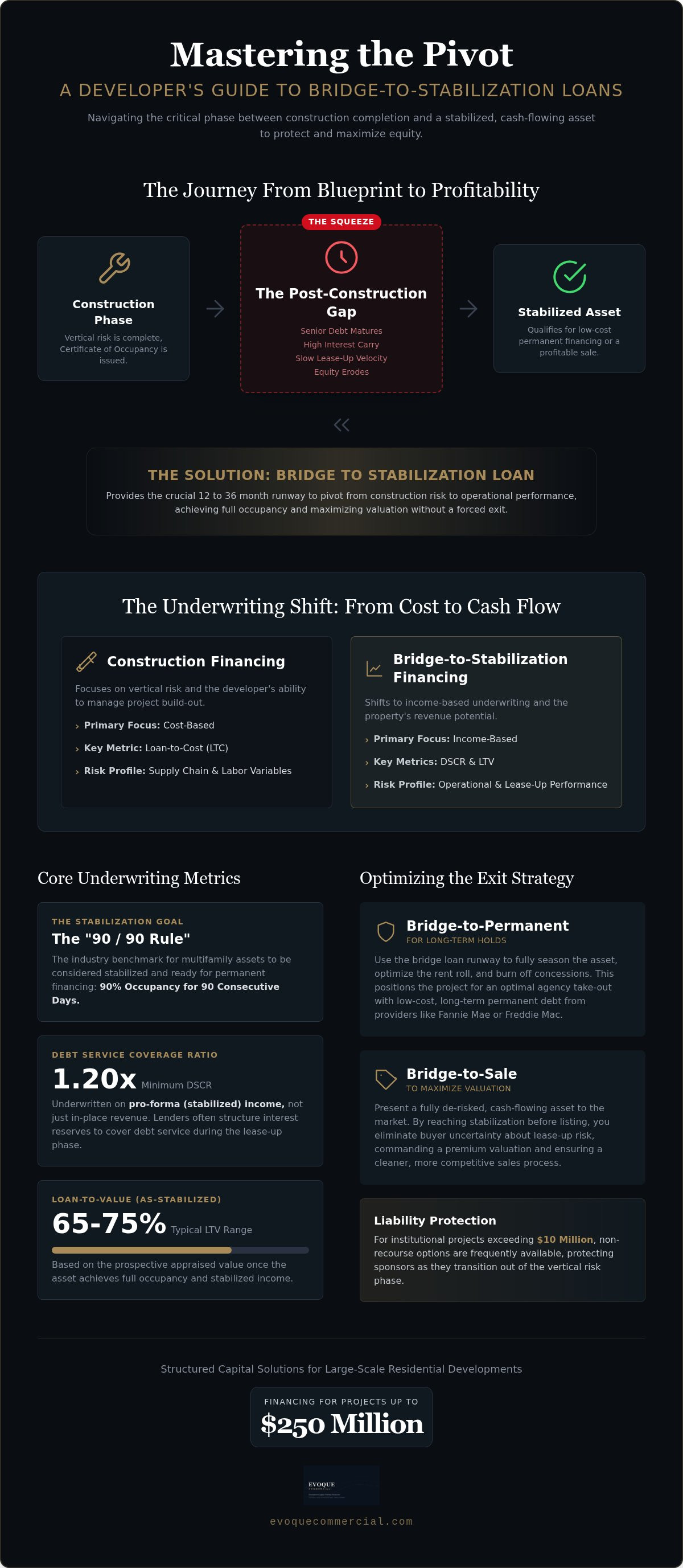
The transition from a construction site to a cash-flowing asset is rarely instantaneous. Developers often find themselves in a precarious position once the certificate of occupancy is issued. While the building is complete, the project has not yet reached the occupancy levels required to qualify for low-cost permanent financing. Bridge to stabilization loans serve as the strategic pivot point for developers who have completed vertical construction but need additional runway to reach the "90/90" threshold, which is typically 90% occupancy for 90 days.
This financing solves the "gap" created by traditional construction lenders. Most senior construction loans are structured to fund vertical risk, not operational seasoning. Once the structure is built, these lenders often face regulatory or internal pressure to exit the credit. They are frequently unwilling to extend terms during a slow lease-up, creating a maturity wall that threatens the developer's equity. To understand the broader context of What is a Bridge Loan?, one must look at how these instruments solve immediate liquidity needs by replacing construction debt with more flexible, non-recourse or limited-recourse capital.
Stabilization vs. Construction Financing
The primary shift when moving into bridge to stabilization loans is the underwriting methodology. Construction financing is inherently cost-based, focusing on the Loan-to-Cost (LTC) ratio and the developer's ability to manage supply chain and labor variables. Stabilization financing shifts the focus to income-based underwriting, specifically the Debt Service Coverage Ratio (DSCR). Lenders look past the "sticks and bricks" to evaluate the quality of the rent roll and the strength of the property management team. This transition moves the project from vertical risk to operational risk, which naturally commands a different capital structure. These loans typically offer 12 to 36 months of flexible runway, allowing the sponsor to optimize rents and burn off concessions before seeking a permanent take-out.
The 2026 Market Context
The 2026 residential market presents unique challenges for developers finishing large-scale projects. With SOFR rates stabilizing around 3.6% in mid-2026, the cost of carry has become more predictable, yet the influx of new supply in key markets has extended lease-up timelines beyond original projections. Prematurely locking into permanent debt in this environment can be a costly mistake, as it often limits the loan proceeds based on "in-place" rather than "stabilized" income. In the 2026 residential market, stabilization is defined as the achievement of a net operating income that supports a minimum 1.20x debt service coverage ratio based on prevailing institutional permanent rates.
Key Mechanics and Underwriting Criteria
Underwriting for bridge to stabilization loans represents a fundamental shift from monitoring supply chain costs to evaluating market-driven revenue potential. Lenders move away from the rigid cost-tracking of a construction loan and focus on the project's ability to generate net operating income. Understanding the Key Mechanics and Underwriting Criteria for these instruments is essential for developers managing institutional-grade assets. The goal is to de-risk the asset through seasoning, making it attractive for permanent capital or a clean sale.
Debt Service Coverage Ratio (DSCR) requirements are the primary filter in this phase. Unlike permanent loans that require "in-place" income, bridge lenders often underwrite based on "pro-forma" or "stabilized" income. To bridge the gap during the early months of lease-up, lenders typically structure interest reserves. These reserves ensure debt service is met while occupancy climbs toward the 90% mark. For institutional projects exceeding $10 million, non-recourse options are frequently available, providing sponsors with significant liability protection as they exit the vertical risk phase.
LTV and LTC Thresholds
Loan-to-Value (LTV) ranges for these projects typically fall between 65% and 75% of the "as-stabilized" appraised value. This differs from construction financing, where Loan-to-Cost (LTC) is the dominant metric. While verified capital expenditures for final finishes or tenant improvements still influence the LTC calculation, the lender's primary concern is the "prospective" value once the asset reaches full occupancy. If your project sits at a high cost-basis, securing bridge to stabilization loans based on a strong prospective value can help you recoup equity earlier than a traditional refinance would allow.
Interest Rates and Fee Structures
In the 2026 capital markets, interest rates for institutional bridge loans generally range from 8.0% to 11.5%. With the SOFR rate hovering around 3.6% as of mid-July 2026, many developers prefer floating-rate structures that allow for a lower cost of capital if rates continue to normalize. You should expect origination fees between 1 and 3 points. Be mindful of "minimum interest" clauses or prepayment penalties that can limit your flexibility if you achieve stabilization faster than anticipated. For projects between $3M and $250M, aligning with a partner who understands these structural nuances is vital. You can review our bridge loans for residential development strategic guide to see how we bridge these complex financial gaps.
Primary Use Cases for Residential Developers
Residential developers deploy bridge to stabilization loans to manage the high-stakes transition from a finished structure to a de-risked, cash-flowing asset. While the mechanics remain consistent, the strategic application varies significantly across different asset classes. For multifamily projects, the primary objective is often reaching the "90/90 rule." This requires maintaining 90% occupancy for 90 consecutive days to qualify for institutional agency take-outs. Without this stabilization period, a developer might be forced to accept a lower valuation based on inconsistent rental data, effectively leaving millions in equity on the table.
Inventory financing represents another critical use case for developers of for-sale products. When units are complete but awaiting closing dates, bridge debt can release trapped equity. This capital can then be redeployed into the next phase of development or used to pay down high-interest construction debt. By decoupling the construction exit from the final sales velocity, developers maintain control over their pricing strategy rather than being pressured by a maturing senior loan to offer deep discounts for quick liquidations.
Multifamily and BTR Stabilization
Build-to-Rent (BTR) communities present a unique challenge due to phased completions. In a 150-unit BTR project, the first 30 homes might be ready for occupancy while the final phase is still months away. Standard construction lenders are rarely equipped to manage this hybrid operational phase. Utilizing bridge to stabilization loans allows the developer to consolidate debt once the initial phases are rent-ready, providing the necessary runway to lease up the entire community. Managing this transition requires a deep understanding of multifamily construction loans and how they interface with subsequent bridge debt. Strategic use of concessions is often necessary during this phase; however, developers must ensure these don't negatively impact the net effective rent used in bridge underwriting.
Luxury Residential and Spec Development
Luxury spec homes and high-end subdivisions often face a "sales velocity gap" that standard rentals don't experience. A $10 million luxury residence has a much smaller pool of buyers, naturally leading to a longer time on the market. If a construction loan matures before a buyer is secured, the developer's profit margin is at immediate risk. Stabilization bridge debt provides a 12 to 24-month cushion, protecting the asset from fire-sale pressure and allowing the marketing team to hold firm on the asking price. Understanding how single family subdivision financing sets the stage for this phase is essential. It ensures that the transition from infrastructure development to final inventory sales is supported by a capital structure that respects the reality of luxury market absorption rates.
Optimizing the Exit: Bridge to Permanent vs. Bridge to Sale
The bridge phase is a tactical runway; the exit is the destination. Developers must determine early in the lease-up whether the asset is destined for a long-term hold or a strategic disposition. Using bridge to stabilization loans allows for the decoupling of construction completion from the final capital event, giving the sponsor the necessary time to maximize Net Operating Income (NOI). A higher NOI at the point of exit directly translates to a higher valuation, whether through a sale or a permanent refinance.
Refinance risk remains a primary concern in the 2026 market. While the SOFR rate has stabilized near 3.6%, developers often utilize interest rate caps or swaps within their bridge structure to hedge against potential volatility during the stabilization period. This protection ensures that the debt service remains manageable while the project works toward the seasoning requirements demanded by institutional take-out lenders. Properly structured bridge to stabilization loans provide the financial stability needed to wait for an optimal interest rate environment before locking in a 10-year or 30-year permanent facility.
Preparing for Permanent Debt
Transitioning to permanent financing requires audit-ready financials and a clear operational history. Most permanent lenders, including Fannie Mae and Freddie Mac, typically require 6 to 12 months of seasoned operational data before they'll commit to a long-term, low-interest facility. This phase is the culmination of a strategy that often begins with land acquisition and development loans, where the eventual permanent debt capacity is first modeled. Sponsors should ensure that every lease agreement and utility bill is documented with institutional-grade precision to avoid delays during the final underwriting process.
Recapitalization and Mezzanine Debt
For projects with complex capital stacks, stabilization bridge debt offers an opportunity to restructure. Developers frequently use these loans to buy out expensive mezzanine or preferred equity partners who were brought in to cover construction cost overruns. By replacing 15% to 20% cost capital with bridge debt in the 8% to 11.5% range, the developer significantly improves the project's overall cash flow. Debt yield, calculated as the net operating income divided by the total loan amount, serves as the primary metric for permanent lenders to assess their risk exposure regardless of cap rate fluctuations. If you're looking to optimize your project's capital structure, you can contact our structured capital team to discuss a tailored bridge-to-exit strategy.
The Evoque Advantage: Structured Capital for Large-Scale Projects
Evoque Lending operates at the intersection of institutional scale and boutique agility. We provide bridge to stabilization loans for residential projects ranging from $3 million to $250 million, filling the void left by rigid traditional banks. Our team understands that middle-market developers require more than just capital; they need a partner who recognizes the technical milestones of the development lifecycle. Whether you're managing a Build-to-Rent community or a luxury multifamily asset, our national reach ensures we can support your project regardless of geographic constraints.
Our approach is rooted in the belief that every project deserves a capital structure that reflects its specific operational reality. We don't offer one-size-fits-all debt. Instead, we analyze the nuances of your lease-up velocity and the local market supply to structure interest reserves and extension options that provide genuine breathing room. This strategic alignment is why developers trust us to manage their most complex transitions during the 2026 market cycle.
Tailored Financing Paths
We specialize in identifying the optimal pivot point for your asset. Our involvement often begins with the initial land loan, continues through construction, and culminates in a structured bridge-to-exit strategy. This continuity reduces friction and ensures that the underwriting for your bridge loans for residential development aligns perfectly with your eventual permanent financing goals. For example, we recently assisted a developer whose lease-up stalled due to unexpected market supply. By restructuring their debt into a bridge to stabilization loans facility, we provided the interest reserves needed to reach 92% occupancy, ultimately facilitating a clean agency take-out that protected their original equity.
Getting Started with Evoque Lending
Speed is the most critical factor when construction debt reaches maturity. Our project review process is designed for efficiency, providing direct access to decision-makers rather than layers of committees. To provide a stabilization bridge quote, we typically require a current rent roll, a trailing 3-month operating statement, and the original construction budget alongside the Certificate of Occupancy. Closing timelines are disciplined, often occurring within 30 to 45 days of a signed term sheet. We prioritize transparency, ensuring that every structural detail, from exit fees to extension options, is clearly defined from the outset to avoid surprises at the closing table.
Securing Your Project's Future Value
The silence after construction completion shouldn't be a source of stress; it's a window of opportunity for strategic valuation growth. By decoupling your exit from construction maturity, you gain the necessary runway to reach stabilized occupancy and secure institutional-grade permanent financing. We've explored how bridge to stabilization loans act as a critical pivot point. This structure allows you to optimize net operating income and manage lease-up velocity without the looming pressure of a maturing senior loan.
Evoque Lending provides national coverage for residential developers with financing solutions ranging from $3 million to $250 million. Our team combines deep institutional capital relationships with the personal responsiveness of a boutique firm. We're ready to review your project's technical and financial milestones to find the most efficient path to your final exit. Request a Project Review for Your Stabilization Bridge Needs to ensure your equity remains protected through the final stage of development. We look forward to supporting your transition to a stabilized, cash-flowing asset.
Frequently Asked Questions
How does a bridge-to-stabilization loan differ from a standard bridge loan?
A bridge-to-stabilization loan is specifically structured for projects where vertical construction is already complete and a Certificate of Occupancy has been issued. Standard bridge loans often fund heavy renovations or property repositioning, whereas stabilization financing focuses strictly on the lease-up or sales velocity phase. The primary objective is to provide a lower-cost runway to reach the seasoning requirements necessary for a permanent institutional take-out or a strategic asset disposition.
What is the typical interest rate for bridge-to-stabilization loans in 2026?
In the 2026 capital markets, institutional interest rates for bridge to stabilization loans generally range between 8.0% and 11.5%. These rates are typically floating and pegged to SOFR, which was approximately 3.6% as of mid-July 2026. Developers should also expect origination fees between 1 and 3 points. The final rate depends on the project's leverage, the sponsor's experience, and the specific residential asset class being stabilized.
Can I get a non-recourse bridge-to-stabilization loan?
Non-recourse options are frequently available for institutional-grade projects, particularly those with loan amounts exceeding $10 million. Lenders provide these terms based on the strength of the asset and the sponsor's track record in the residential sector. While smaller loans may still require some form of personal guarantee, larger structured capital solutions often limit recourse to standard "bad boy" carve-outs once the vertical construction risk has been successfully mitigated.
What occupancy level is required to qualify for stabilization financing?
A project typically only needs a Certificate of Occupancy to qualify for the initial bridge facility. There is no strict minimum occupancy requirement at closing, as the loan itself is designed to fund the period before stabilization. However, the ultimate goal of bridge to stabilization loans is to reach the "90/90 rule," which is 90% occupancy for 90 days. This milestone is required by most permanent lenders to prove the asset's income-producing capacity.
How long does it take to close a bridge-to-stabilization loan?
Closing typically occurs within 30 to 45 days of a signed term sheet. This disciplined timeline is essential for developers facing maturity pressure from senior construction lenders. Because we provide direct access to decision-makers, the underwriting process is streamlined to focus on the project's pro-forma income and market absorption rates. Rapid execution ensures that the transition from construction debt to bridge financing happens before any maturity defaults occur.
Are there prepayment penalties on bridge-to-stabilization loans?
Most stabilization bridge facilities do not have traditional long-term prepayment penalties, but they often include minimum interest clauses. This clause typically ensures the lender receives between 6 and 12 months of interest, even if you stabilize and refinance the project early. Developers should also account for exit fees, which are common in the capital stack. These structures provide the flexibility to exit the loan as soon as the asset is de-risked.
Can these loans be used for luxury spec home subdivisions?
Luxury residential developers frequently use this financing to bridge the "sales velocity gap" for high-end inventory. In this context, the loan functions as inventory financing, allowing the sponsor to release equity from completed homes while awaiting final closings. This strategy protects the developer's profit margin by removing the pressure to offer deep discounts for a quick liquidation. It provides a stable 12 to 24-month window to capture the highest market valuation.
What happens if my project doesn’t reach stabilization within the loan term?
If a project hasn't reached 90% occupancy by the end of the term, developers typically utilize built-in extension options. Most bridge loans include one or two 6-month extensions, provided the project meets specific performance hurdles. If extensions aren't available, the sponsor may need to consider a recapitalization or a strategic sale. Maintaining transparent communication with your lending partner throughout the lease-up phase is the best way to navigate unexpected shifts in market absorption.