
Every day a permitted site sits idle, high carry costs and interest rate volatility erode the project's feasibility. In an environment where construction input prices have risen 7.4% over the last year, waiting for a traditional lender to catch up with your timeline is a risk you can't afford. Securing the right shovel ready project financing requires more than just a permit set. It demands a strategic alignment between your existing land debt and the capital needed for immediate vertical construction.
You've navigated the complexities of entitlements and design, so you know that the transition to ground-up construction is often where the most significant delays occur. We understand that your priority is a seamless execution that protects your equity. This guide will help you master the specific criteria required to compress your development timelines and secure optimal capital for your next multifamily or luxury residential project.
We'll explore how to maximize your Loan-to-Cost (LTC) ratios, navigate the 2026 regulatory shifts, and coordinate rapid loan closings. From structured capital solutions to bridge-to-stabilization strategies, you'll learn how to move from acquisition to vertical construction with institutional precision and boutique responsiveness.
What is Shovel-Ready Project Financing in Residential Development?
In the disciplined world of institutional lending, shovel ready project financing represents capital structured specifically for projects that have cleared every entitlement hurdle. It's not merely a loan for a proposed idea; it's the financial engine for a project that could break ground tomorrow. While many developers rely on acquisition and land financing to secure a site, shovel-ready debt is the pivot point where speculative risk transforms into execution reality. Understanding What 'Shovel-Ready' Means in a private residential context is vital for protecting your equity. It signifies that the gap between land carry and vertical construction has been bridged, allowing for immediate mobilization.
Lenders define the "Ready-to-Build" threshold by the absence of municipal or environmental variables. If a project still requires a zoning variance or a final site plan approval, it isn't shovel-ready. Developers prioritize this specific financing because it minimizes negative carry, the period where you're paying interest on land debt without the ability to generate future value through construction. By securing ground-up construction financing at the exact moment permits are issued, you ensure that every dollar of interest contributes directly to the project's physical completion.
The Private vs. Public Sector Definition
The term shovel-ready is often used in public policy to describe infrastructure projects aimed at economic stimulus, but the private residential sector demands higher precision. For single-family subdivision financing, this status often hinges on "Final Map" approval. This legal milestone confirms that the land is subdivided and ready for individual lot development. In multifamily construction, being "Bidding Ready" is equally important. This means your architectural plans are finalized and you've secured a Guaranteed Maximum Price (GMP) contract. When a lender sees that your costs are locked and your permits are pulled, their confidence increases, often leading to more favorable spreads over SOFR.
The Financing Life Cycle: From Land to Vertical
The transition from acquisition to vertical construction is rarely a straight line. It's a complex sequence that requires a strategic capital stack.
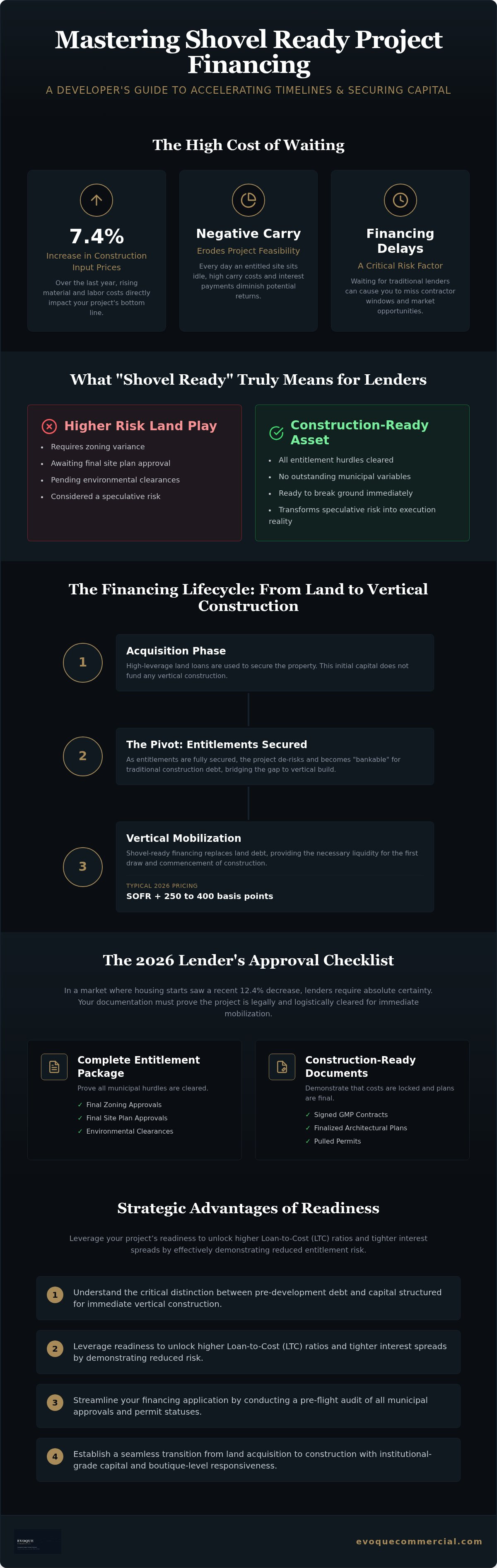
- Acquisition Phase: High-leverage land loans secure the property but don't fund construction.
- The Pivot: As entitlements are secured, the project becomes "bankable" for traditional construction debt.
- Vertical Mobilization: Shovel-ready financing replaces land debt and provides the liquidity for the first draw.
Current 2026 market data shows that regional and national banks are pricing these loans at SOFR plus 250 to 400 basis points for well-structured deals. Using bridge capital during this transition can maintain project momentum. It ensures you don't lose your contractor's window while waiting for the primary construction loan to close. This methodical approach protects your timeline and your bottom line.
The 2026 Criteria for Shovel-Ready Financing Approval
In the current capital environment, securing shovel ready project financing requires more than a basic permit. Lenders in 2026 are scrutinizing every detail to mitigate risk in a market where housing starts faced a 12.4% decrease in July. A complete entitlement package must include final zoning, site plan approvals, and environmental clearances. These documents prove that the municipal hurdles are behind you and the project is legally cleared for mobilization. Without this certainty, capital providers will treat the deal as a higher-risk land play rather than a construction-ready asset.
Beyond entitlements, construction-ready documentation is the primary catalyst for funding. Lenders expect signed Guaranteed Maximum Price (GMP) contracts and finalized architectural plans. This level of preparation ensures that the project won't stall due to cost overruns or design revisions. Some analysts discuss the Effectiveness of Shovel-Ready Projects in broader economic terms, but for a private developer, readiness is strictly about financial viability. If your costs aren't locked, your loan proceeds will likely be insufficient to cover the inevitable fluctuations in construction input prices.
Verified equity remains a cornerstone of the approval process. You must document your "skin in the game" through land cost basis or liquid cash. While some debt funds offer up to 80% LTC, regional banks often cap leverage at 65% to 75% in the current climate. Additionally, utility "Will-Serve" letters and verified infrastructure connectivity must be in hand. If a project lacks confirmed water, sewer, or electrical capacity, it isn't truly ready to break ground, regardless of its permit status.
Technical Documentation Requirements
Lenders require a granular look at how capital will be deployed. A detailed vertical construction financing draw schedule is essential to align funding with physical progress. You'll also need a suite of third-party reports, including a Geotechnical study, an environmental Phase I, and a current appraisal. Insurance is another critical hurdle; you must have course of construction and general liability policies ready for binding. These technical layers are what separate a speculative shovel ready project financing request from a professional, fundable development.
Developer Experience and Track Record
Lenders underwrite the sponsor as much as the asset itself. If you have a history of successful ground-up builds, your approval odds increase significantly. They want to see that you've managed the transition from entitlement to vertical execution before. A proven track record helps a lender feel confident that you can navigate the complexities of a large-scale residential build. If you're looking for a partner who understands these nuances, structuring your capital stack with an experienced firm can provide the responsiveness your project demands.
Speed to Market: How Readiness Impacts Loan Terms
Achieving full entitlement status does more than just permit physical activity; it fundamentally recalibrates your project's financial profile. When applying for shovel ready project financing, you aren't just presenting a development; you're offering a de-risked investment vehicle. Lenders reward this certainty with more competitive capital. In a market where construction loans can reach as high as 15%, being "ready to build" is your strongest leverage point to secure lower rates and more flexible structures.
The most tangible benefit of readiness is the reduction in risk premiums. Lenders in 2026 typically offer tighter interest spreads for projects that have eliminated permit uncertainty. While a speculative land play carries a significant premium, a shovel-ready multifamily project can often secure rates near the lower end of the current 5.53% to 8.90% range for conventional mortgages, or SOFR plus 250 to 400 basis points for construction debt. Leverage also shifts in your favor. While regional banks may stay conservative at 65% LTC, debt funds and private credit providers are more likely to stretch to 80% or even 85% LTC for projects that break ground immediately. This increased leverage is often paired with the option for non-recourse construction loans for developers, allowing you to protect your personal balance sheet while executing a large-scale build.
Readiness also compresses closing timelines. Because the technical due diligence is largely complete, funding can move from term sheet to closing in as little as three to four weeks. This speed is critical when coordinating the payoff of existing land debt with the start of vertical mobilization.
Risk Mitigation and the Capital Stack
Eliminating "Permit Risk" changes a lender's internal rating from speculative to execution-based. This shift unlocks the full capital stack, making mezzanine debt and preferred equity more available and affordable. For entitled projects, senior debt pricing is consistently lower because the primary variable-the right to build-is already solved. This clarity allows for a more efficient layering of debt, ensuring that the weighted average cost of capital remains as low as possible throughout the construction lifecycle.
IRR Maximization Through Efficiency
Calculating the cost of delay is vital in a high-cost environment. With construction input prices up 7.4% as of July 2026, every month spent in pre-development can erode millions in potential profit. Rapid funding supports a "Build-to-Exit" strategy, allowing you to capitalize on current market timing rather than chasing a moving target. Shovel-ready status also makes your project more attractive to preferred equity partners who seek immediate deployment of capital. By moving quickly, you maximize your Internal Rate of Return (IRR) and minimize the negative impact of carry costs on your equity position.
Strategic Steps to Secure Shovel-Ready Debt
Securing shovel ready project financing is a methodical process that begins long before the first draw request. You must conduct a pre-flight audit of all municipal approvals to ensure no expiration dates are looming on your site plans or environmental clearances. This audit should be paired with a finalization of your capital stack. Identifying gaps for senior or mezzanine debt early allows you to structure the deal for maximum efficiency. If you're transitioning from the entitlement phase, engaging a boutique firm for tailored land acquisition and development loans can provide the bridge needed to reach vertical mobilization without losing project momentum.
Your pro forma must reflect current 2026 economic realities. With the NAHB Housing Market Index at 35 in August, lenders are looking for conservative absorption rates and healthy interest reserves to offset market cooling. A comprehensive project narrative should accompany your financial models. This narrative isn't just a summary; it's a strategic document that justifies your cost assumptions and exit strategy in a localized environment. It must demonstrate that you've accounted for the volatility in construction input prices, ensuring the project remains viable even if costs vary during the build cycle.
Polishing the Project Narrative
Your project narrative serves as the bridge between technical data and lender confidence. It must clearly sell the market demand for your specific residential asset class, whether it's luxury multifamily or single-family build-to-rent. Highlight the "barrier to entry" in your market, such as limited land availability or complex local zoning requirements that you've already cleared. A transparent "Sources and Uses" statement is non-negotiable. It shows the lender exactly where their capital is going and how your equity is being utilized. This level of transparency reduces friction during the initial review phase and helps establish you as a disciplined sponsor.
Navigating the Underwriting Process
Underwriting for shovel-ready debt is intensive. Expect a detailed site visit where the lender will verify infrastructure connectivity and site conditions. Managing the appraisal process is equally critical; the appraiser must value the project based on its "as-complete" status rather than just land value. This is the stage where you finalize the single family subdivision financing agreement. If the project involves multiple phases, the documentation must reflect how future lots are released as vertical construction progresses. To begin this process with a partner that values your timeline, structure your capital stack with Evoque Lending for a strategic project review.
Partnering with Evoque Lending for Immediate Execution
Executing a large-scale residential development requires a capital partner that matches your technical discipline and sense of urgency. Evoque Lending provides institutional-grade capital relationships combined with the middle-market responsiveness necessary for shovel ready project financing. We focus on residential developments ranging from $3M to $250M, offering a national service area that covers luxury residential, multifamily, and single-family subdivisions. Our role is to serve as a strategic partner, ensuring that your transition from land entitlement to vertical construction is seamless and fiscally optimized.
We recognize that developers in 2026 face unique pressures, from interest rate volatility to shifting housing starts. Navigating these challenges requires a lender that understands the full project lifecycle. We provide comprehensive solutions that span from acquisition and land financing through construction completion and the eventual bridge to stabilization or exit. By focusing on the specific needs of middle-market developers, we deliver the precision of a major institution without the bureaucratic delays that often stall vertical starts.
The Evoque Advantage: Structured Capital Solutions
Our approach to structured capital solutions is built on a deep understanding of the developer's timeline. We bridge the gap for projects requiring rapid mobilization, ensuring that your equity is protected while you scale. When underwriting high-end residential and multifamily builds, we look beyond the permits to the underlying market fundamentals and sponsor experience. This methodical perspective allows us to offer ground-up construction financing that's tailored to the specific risk profile of your project. Whether you're managing a complex multifamily structure or a luxury residential build, we provide the liquidity needed to maintain momentum from the first draw to the final certificate of occupancy.
Getting Started: Your Project Review
The path to securing shovel ready project financing with Evoque Lending is defined by transparency and efficiency. We've streamlined our intake process to allow for rapid project evaluations, focusing on the critical milestones that determine fundability.
- Initial Intake: Submit your comprehensive project narrative, pro forma, and permit status for a preliminary review.
- Strategic Evaluation: Our team conducts a deep dive into your capital stack, identifying the most efficient debt or equity layers for your specific asset class.
- Execution: We move from the term sheet to the closing table with a focus on your ground-breaking schedule, ensuring capital is available exactly when mobilization begins.
Our goal is to move your project from a permitted site to a vertical asset with minimal friction. By submitting your project for a strategic review, you gain access to a team that values your time and respects the volume of work required to reach shovel-ready status.
Accelerating Your Vertical Construction Timeline
Maximizing the value of your permitted site requires more than just breaking ground. It requires a capital structure that rewards your pre-development discipline. By securing shovel ready project financing, you transform regulatory readiness into a strategic financial advantage. This readiness allows for tighter interest spreads and the higher leverage needed to scale your portfolio. You've already navigated the complexities of entitlements and design; the focus now shifts to execution and protecting your equity throughout the build cycle.
Evoque Lending provides the institutional reach and boutique responsiveness needed to bridge the gap from acquisition to exit. We offer structured capital solutions for residential developments up to $250M across the United States. Our team understands that for middle-market developers, time is the most expensive commodity in a shifting market. Request a Project Review for Shovel-Ready Financing to ensure your project moves from the term sheet to mobilization with professional precision. Your development is ready for its next phase, and we're committed to ensuring your transition to vertical construction is seamless and successful.
Frequently Asked Questions
What qualifies a residential project as "shovel-ready" for financing?
A residential project is qualified as shovel-ready when it possesses all final entitlements, municipal approvals, and building permits required for immediate mobilization. From a lender’s perspective, this means zoning is locked and environmental clearances are secured. You must also have a signed Guaranteed Maximum Price (GMP) contract and finalized architectural plans. This level of preparation eliminates primary speculative risks, allowing the capital provider to focus strictly on construction execution and market absorption.
How does shovel-ready status affect the interest rate on a construction loan?
Shovel-ready status significantly lowers interest rates by reducing the risk premium associated with entitlement uncertainty. In 2026, lenders often price shovel ready project financing at the lower end of the market spread, frequently ranging from SOFR plus 250 to 400 basis points. By removing the "right-to-build" variable, you present a de-risked asset that qualifies for institutional-grade pricing, which is consistently more favorable than the rates assigned to speculative pre-development or land acquisition loans.
Can I get non-recourse financing for a shovel-ready project?
Yes, non-recourse construction financing is frequently available for shovel-ready projects through debt funds and private credit institutions. Since the entitlement risk has been cleared, lenders are more willing to rely on the asset’s value and the sponsor's track record rather than personal guarantees. This structure allows developers to protect their personal balance sheets while executing large-scale builds. Eligibility typically depends on the sponsor's experience and the project’s Loan-to-Cost (LTC) ratio.
What is the typical loan-to-cost (LTC) for shovel-ready residential developments?
Shovel-ready residential developments typically secure Loan-to-Cost (LTC) ratios between 65% and 85%. Regional and national banks generally cap their leverage at 65% to 75% due to current regulatory caution. However, debt funds and private credit providers often stretch to 80% or 85% LTC for projects that can break ground immediately. This higher leverage is a direct result of the project’s readiness, which provides lenders with the confidence that the capital will be deployed into value-adding vertical construction.
How long does it take to close on shovel-ready project financing?
Closing on shovel ready project financing typically takes between three and four weeks from the issuance of a term sheet. This compressed timeline is possible because much of the technical due diligence, such as environmental reports and permit verification, is already complete. Speed is a critical advantage for developers who need to coordinate the payoff of land debt with the mobilization of their general contractor, ensuring that carry costs don't erode project feasibility during the transition.
Do I need to have a general contractor signed before applying for financing?
Most lenders require a signed Guaranteed Maximum Price (GMP) contract before they'll issue a final loan commitment. Having a general contractor under contract provides the cost certainty required for accurate underwriting. Lenders need to know that the budget is locked and that the contractor has the capacity to execute the build. While you can begin the application process during negotiations, the finalized contract is a mandatory milestone for the closing of construction-ready debt.
What happens if my project is entitled but lacks final building permits?
If a project is entitled but lacks final building permits, it isn't technically shovel-ready and may face different loan terms. Lenders might issue a term sheet with a "permit-at-closing" requirement or offer a bridge loan to cover the final pre-development phase. This gap can be managed by a strategic partner who understands the transition, but the highest leverage and tightest interest spreads are reserved for projects that have every municipal permit in hand.
How does Evoque Lending handle bridge-to-stabilization for completed projects?
Evoque Lending provides bridge-to-stabilization loans designed to replace construction debt once a project receives its certificate of occupancy. This capital provides a necessary runway for multifamily or single-family rental projects to reach stabilized occupancy levels. Our structured solutions ensure a seamless transition from the construction phase to long-term permanent financing. We focus on middle-market needs, offering the responsiveness required to manage the project’s liquidity as it moves from completion to a stabilized exit.