

What if the primary obstacle to your project's success isn't the cost of capital, but the speed at which you can access it? In a market where institutional banks often take months to underwrite a deal, the ability to move decisively can mean the difference between securing a prime site and losing it to a more agile competitor. Many developers face the reality of stalled projects due to financing gaps or high entitlement risks that prevent traditional construction loan approval. It's a common challenge that requires a more sophisticated, strategic approach to the capital stack.
This guide will help you master the mechanics of bridge loans for residential development to accelerate your project timelines and optimize your funding structure. You'll learn how to leverage these flexible instruments to gain quick site control, manage development delays, and create a clear path toward permanent financing. We'll explore the strategic application of bridge capital from acquisition through to construction completion, ensuring your project remains on track regardless of market volatility.
Defining Bridge Loans for Residential Development: Beyond the Consumer Gap
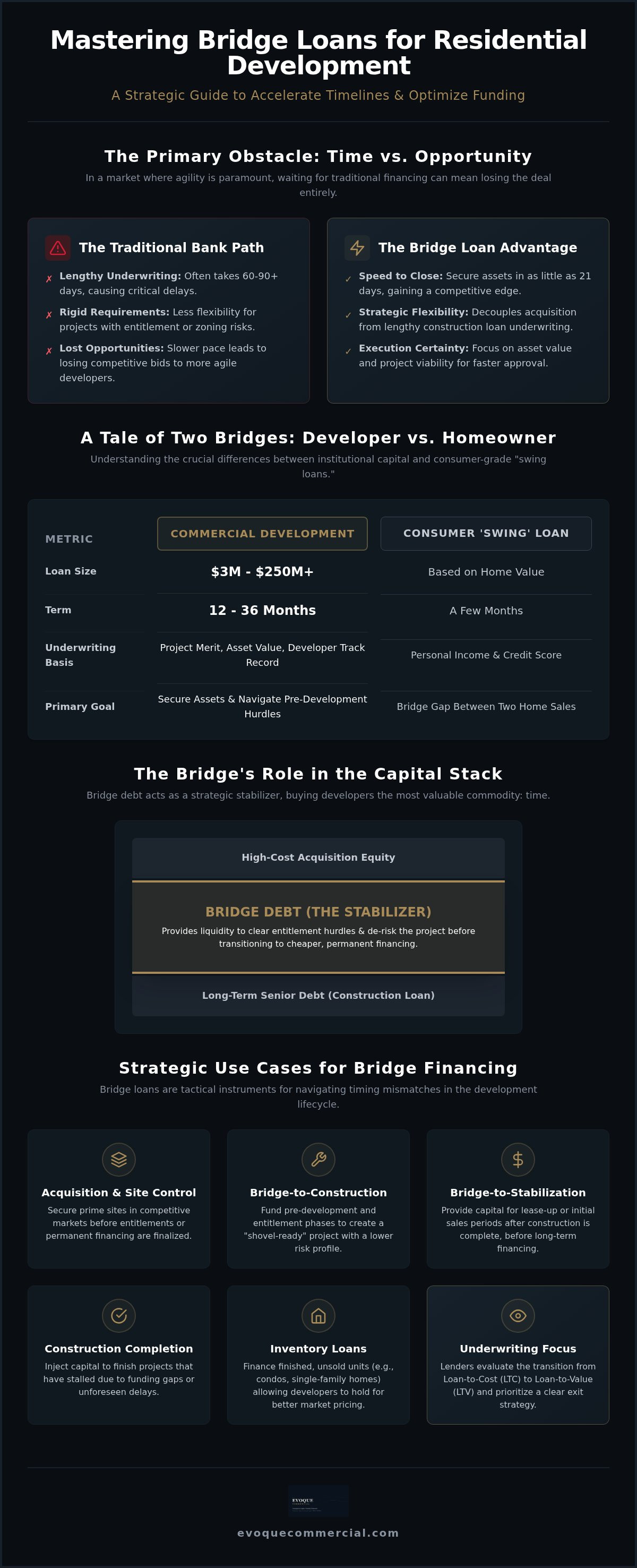
Institutional real estate development requires a specific type of financial agility. While many general definitions suggest that What is a bridge loan? refers to a simple gap-filler for homeowners, the reality for professional developers is far more complex. In the context of large-scale projects, bridge loans for residential development serve as a sophisticated tool designed to manage the transition between acquisition and stabilization. These aren't small-scale personal loans. They are structured financial products typically ranging from $3 million to $250 million, providing the necessary liquidity to handle everything from ground-up construction to completion financing.
The standard duration for these loans reflects the timeline of modern development. While a consumer might only need a few months, a developer often requires 12 to 36 months. This window provides enough time to navigate local bureaucracy, finalize entitlements, or wait for market conditions to improve before securing a permanent exit. It's about creating a buffer that protects the project's viability during its most vulnerable phases.
Commercial vs. Consumer Bridge Loans
Professional developers often find search results frustrating because they're saturated with consumer-grade "swing loans." There's a fundamental difference. Consumer products rely on personal income and credit scores to bridge the gap between two homes. Institutional bridge capital is underwritten based on the project’s merit, the developer’s track record, and the underlying asset's value. Speed is the primary driver here. Developers don't choose bridge debt because it's the cheapest capital available. They choose it because it's the fastest. When an acquisition opportunity arises, waiting ninety days for a traditional bank to finish underwriting isn't an option. Bridge lenders prioritize flexibility and execution certainty over the lowest possible interest rate.
The Role of Bridge Debt in the Capital Stack
Bridge financing occupies a critical space in the capital stack, sitting between high-cost acquisition equity and long-term senior debt. It acts as a stabilizer. For example, a developer might use bridge capital to acquire a site while still working through zoning changes or environmental permits. This allows them to control the land without committing to a more restrictive construction loan too early. This type of funding is often the precursor to more permanent land acquisition and development loans. It buys the developer the most valuable commodity in real estate: time. By using bridge debt to clear entitlement hurdles, the developer can eventually transition to traditional financing with a significantly lower risk profile and better terms.
Strategic Use Cases for Residential Bridge Financing
Bridge financing isn't merely a fallback for developers; it's a tactical instrument used to navigate timing mismatches in the capital stack. The strategic use of bridge financing allows a developer to move with a level of speed that traditional lenders simply can't match. By utilizing bridge loans for residential development, a sponsor can decouple the acquisition of a high-value asset from the lengthy underwriting process of a permanent construction loan. This flexibility is vital when market opportunities outpace the administrative speed of institutional banks.
Acquisition and Pre-Development Speed
Speed defines the acquisition phase. In competitive markets, the ability to close in twenty-one days versus ninety days is often the deciding factor in a winning bid. While traditional banks focus on exhaustive checklists, bridge lenders prioritize the asset's intrinsic value and the developer's execution plan. This allows for the acquisition of "shovel-ready" projects where the seller demands a quick exit. Bridge capital functions as a temporary financial anchor that secures a development site during the entitlement phase, preventing the loss of the asset while the developer works to mitigate pre-construction risks. This phase is often the most volatile, and having a lender who understands the nuances of zoning and permitting changes is a significant competitive advantage. Developers seeking this level of agility often partner with Evoque Commercial for structured solutions that respect the project's velocity.
Construction Completion and Stalled Projects
Project delays are a reality of residential development, but a stalled site doesn't have to mean a failed investment. Bridge financing often serves as rescue capital for projects facing unexpected cost overruns or the exit of a previous lender. When a project is 70% or 80% complete, traditional banks are often hesitant to step in because they didn't originate the initial loan. Completion financing fills this void. It provides the final injection of capital needed to reach the Certificate of Occupancy (CO). By securing bridge debt to finish the build, developers can avoid predatory equity terms or forced liquidations. This capital allows the sponsor to maintain control, complete the units, and transition to a stabilization phase where they can refinance into a lower-interest permanent loan or sell the inventory at peak market value.
Beyond completion, bridge debt is an effective tool for releasing equity from existing assets. Developers often find their capital trapped in a nearly finished project while a new opportunity requires an immediate deposit. A bridge-to-stabilization loan can pay off the construction debt and return a portion of the developer's equity, providing the liquidity needed for the next project start without waiting for the final unit sale.
Comparing Bridge Structures: Acquisition, Completion, and Stabilization
The architecture of a bridge loan isn't static. It evolves based on the specific risk profile of the project's current phase. Successful developers understand that bridge loans for residential development are categorized by their specific "exit" strategy. Whether you're moving from raw land to horizontal work or from construction to lease-up, the loan structure must align with your next capital event. Most development bridge structures include an interest reserve account. Since these projects typically don't produce cash flow during the hold period, the lender sets aside a portion of the loan proceeds to cover monthly interest payments. This protects the lender's yield while ensuring the developer isn't burdened by debt service before the asset is productive.
Recourse is another critical structural variable. For projects in the $3 million to $15 million range, lenders often require a personal guarantee to mitigate early-stage risk. However, as projects scale toward the $250 million mark, non-recourse options become more common for experienced sponsors with significant liquidity. Large-scale residential developments often utilize these non-recourse structures to limit the developer's personal exposure, relying instead on the asset’s projected value and the sponsor's track record for security.
Homebuilders also utilize a specialized structure known as an inventory loan. This allows a developer to pay off their high-interest construction loan once units are finished but not yet sold. By carrying completed inventory with a lower-cost bridge loan, builders can avoid fire-sales and maintain their pricing power in a fluctuating market.
Bridge to Construction Loans
Horizontal development is often the most difficult phase to finance through traditional channels. A bridge-to-construction loan provides the capital needed for land purchase and initial infrastructure work, such as roads and utilities. The goal is to reach "shovel-ready" status. Once entitlements are secured and the site is prepped, the developer can transition into ground-up construction financing. Lenders look for a clear path to this transition, requiring proof that the project will meet the stricter underwriting criteria of a senior construction lender within 12 to 18 months.
Bridge to Stabilization Financing
This structure, often called a "mini-perm" loan, is used after the heavy lifting of construction is finished. Developers use bridge-to-stabilization debt to pay off their construction lender while they wait for the project to reach its target occupancy or for interest rates to soften. It's a strategic move to optimize the exit. By waiting for lease-up, the developer can achieve a significantly higher valuation before applying for permanent agency financing. While the cost of bridge debt is higher than a permanent mortgage, the benefit of a stabilized valuation often outweighs the temporary interest expense. It provides a calm environment to finalize the project's business plan without the pressure of a looming construction loan maturity date.
Underwriting the Development Bridge: What Lenders Evaluate
Underwriting bridge loans for residential development requires a shift from personal credit metrics to project-specific fundamentals. Unlike consumer lenders who focus on debt-to-income ratios and personal credit scores, institutional bridge lenders prioritize the asset’s performance and the sponsor’s execution capability. The evaluation centers on two primary metrics: Loan-to-Cost (LTC) and Loan-to-Value (LTV). LTC measures the loan amount against the total project budget, including hard and soft costs. LTV assesses the loan relative to the current or future appraised value. For ground-up residential projects, LTC is often the more restrictive cap; it ensures the developer maintains sufficient skin in the game throughout the project lifecycle.
Lenders also scrutinize the developer's track record with surgical precision. They look for specific experience in the relevant residential asset class, whether that is a luxury single-family subdivision or a high-density multifamily build. A sponsor who has successfully navigated similar market cycles is viewed as a lower risk. Market feasibility studies determine if the local residential demand supports the projected absorption rates. If the local market is oversaturated or showing signs of a slowdown, even a perfectly designed project may struggle to secure bridge approval. The lender must be certain that the finished product will find its place in the market.
The Critical Nature of the Exit Plan
The exit strategy is the cornerstone of bridge underwriting. Lenders evaluate the viability of the take-out event, which is typically a permanent construction loan, a sale of the completed units, or a long-term refinancing. Mitigating interest rate risk is a key part of this analysis. Lenders often require interest rate caps or larger interest reserves to protect the project against fluctuating capital markets during the bridge term. A bridge loan without a clear exit plan is a risk to the developer’s equity. Without a defined path to repayment, the sponsor risks a forced liquidation or a predatory refinancing situation when the short-term bridge matures.
Entitlement and Permitting Risk
The status of entitlements significantly impacts the leverage and terms of a bridge loan. Unentitled land carries the highest risk, often resulting in lower loan-to-value ratios and higher interest spreads. Conversely, a fully permitted site that is ready for horizontal work commands more competitive pricing. Lenders often use milestone-based funding, where capital is released only after specific benchmarks, such as zoning approval or environmental clearance, are met. This process relies heavily on third-party reports. Appraisals, Phase I environmental assessments, and geotechnical surveys provide the objective data needed to validate the project's physical and financial feasibility.
To ensure your project meets these rigorous institutional standards, you can partner with Evoque Commercial for a detailed pre-underwriting assessment that aligns your capital stack with market realities.
Evoque Commercial: Boutique Bridge Solutions for National Growth
Success in large-scale residential projects depends on a lender who can balance institutional-grade funding with the agility of a boutique firm. Evoque Commercial occupies this specific middle-market space, providing capital solutions ranging from $3 million up to $250 million. Our approach to bridge loans for residential development focuses on the strategic needs of the project lifecycle, ensuring that capital is available exactly when the project reaches its most critical milestones. We don't just provide debt; we act as a strategic partner that understands the technical complexities of ground-up construction and completion financing.
Why Developers Choose Evoque Over Traditional Banks
Traditional banks often struggle with the non-linear nature of development. Their rigid underwriting boxes can disqualify projects that are otherwise fundamentally sound. Evoque provides a distinct advantage through speed of execution. When a developer needs to close a site acquisition in weeks rather than months, our streamlined process eliminates the bureaucratic layers that typically cause delays. We offer flexibility in structuring that goes beyond "cookie-cutter" products. This allows us to accommodate unique project requirements, such as interest reserves or complex capital stacks. Developers benefit from direct access to senior decision-makers, ensuring that complex project reviews are handled with the professional attention they deserve.
Getting Started with Your Project Review
The path to a structured capital solution begins with a methodical review of the project's fundamentals. For a preliminary assessment, we typically require a current executive summary, a detailed project budget, and proof of the sponsor's track record. We specialize in creating tailored financing paths for multifamily construction loans and luxury residential subdivisions. Our team evaluates the project's viability based on the exit strategies and market feasibility discussed earlier in this guide. We prioritize transparency throughout the process, providing clear feedback on how to optimize your capital stack for maximum efficiency. If you're ready to accelerate your project timeline with a reliable capital partner, you can Request a project review with Evoque Lending today. We look forward to analyzing your project's potential and executing a solution that supports your long-term growth.
Accelerating Residential Development with Strategic Capital
Mastering the use of bridge loans for residential development transforms financing from a hurdle into a strategic advantage. These flexible instruments provide the speed needed for immediate site control and the stability required to finalize inventory sales or rescue stalled projects. By aligning your loan structure with your specific project phase and maintaining a transparent exit strategy, you protect your equity while maintaining development momentum. It's about ensuring that your capital stack remains as agile as your project demands.
Successful developers recognize that the right capital partner is just as important as the project itself. Evoque Commercial combines institutional capital access with boutique responsiveness to ensure your project receives the professional attention it requires. We specialize in residential, multifamily, and luxury developments, with the capacity to fund projects ranging from $3M to $250M. It's our priority to support your project lifecycle through every technical and financial milestone with precision and reliability.
Partner with Evoque Commercial for your next residential development bridge loan. Your vision deserves a financing strategy built on discipline and a deep understanding of the development process. We're ready to help you secure a clear path toward long-term stabilization and growth.
Frequently Asked Questions
How do bridge loans work for residential property developers?
Bridge loans for residential development provide short-term liquidity to developers for acquisition or pre-development. These loans typically last 12 to 36 months and are underwritten based on the property’s current or future value. Unlike consumer loans, they prioritize the asset's potential and the developer's track record. This structure allows sponsors to secure a site quickly while they finalize entitlements or wait for a more restrictive construction loan to be approved.
What are the typical interest rates for a commercial residential bridge loan in 2026?
As of 2026, interest rates for residential bridge loans for 1 to 4 units generally range from 8.5% to 13%, depending on the loan-to-value ratio. For commercial properties with 5 or more units, rates slightly increase, typically falling between 9% and 14%. Origination fees usually range from 0.5% to 2.0% of the loan amount. These rates reflect the speed and flexibility provided by bridge lenders compared to traditional institutional banks.
Can I get a bridge loan for a stalled residential construction project?
Yes, developers can access construction completion financing to rescue stalled residential projects. This type of bridge capital is specifically designed for situations where a previous lender has exited or cost overruns have created a funding gap. Lenders evaluate the remaining hard costs and the projected value upon completion. It provides the final injection of capital needed to reach the Certificate of Occupancy, allowing the developer to protect their initial equity investment.
What is the difference between a bridge loan and a construction loan?
The primary difference lies in the purpose and underwriting focus. A bridge loan is a short-term instrument used for speed, acquisition, or stabilization. A construction loan is specifically structured for the vertical build phase, often featuring draw-based funding and stricter oversight of the development timeline. Bridge financing is typically more flexible and asset-focused, while construction loans require a higher level of entitlement certainty and detailed horizontal development plans before approval.
Are bridge loans for residential development typically non-recourse?
Recourse requirements often depend on the project's scale and the sponsor's experience. For bridge loans in the $3 million to $15 million range, lenders typically require a personal guarantee to mitigate early-stage risk. However, for large-scale developments reaching up to $250 million, non-recourse structures are common for established developers with significant liquidity. These options allow sponsors to limit personal exposure by securing the debt solely against the residential asset and its future cash flow.
How long does it take to close a bridge loan for a large-scale project?
Large-scale bridge loans can often close within 2 to 4 weeks, depending on the complexity of the project and the quality of the provided documentation. This is significantly faster than the 90-day underwriting cycle typical of traditional banks. The speed of execution is a primary reason developers use bridge debt, as it allows them to meet tight closing deadlines for acquisitions or secure sites in highly competitive residential markets.
What happens if I cannot secure permanent financing before the bridge loan expires?
If permanent financing isn't secured before maturity, developers may face a liquidity crisis. Most bridge structures include extension options, provided the project has hit certain milestones. If an extension isn't available, the developer might need to refinance into a bridge-to-stabilization loan or a mini-perm alternative. Without a clear exit strategy or a new capital source, the lender may initiate foreclosure, which makes the initial underwriting of the exit plan a critical step.
How much equity do I need to qualify for a residential bridge loan?
Developers generally need to provide 20% to 35% equity to qualify for a residential bridge loan. Lenders evaluate this through Loan-to-Cost (LTC) or Loan-to-Value (LTV) metrics. While some high-leverage options exist for experienced sponsors, having a significant equity position demonstrates skin in the game and reduces the lender's risk. This equity can be in the form of cash, land value, or previously invested capital toward horizontal development and pre-construction soft costs.