
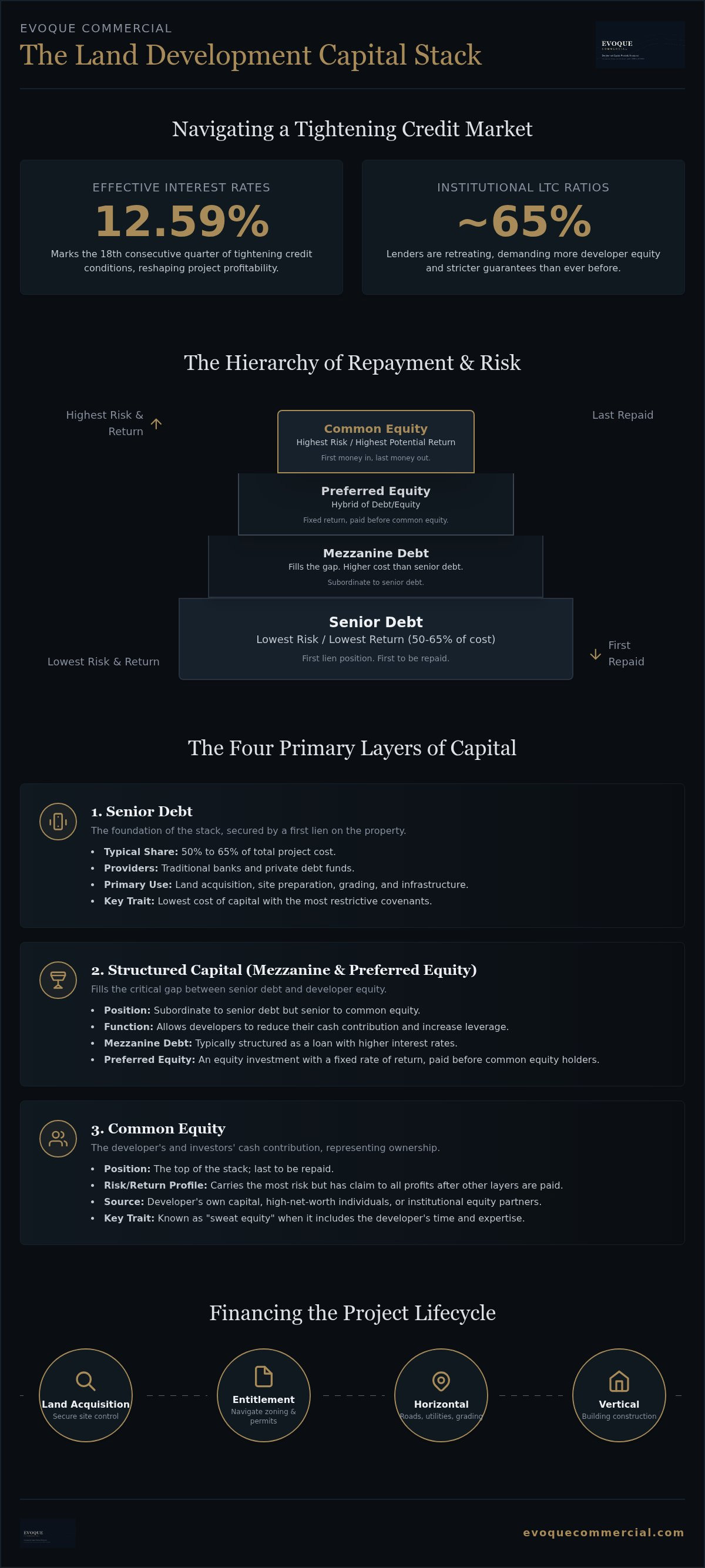
Effective interest rates for land development loans reached a staggering 12.59% in the second quarter of 2026, marking the eighteenth consecutive quarter of tightening credit conditions. For residential developers, this isn't just a temporary market shift; it's a fundamental restructuring of how projects survive. Securing a sustainable capital stack for land development now requires more than just a strong balance sheet. It demands a sophisticated understanding of how to layer senior debt, mezzanine financing, and preferred equity to maintain project momentum when traditional liquidity vanishes.
You've likely noticed that institutional lenders are retreating, lowering LTC ratios to 65% and demanding personal guarantees that once seemed negotiable. It's frustrating to watch your ROI compress while regulatory requirements, including the new FinCEN reporting rules for entity-based transfers, grow more rigid. This guide will help you master the complexities of the real estate capital stack to optimize your returns and mitigate risk in this shifting interest rate environment. We'll examine a clear framework for financing residential lot developments, from raw land acquisition to the final horizontal improvements. By the end, you'll understand how to leverage strategic partnerships to bridge the gap between developer equity and institutional debt.
What is the Capital Stack for Land Development?
The capital stack for land development represents the vertical arrangement of all financing sources utilized to fund a project from initial site control through final disposition. It organizes capital providers based on their priority of repayment and their exposure to risk. Developers use this structure to visualize how much debt they can leverage against their own equity. The land development capital stack is a strategic framework for balancing risk, control, and cost of capital.
In any liquidation or sale scenario, the capital stack dictates exactly who gets paid first. Senior lenders occupy the base; they're followed by mezzanine debt or preferred equity, with common equity holders at the very top. Residential developers must analyze this hierarchy meticulously. A misaligned stack can lead to excessive equity requirements that stifle cash flow or high-cost debt that erodes project profitability. Understanding where each dollar sits in the hierarchy is essential for maintaining project control.
The Hierarchy of Repayment and Risk
The structure follows a strict "First-In, Last-Out" rule regarding equity and debt. Equity is the first capital committed to the project but the last to be repaid. Conversely, senior debt is often the last capital called but always the first to be returned. As you move from the bottom of the stack to the top, the risk profile changes significantly. Senior debt offers the lowest risk and lowest return, while common equity carries the highest risk but offers the greatest potential upside.
This hierarchy directly impacts the project's hurdle rate. If the cost of the mezzanine or preferred equity layers is too high, the developer's required return on common equity increases. This makes the project harder to justify to institutional partners. A balanced stack ensures that the cost of capital remains low enough to provide a sufficient risk-adjusted return for the developer's sweat equity.
Why Land Development Requires a Unique Stack
Financing land is inherently different from financing a stabilized asset. You're dealing with significant pre-development costs like environmental studies and legal fees before a single shovel hits the dirt. Entitlement risks can stall a project for months or years, which requires a capital structure that isn't overly sensitive to short-term delays. The stack must be flexible enough to survive the local zoning process.
The stack must also evolve as the project matures. Developers often transition from acquisition financing to horizontal development loans to fund grading, roads, and utilities. This creates a necessary bridge to vertical construction. Balancing this stack for long-term residential subdivision growth requires a partner who understands the lifecycle of a lot, not just the value of the finished home.
The Four Primary Layers of Residential Development Capital
A successful capital stack for land development functions like a financial pyramid. It prioritizes safety at the bottom and rewards risk at the top. Most residential projects rely on four distinct layers to achieve full funding while balancing the developer's liquidity and the lender's security. Each layer has a specific cost, a specific priority in the repayment queue, and a specific role in the project's overall feasibility. Understanding how these tiers interact is the difference between a project that stalls at the entitlement phase and one that reaches successful disposition.
Senior Debt: Acquisition and Construction Loans
Senior debt provides the foundation of the stack. It typically covers 50% to 65% of the total project cost, though some private lenders may push higher for premium, shovel-ready sites. Traditional banks or private debt funds provide this capital, holding the first lien position on the property. In the current market, effective rates for land development loans have climbed to an average of 12.59% when including initial points. Developers utilize land acquisition and development loans as the primary engine for site preparation, grading, and infrastructure. Because this layer has the absolute first right to project assets, its restrictive covenants often dictate how much additional leverage can be added to the tiers above it.
Structured Capital: Mezzanine and Preferred Equity
Structured capital fills the critical void between senior debt and the developer's equity. This category primarily includes mezzanine debt and preferred equity. Mezzanine debt is typically secured by a pledge of equity interests in the borrowing entity rather than a mortgage on the land itself. It's a vital component of single family subdivision financing, allowing developers to reach 75% to 85% LTC without giving up majority control of the project. Preferred equity acts as a hybrid; it offers a fixed return and priority over common equity but sits below the debt layers in the hierarchy. While these sources carry higher interest rates, they protect the developer from the heavy dilution that comes with bringing on a full common equity partner.
Common equity is the final layer and represents the developer's direct cash investment. It's the most expensive capital because it absorbs the first dollar of loss if the project underperforms. However, it also captures the "promote" and all residual profits once the senior and structured layers are satisfied. Current credit conditions for AD&C loans have tightened for 18 consecutive quarters, making it harder to secure this layer without substantial liquidity. Developers who can effectively structure their capital stack for land development can often reduce their own equity requirement to 10% or 15% of total costs. Professional developers often turn to Evoque Lending to secure the structured capital solutions needed to optimize these middle layers and maximize their project's ROI.
How to Structure Financing for Residential Lot Developments
Structuring the financing for a residential lot development requires a phased approach that mirrors the physical progression of the site. It's not a static loan; it's a dynamic assembly of capital designed to evolve as risk decreases. Developers must coordinate multiple layers of funding to move from a raw parcel to a finished subdivision ready for vertical construction. A well-constructed capital stack for land development ensures that liquidity is available when earthmoving begins and that debt service remains manageable during the entitlement process.
- Step 1: Secure entitled land acquisition loans to lock in the site once the primary zoning hurdles are cleared.
- Step 2: Quantify all horizontal development costs, including grading, drainage, and the installation of wet and dry utilities.
- Step 3: Calculate the Loan-to-Cost (LTC) and Loan-to-Value (LTV) limits for senior debt, which currently hover around 65% for most institutional lenders.
- Step 4: Layer in mezzanine or preferred equity to fill the "equity gap" and reduce your direct cash-out-of-pocket.
- Step 5: Finalize the vertical construction financing path for the residential units to ensure a seamless transition from lot to home.
Financing the Horizontal Phase
The horizontal phase is the most capital-intensive and high-risk period of the project. Lenders are often cautious during this stage because there's no vertical collateral to secure the loan. To manage this, sophisticated developers use lot development credit lines that allow for draws as infrastructure milestones are met. Financing utility hookups and internal road networks requires a lender who understands the local regulatory environment. Transitioning from a simple land loan to a comprehensive development line provides the flexibility needed to scale as lots become "shovel-ready."
Balancing Leverage and Project Viability
Over-leveraging during the entitlement phase is a common pitfall that can jeopardize the entire project. If the debt service is too high before the first lot is sold, a minor delay in municipal approvals can lead to a liquidity crisis. Your capital stack for land development must be resilient enough to survive market fluctuations. A disciplined "waterfall" structure is essential here. This repayment hierarchy should incentivize developer performance by releasing profits only after the senior and structured capital partners have achieved their agreed-upon returns. It keeps all parties aligned on the project's ultimate completion and exit strategy.
Key Metrics and Ratios for Optimizing Your Capital Stack
Optimizing a capital stack for land development is an exercise in mathematical precision. Lenders don't just evaluate the quality of the site; they scrutinize the ratios that govern the project's survival through market volatility. For a developer, these metrics are the primary tools used to communicate risk and return to institutional partners. If your ratios are misaligned, your cost of capital will skyrocket, or worse, your senior debt will vanish. Master these numbers to ensure your project remains attractive to the most competitive capital providers.
Understanding LTC in Construction Projects
Loan-to-Cost (LTC) remains the primary metric for ground-up construction lenders. While Loan-to-Value (LTV) is the standard for stabilized assets, LTC focuses on the actual budget required to bring the project to fruition. In the current 2026 credit environment, most lenders have tightened their stance, with LTC ratios for new residential construction now hovering between 65% and 70%. This calculation must include all soft costs such as architecture, engineering, legal fees, and municipal permits, not just the hard costs of moving dirt and pouring foundations.
Lenders use the as-completed appraisal to verify that the projected value of the finished lots or homes justifies the total development cost. If the appraisal comes in lower than expected, the developer is often forced to inject more common equity to maintain the required LTC. This is where a sophisticated capital stack for land development becomes essential. By layering in mezzanine debt, you can maintain a higher total leverage without violating the senior lender's strict LTC constraints.
The Importance of Interest Reserves
Interest reserves are the lifeblood of a development project. Because a raw parcel of land doesn't generate cash flow until the first lots are sold or units are leased, interest must be serviced through a dedicated reserve fund. This reserve is typically structured within the senior debt layer and sized to cover the entire anticipated construction and absorption period. If a project faces delays in horizontal improvements, a thin interest reserve can lead to a technical default before the project is even half-finished.
- Debt Yield: Lenders look at the exit yield to ensure the project can be refinanced or sold at a price that covers the debt.
- Equity Multiple: This measures the total cash returned to the developer relative to their initial investment.
- Internal Rate of Return (IRR): This accounts for the time value of money, rewarding developers who can execute their horizontal and vertical phases quickly.
Managing the carry cost during the vertical construction phase requires a proactive approach to liquidity. As interest rates fluctuate, the cost of maintaining these reserves can shift, impacting your overall IRR. Developers who prioritize capital efficiency often partner with Evoque Lending to secure structured capital solutions that provide the necessary interest reserves without over-collateralizing the project's equity layer.
Leveraging Structured Capital for National Residential Growth
Residential land development is a high-stakes marathon that requires a lender capable of matching the developer's pace across multiple market cycles. While traditional institutions often retreat when projects face complexity, Evoque Lending operates as a strategic partner for those navigating a sophisticated capital stack for land development. We provide the institutional power necessary for transactions ranging from $3M to $250M alongside the boutique responsiveness required for luxury residential and multifamily projects. This combination of scale and agility ensures that your financing structure remains resilient from the first shovel in the ground through the final certificate of occupancy.
A single-source capital provider offers distinct advantages. Instead of managing fragmented relationships between acquisition lenders and construction debt funds, developers benefit from a cohesive financing path. This continuity reduces closing risks and eliminates the friction of re-underwriting the project at every phase. Structured capital solutions also serve as a vital lifeline for projects that have stalled due to budget overruns or shifting interest rates. Whether you need construction completion financing or bridge-to-stabilization loans to reach an exit; the right partner provides the structured capital layer that traditional institutions typically avoid.
Financing Paths from Acquisition to Exit
Luxury residential and large-scale multifamily projects often require customized financing paths that don't fit into a standard commercial box. As a project nears completion, the role of bridge-to-stabilization loans becomes critical. This layer allows you to pay off higher-cost construction debt while you focus on lease-up or inventory sales. Transitioning to permanent financing or a strategic project exit requires a clear roadmap established at the onset of the development lifecycle. For projects in the Australian market, coordinating with specialized firms like The Home Loan Partners can ensure that the final transition to end-user residential financing is handled with expert guidance. By anticipating these shifts in the capital stack, you can preserve your IRR and protect your equity position throughout the project's duration.
Similarly, for developers targeting the New Zealand market, ensuring that the end-product is accessible through competitive first home buyer loans NZ is a critical factor in achieving a swift and profitable exit.
For developers or property owners operating within the UK market, you can discover I Need Cash to explore a variety of homeowner and personal loan products designed to meet diverse financial needs.
For those who wish to explore the nuances of fast-access credit and how to borrow responsibly, you can read more about the UK's short-term loan market.
Furthermore, contractors and service providers within the construction ecosystem can enhance their competitiveness by implementing consumer financing for small business, which helps end-users manage the costs of specialized improvements.
Additionally, for individuals seeking flexible personal financial options, ILoveYourLoans provides a comprehensive suite of installment loans and cash advances designed to meet diverse needs.
The most successful projects involve capital consultation during the early entitlement phase. Waiting until you're shovel-ready to discuss your capital stack for land development often limits your options and increases your cost of capital. We encourage developers to engage with our team early to review project feasibility and structural requirements. You can request a comprehensive project review via the Evoque Lending platform to begin the underwriting process and secure a commitment that aligns with your project's milestones.
Partner with Evoque Lending for your residential development financing to optimize your project's leverage and secure a responsive capital partner for your next national residential project.
Optimizing Your Residential Development Strategy
Mastering the capital stack for land development is no longer optional in a market defined by eighteen consecutive quarters of credit tightening; it's the foundation of project survival. By organizing your financing into a logical hierarchy, you protect your common equity and ensure that high-cost debt doesn't erode your internal rate of return. The transition from horizontal infrastructure to vertical home construction requires a capital partner who understands the unique lifecycle of residential subdivisions. A disciplined approach to leverage allows you to maintain control while maximizing your project's overall ROI.
Evoque Commercial provides financing from $3M to $250M, offering the institutional power your project needs with the boutique responsiveness you deserve. Our expertise in ground-up residential construction helps you bridge the gap between senior debt and equity with precision. Don't let capital constraints stall your project's momentum in a shifting interest rate environment. Request a Project Review with Evoque Commercial today to secure a strategic partner for your next development. We're ready to help you build the financial framework your project deserves.
Frequently Asked Questions
What is a typical capital stack for residential land development?
A typical capital stack for residential land development consists of 50-65% senior debt, 10-20% structured capital, and 15-30% developer common equity. The specific ratios depend on the project's risk profile and the developer's track record. In 2026, lenders are more conservative, often requiring higher equity contributions to offset entitlement risks. This structure ensures a balanced capital stack for land development that protects senior lienholders while maximizing developer leverage through middle-market agility.
How does mezzanine debt differ from preferred equity in the capital stack?
Mezzanine debt is a loan secured by a pledge of equity interests in the borrowing entity, whereas preferred equity is a direct equity investment with a priority return. Mezzanine debt sits lower in the risk hierarchy than preferred equity but higher than senior debt. Preferred equity holders usually have more control rights in a default scenario. Developers choose between them based on their desired cost of capital and the level of equity dilution they're willing to accept.
Can I use a bridge loan to finance land acquisition before construction?
Yes, bridge loans are specifically designed to provide short term liquidity for land acquisition before horizontal development begins. These loans allow developers to secure a site quickly while they finalize entitlements or secure a full construction loan. Bridge-to-stabilization loans also help manage the transition between project phases. They're particularly useful when traditional banks are too slow to respond to time-sensitive acquisition opportunities in competitive residential markets where speed is a critical factor for success. For those needing smaller-scale financial solutions where speed is essential, you can explore Payday Loans through QuickCashDirect to bridge immediate personal gaps.
What is the maximum LTC for a ground-up residential construction loan?
Most institutional lenders currently cap ground-up residential construction loans at 65% to 70% LTC. This ratio has tightened significantly over the last 18 quarters as credit conditions have become more restrictive. To reach a higher total leverage, such as 80% or 85% LTC, developers often need to layer in mezzanine debt or preferred equity. This structured approach allows the project to move forward without requiring the developer to fund 35% of the total budget out-of-pocket. Outside of these large-scale requirements, for more accessible personal asset-based financing, car title loans online can provide a fast alternative for managing individual cash flow.
Lenders care about the capital stack structure because it determines their priority of repayment and the amount of equity protecting their position. A well-structured capital stack for land development ensures there's enough common equity to absorb potential losses before the debt layers are affected. Lenders specifically look for a disciplined hierarchy that aligns the interests of all capital providers. If the stack is too debt-heavy, the risk of default during the entitlement or construction phases increases significantly.
How does the capital stack impact the developer’s return on equity (ROE)?
The capital stack directly determines ROE by dictating the amount of leverage used relative to the developer's cash investment. Higher leverage through mezzanine debt or preferred equity can significantly boost ROE if the project's return exceeds the cost of that capital. However, this also increases the project's risk profile. Strategic developers use structured capital to optimize their ROE while maintaining enough liquidity to survive potential delays in the residential lot sales cycle or shifting interest rates.
What happens to the capital stack if a project is stalled?
Stalled projects often face a liquidity crisis as interest reserves are depleted and carry costs continue to mount. In these scenarios, the capital stack may require a rescue layer of structured capital or a bridge loan to fund completion. The priority of repayment remains the same, but the cost of the upper layers often increases to reflect the heightened risk. Responsive capital providers can help restructure the stack to provide the necessary runway for project stabilization and exit.
Is non-recourse financing available for all layers of the capital stack?
Non-recourse financing is primarily available for the senior debt layer in large-scale residential projects, though it often requires lower leverage. Mezzanine debt and preferred equity are frequently structured as non-recourse with standard carve-outs. In the current market, 53% of developers report that lenders are increasing requirements for personal guarantees. Securing non-recourse options across the entire stack usually depends on the developer's experience and the project's LTC. To strengthen your financial profile and access alternative funding options, you can learn more about Koval Investments. It's essential to consult with a structured capital expert early.