

The most critical phase of any residential development isn't the vertical construction; it's the quiet, expensive gap between land acquisition and the first shovel in the ground. You've likely felt the pressure of watching liquidity drain into architectural fees, legal filings, and engineering studies while waiting for municipal approvals. It's a high-stakes period where entitlement risk can stall a promising pipeline before it even begins. Finding flexible pre-development loans for residential projects is often a significant hurdle, especially in a rebalancing market where traditional institutions shy away from the early-stage risks that define this phase.
We understand that you need more than just a lender; you need a strategic partner who recognizes the value of your project's milestones. This guide will show you how to master the complexities of securing early-stage capital to mitigate entitlement risk and accelerate your residential project pipeline. We'll examine how to optimize your capital stack to finish entitlements, bridge the gap from acquisition to horizontal development, and ensure your project stays on track from the first site plan to the final exit.
Understanding Pre-Development Loans for Residential Projects
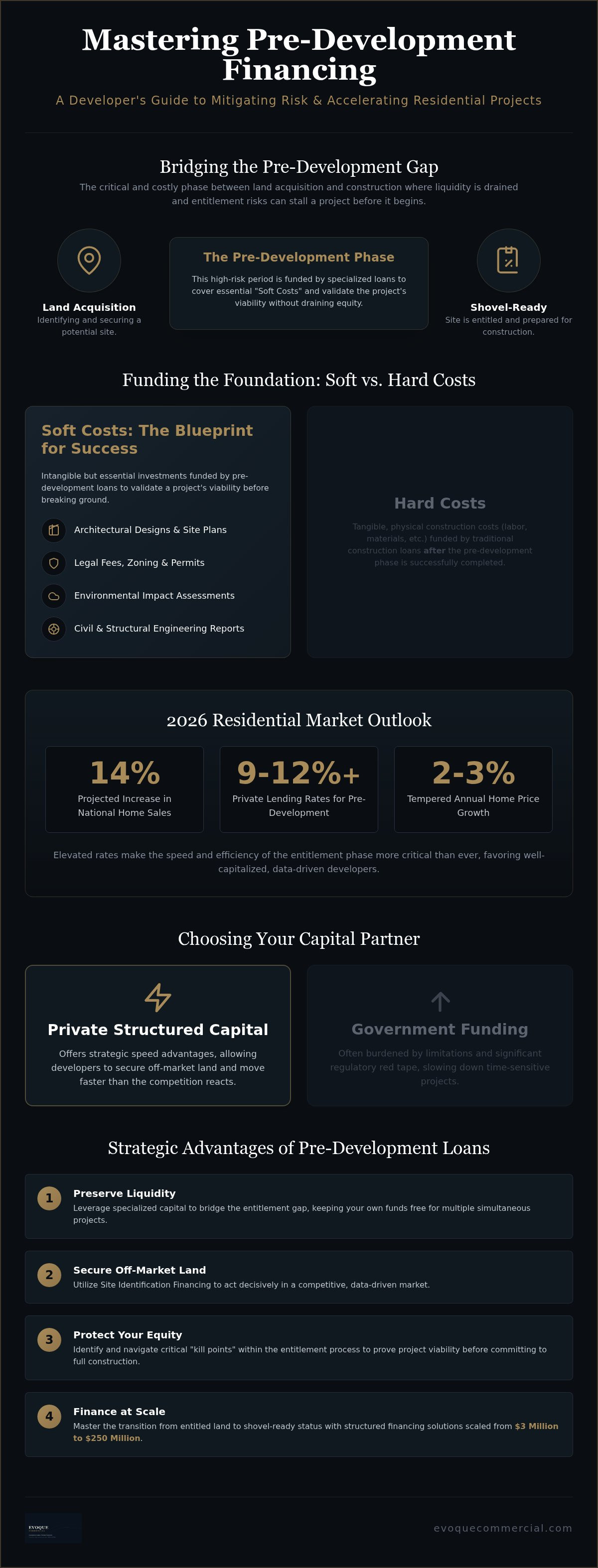
Pre-development financing is the high-leverage bridge that spans the critical gap between identifying a potential site and initiating horizontal construction. For market-rate developers, this capital doesn't just cover expenses; it functions as a strategic lever. By utilizing pre-development loans for residential projects, developers can preserve their primary liquidity for multiple simultaneous pipelines while accelerating their time-to-market. This early-stage capital is essential for navigating the complex journey from initial concept to a shovel-ready site. Understanding the Real Estate Development Process reveals that these early milestones often dictate the eventual ROI of the entire project.
Within the broader context of land acquisition and development loans, pre-development acts as the validation phase. It allows a developer to secure site control and complete the necessary due diligence without tying up significant equity in non-tangible assets. This disciplined approach ensures that capital is deployed where it is most effective during the riskiest hours of the project lifecycle.
Soft Costs vs. Hard Costs: A Developer’s Breakdown
Soft costs represent the intangible but essential investments in intellectual property, regulatory compliance, and design that validate a project's physical viability. Unlike hard costs, which are visible in the vertical structure, pre-development funds cover the exploratory work required to reach the construction phase. These exploratory costs include:
- Comprehensive architectural designs and site plans.
- Civil and structural engineering reports.
- Legal fees for zoning changes, easements, and municipal permits.
- Environmental impact assessments and market feasibility studies.
These funds effectively bridge the gap to horizontal development loans. By financing these soft costs separately, you ensure that the land is fully entitled and prepared for infrastructure work without draining your operating reserves.
The Risk-Reward Profile of Early-Stage Capital
Lenders often view pre-development as a higher-risk venture compared to vertical construction. The primary reason is the lack of physical collateral and the inherent uncertainty of municipal approvals. However, for the developer, this financing is a powerful de-risking tool. By completing entitlements and feasibility milestones early, you create a clear path for permanent lenders to follow. Securing site control through these loans allows you to lock in pricing and project scope before market conditions shift. This strategic positioning makes the project more attractive for future financing rounds, as much of the speculative risk has already been mitigated through professional due diligence.
Trends in Residential Site Identification Financing for 2026
The residential development market in 2026 is defined by a strategic rebalancing. Developers no longer view pre-development as a generic cost of doing business; they see it as a targeted instrument called "Site Identification Financing." This shift allows for the aggressive pursuit of off-market land in a climate where national home sales are projected to increase by 14%. While home price growth is tempering at approximately 2% to 3%, the competition for viable acreage remains intense. Developers are using these specialized funds to move faster than the broader market can react.
Elevated interest rates continue to dictate the rhythm of early-stage capital. With private lending rates for pre-development and construction hovering between 9% and 12%+, the cost of carrying land has become a primary concern for project feasibility. Every month spent in the entitlement phase carries a heavier financial weight than in previous cycles. This reality has pushed developers toward larger-scale, master-planned community projects. These expansive developments allow for economies of scale that can better absorb the holding costs associated with high-leverage pre-development capital.
Data-Driven Site Selection and Funding
Modern underwriting for pre-development loans for residential projects now relies heavily on data transparency. Developers are increasingly using AI-driven GIS platforms to justify loan requests, providing lenders with granular heat maps of demographic shifts and infrastructure growth. This quantitative approach allows boutique lenders to move with greater precision than traditional banks. When you can prove site viability through hard data, you reduce the perceived risk of the pre-entitlement phase. Speed in site identification is now directly correlated to project profitability. Locking in land before the broader market recognizes its value is the only way to maintain healthy margins in a low-growth price environment.
Securing Pipeline in High-Barrier Markets
In high-barrier markets, pre-development capital is the primary tool used to lock in site control while navigating municipal red tape. This often serves as a necessary precursor to entitled land acquisition loans, which provide the secondary phase of financing once the heaviest regulatory risks are cleared. Boutique firms offer the structural flexibility needed for unique residential infill projects that don't fit the rigid criteria of institutional banks. By securing a structured capital solution early, you ensure your pipeline remains robust even as market complexities evolve. This flexibility is particularly vital given the 2026 focus on "missing middle" housing and the legislative tailwinds from the 21st Century ROAD to Housing Act.
Private Structured Capital vs. Government Pre-Development Funds
Professional developers often face a strategic choice between bureaucratic public programs and agile private capital. Government pre-development funds typically arrive with heavy red tape and restrictive mandates. These programs often require specific affordable housing percentages or community benefit agreements that don't always align with market-rate or luxury residential pipelines. Private structured capital offers the freedom to execute on large-scale projects without these external constraints. Integrating these funds into the capital stack for land development provides the necessary leverage to maintain momentum while navigating the entitlement phase. This flexibility allows developers to pivot quickly as market conditions or site requirements evolve.
The speed and scale of pre-development loans for residential projects in the private sector far exceed what public agencies can offer. Institutional-scale developers prioritize the ability to secure site control and finish due diligence on their own timeline. Relying on government cycles can lead to missed opportunities in high-demand markets where sellers expect rapid closings. Private lenders act as strategic partners, focusing on the commercial viability of the project rather than socio-political checklists.
Loan Sizing and Transaction Speed
The disparity in loan sizing is a primary factor for professional builders. Government grants or loans often cap out between $50,000 and $500,000. For a large subdivision, a luxury multifamily project, or a development of luxury new build homes Newcastle, these amounts barely cover initial architectural and legal fees. Private boutique lenders specialize in the $3 million to $250 million range, providing the depth of capital required for significant soft costs and site identification. Closing timelines are equally distinct. While government programs may take six months for approval, boutique firms often close in weeks. This middle-market responsiveness is critical for residential builders who must act decisively to lock in land in competitive 2026 environments.
Private lenders evaluate the exit strategy with extreme precision. They look for a clear, documented path toward a construction loan or permanent financing. Security structures for these loans typically involve a first lien on the property, and depending on the project's risk profile, personal guarantees may be required. Underwriting in the private sector places significant weight on the developer's track record. A proven history of successful project completions and exits allows for more favorable terms and higher leverage. This focus on experience ensures that capital is deployed to developers who can effectively manage the transition from entitled land to vertical construction.
Navigating Entitlement Risk and Feasibility Milestones
Entitlement risk remains the primary variable in any development timeline. Professional developers use pre-development loans for residential projects as a strategic filter to identify the "Kill Point" of a deal. This is the moment where data or regulatory feedback indicates that a project is no longer commercially viable. By using early-stage capital to reach this conclusion early, you protect your core equity from being trapped in a stagnant asset. Successful navigation of this phase transforms a raw site into a shovel-ready asset, which significantly increases its value for the next tier of lenders.
Structuring loan draws based on specific milestones ensures that capital deployment aligns with risk reduction. Lenders typically release funds after key hurdles are cleared, such as the submission of a formal site plan or the completion of a municipal public hearing. This disciplined approach keeps the project team focused on the most critical path to approval. It also provides the documentation necessary to prove to future construction lenders that the project is moving toward a predictable exit.
The Path to Shovel-Ready Status
Lenders look for specific evidence of progress before converting pre-development debt into horizontal construction financing. These milestones include final zoning approvals, utility capacity letters, and fully executed easements. Addressing regulatory hurdles or local opposition often requires significant legal capital during the early stages. A clean environmental report is essential for securing future construction draws because it removes the threat of unforeseen remediation costs that could derail the project budget. Reaching this status allows the developer to transition from speculative risk to execution risk, which is a much more favorable position for securing long-term debt.
Feasibility Analysis
as a Financing Tool
A robust financial feasibility analysis serves as more than just an internal check; it is a primary financing tool. Developers use pre-development funds to iterate on unit mixes and density plans to find the most profitable configuration for the current market. High-quality early design work and engineering data allow you to leverage the project's potential to attract preferred equity partners. When you can present a project that is already de-risked through professional feasibility studies, you command better terms across the entire capital stack. This level of preparation signals to the market that the project is managed by a disciplined strategist.
If you are ready to secure capital for your next project, explore our structured capital solutions to bridge the gap from acquisition to completion.
Structuring Your Residential Pre-Development Loan with Evoque
Evoque Lending operates at the intersection of institutional-grade capital and boutique-level responsiveness. We recognize that pre-development loans for residential projects are the foundation of a successful pipeline. Our "Acquisition to Exit" philosophy means we don't just provide a one-time loan; we support the project's entire lifecycle from the first site identification to the final unit sale. With financing paths ranging from $3 million to $250 million, we have the capacity to handle large-scale residential developments that traditional banks often overlook. This scale allows us to act as a primary capital partner for developers who require significant soft cost coverage without the constraints of retail lending.
Submitting a project for review is a straightforward, disciplined process. Our underwriting team focuses on the technical merits of your site, your professional track record, and the project's ultimate viability. When evaluating pre-development loans for residential projects, we look for a clear path toward entitlement and a defined exit strategy. You'll work with a dedicated strategist who understands the nuances of the entitlement process. This ensures that the capital structure we build today supports the construction milestones of tomorrow. We value your time and provide a transparent, efficient review process that moves at the speed of your development schedule.
Flexible Terms for Market-Rate Developments
We tailor our loan terms to match the specific entitlement timeline of your project. Whether you're focused on luxury spec homes, high-density multifamily, or single family subdivision financing, our structures remain agile. We understand that residential growth isn't linear. Municipal delays or zoning pivots require a lender who can adapt without the rigid constraints of a retail bank. This flexibility allows you to maintain site control while navigating the regulatory hurdles discussed in previous sections. By aligning our terms with your feasibility milestones, we ensure your liquidity is preserved for the project's most critical phases.
Partnering for Long-Term Growth
Our goal is to build a relationship that extends far beyond the first closing. As your project moves through its lifecycle, we provide access to bridge-to-stabilization loans, construction completion financing, and preferred equity. This continuity of capital reduces the friction of finding new lenders at every milestone. By partnering with Evoque Lending, you gain a strategic ally committed to optimizing your capital stack for maximum ROI. We don't just fund projects; we support the long-term growth of your development firm by providing reliable, structured capital solutions in any market environment.
Request a Project Review with Evoque Lending
Accelerate Your Residential Development Pipeline
Success in the current market depends on your ability to move from site identification to horizontal construction with precision. By securing specialized pre-development loans for residential projects, you can effectively mitigate entitlement risk while preserving liquidity for your broader pipeline. This strategic use of early-stage capital transforms speculative ventures into de-risked, shovel-ready assets that attract permanent lenders. We've established how private structured capital offers a distinct speed advantage over public funds, allowing you to act decisively in competitive, high-barrier markets.
Evoque Lending provides the institutional-grade capital and national coverage required to support your vision from acquisition to completion. With financing available from $3 million to $250 million, we offer the scale of a major institution combined with the personal attention of a boutique partner. Our team is ready to help you optimize your capital stack and secure the milestones necessary for long-term growth. We understand the technical nuances of your project and prioritize the commercial realities of the development lifecycle.
Secure your project's future with Evoque Lending. Request a Review Today
Your next project deserves the precision and expertise that only a dedicated strategic partner can provide. We look forward to helping you reach your next development milestone with confidence.
Frequently Asked Questions
What is the typical interest rate for a pre-development loan on a residential project?
Private lending rates for pre-development and residential projects usually range from 9% to 12% or higher, depending on the project's risk profile and the developer's experience. These rates reflect the early-stage nature of the capital and the lack of physical collateral. While bank financing might offer lower rates for vertical construction, pre-development loans for residential projects prioritize speed and flexibility. Terms are often structured on a case-by-case basis to align with specific entitlement milestones.
How long does it take to close a private pre-development loan?
Closing timelines for private pre-development financing typically range from two to four weeks, depending on the complexity of the project and the readiness of the due diligence package. This responsiveness is a primary advantage over traditional institutional banks or government programs, which can take several months to reach a decision. Boutique lenders prioritize efficiency to help developers secure site control and lock in land pricing before market conditions shift or competing bids emerge.
Can pre-development loans be used for land acquisition?
Yes, these loans are frequently used to facilitate land acquisition while simultaneously funding the soft costs required for entitlement. This dual-purpose structure allows developers to secure site control early in the lifecycle without exhausting their primary liquidity. By combining acquisition and pre-development capital, you create a seamless transition from site identification to the feasibility phase. This approach is particularly effective for off-market residential land where sellers expect a professional, rapid closing process.
What is the difference between a pre-development loan and a bridge loan?
A pre-development loan specifically targets the early-stage soft costs and entitlement risks before a project is shovel-ready. In contrast, a bridge loan typically serves as a temporary solution to bridge the gap between two major financing events, such as moving from construction completion to permanent stabilization. While both are short-term structured capital solutions, pre-development funds are deployed when the project's physical structure doesn't yet exist and regulatory approvals are still pending.
Is a personal guarantee required for residential pre-development financing?
Personal guarantees are commonly required for residential pre-development financing because the project lacks physical collateral during the entitlement phase. Lenders look for this commitment to align the developer's interests with the project's success. However, the exact security structure depends on the developer's track record, the project's loan-to-value ratio, and the strength of the exit strategy. In some high-leverage or institutional-scale transactions, lenders may offer limited-recourse options based on the specific risk profile.
What happens to the pre-development loan once construction begins?
Once a project reaches shovel-ready status and construction begins, the pre-development loan is typically refinanced into a larger ground-up construction loan. The principal and any deferred interest from the pre-development phase are rolled into the new debt facility. This transition marks the point where speculative entitlement risk is replaced by execution risk. Professional lenders often coordinate this exit internally to ensure a smooth transition from the soft cost phase to vertical construction.
Can I use pre-development funds for market studies and legal fees?
Yes, market feasibility studies and legal fees are eligible soft costs covered by these loans. These expenses are critical for validating the project's viability and navigating zoning or regulatory hurdles. Using pre-development loans for residential projects to cover these costs allows developers to optimize their unit mix and density before committing to a final site plan. Other eligible costs include architectural designs, civil engineering reports, and environmental assessments required for future construction draws.
Do pre-development lenders require a first lien position on the land?
Most private lenders require a first lien position on the land to secure their capital. This priority ensures that the lender has the primary claim on the asset if the project fails to reach the construction phase. Because pre-development is viewed as a high-risk phase, maintaining a first lien position is a standard requirement for institutional-grade capital. This security allows lenders to offer the high-leverage funds necessary to bridge the gap between acquisition and horizontal development.