

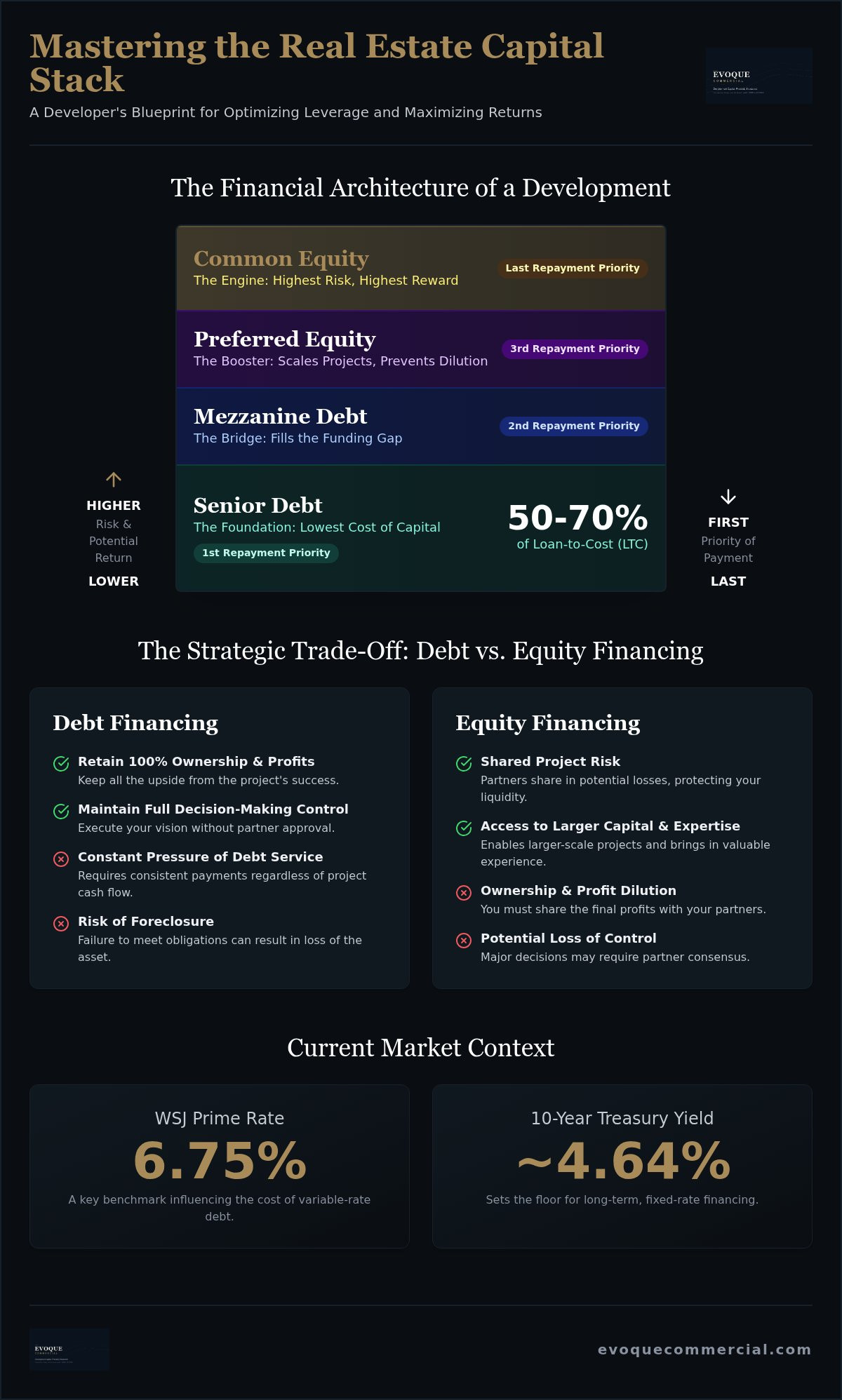
The lowest interest rate on a term sheet is often a distraction from the structural flaws that could cost you millions in future profit. Many developers prioritize the headline cost of capital over the flexibility of the structure, only to find themselves trapped by strict recourse requirements or excessive equity dilution. In a market where the WSJ Prime Rate is 6.75% and the 10-year Treasury yield sits near 4.64%, the margin for error in your capital stack is razor thin.
Deciding between debt vs equity financing for real estate development is the most consequential choice you'll make before breaking ground. You likely recognize the struggle of balancing high interest rates against the need to protect your ownership stake and maintain project control. This article provides the blueprint to master the mechanics of the capital stack, allowing you to optimize project leverage and maximize total returns. We'll examine how to secure limited-recourse financing and use structured capital to maintain control while driving your Internal Rate of Return (IRR) to its highest potential.
The Real Estate Capital Stack: A Strategic Framework for Developers
The capital stack is the financial architecture of a development project. It defines the hierarchy of every dollar invested, from the base of senior debt to the peak of common equity. For any developer, understanding the capital stack is not just about securing funds; it's about disciplined risk mitigation. This hierarchy dictates the priority of payment during monthly cash flow and at the eventual project exit. If a project underperforms, those at the bottom of the stack lose their capital first. Conversely, those at the top, typically senior lenders, accept lower returns in exchange for the security of being first in line.
The mix of capital is rarely static. It evolves as a project moves from land acquisition through construction and into stabilization. As risk decreases, the cost of capital often follows, allowing for refinancing opportunities that can significantly alter the stack's composition. A well-structured stack ensures that the developer remains in control while meeting the stringent requirements of institutional lenders.
Senior Debt vs. Common Equity: The Bookends of Finance
Senior debt serves as the foundation of most residential projects, typically covering 50% to 70% of the Loan-to-Cost (LTC). This is the cheapest capital available, but it comes with strict debt service requirements. On the opposite end sits common equity. This is the fuel that drives the development. It represents the highest risk and the highest potential reward, usually held by the developer (GP) and their partners (LP). While senior debt requires consistent service regardless of performance, common equity only receives profit after all other obligations are met. The central tension in debt vs equity financing for real estate development lies here: taking more debt reduces the need for outside partners but increases the pressure on your debt service coverage ratio (DSCR).
The Gap: Mezzanine Debt and Preferred Equity
When senior lenders tighten their requirements, a funding gap often emerges. This is where structured capital solutions, such as mezzanine debt and preferred equity, become essential. Mezzanine debt is a hybrid instrument. It's subordinated to senior debt but remains senior to all equity layers. It often carries higher interest rates but requires less collateral than a primary construction loan.
Preferred equity offers a different strategic path. It functions as an ownership stake with a fixed return, sitting between mezzanine debt and common equity. For developers, this layer is a powerful tool to prevent full profit dilution. It allows you to scale larger projects without surrendering the majority of your decision-making power or long-term upside. By filling the space between senior debt and equity, these structured solutions provide the flexibility needed to navigate volatile market conditions.
Debt Financing: Leveraging Capital While Retaining Ownership
The decision between debt vs equity financing for real estate development often hinges on how much upside you're willing to share. Debt financing remains the preferred choice for developers who wish to retain 100% of the project’s profit and total decision-making control. This is particularly common in high-margin luxury residential spec projects, where the developer’s specific vision drives the ultimate value. Unlike equity, debt doesn't require you to consult with partners on every minor design change or exit timing choice. But this autonomy has a price. With the WSJ Prime Rate holding at 6.75% as of August 2026, the burden of debt service is a constant pressure on liquidity. Beyond interest, you must account for origination fees and the risk of foreclosure if you fail to meet strict maturity dates.
Senior Construction Loans and Draw Schedules
Senior lenders release capital through structured draw schedules. This process ensures that funds are only disbursed as you reach specific, verified construction milestones. It keeps the loan in balance and protects the lender from over-exposure. Most multifamily construction loans are structured with interest-only periods during the build phase. This allows you to delay principal repayment until the project reaches stabilization and begins generating cash flow. Lenders typically use metrics like Loan-to-Cost (LTC) to cap their risk, usually funding 50% to 70% of the actual construction budget rather than the projected future value.
Recourse vs. Non-Recourse Debt
The requirement for a personal guarantee is a major pain point for many developers. In the current market, recourse is often mandatory for projects below the $20 million mark. This places your personal balance sheet directly behind the project's success. Large-scale developments can often secure non-recourse financing, where the property itself serves as the only collateral. Even in these arrangements, lenders include "bad-boy carve-outs" to protect against fraud, waste, or environmental negligence. If you want to pursue larger projects while protecting your personal assets, exploring structured capital solutions can provide the leverage you need with limited-recourse options. This balance between debt vs equity financing for real estate development is what ultimately determines your project's risk profile and your personal financial exposure.
Equity Financing: Trading Upside for Project Viability and Scale
Equity financing is the strategic alternative when a project’s risk profile or sheer scale exceeds the limits of traditional lending. The primary advantage is the total absence of mandatory monthly debt service. By removing the pressure of immediate interest payments, you significantly reduce project-level bankruptcy risk during the volatile pre-development and construction phases. This flexibility allows you to focus on execution rather than liquidity management. However, the cost of equity is the highest in the stack. You are trading a portion of your project’s upside and, in some cases, a degree of decision-making power for the stability of a partner's capital.
Strategic equity partners often bring more than just funds. They provide the institutional credibility required to secure the most competitive senior debt terms. For projects requiring land acquisition and development loans, equity is often the only viable path before horizontal work begins. Lenders are increasingly cautious about speculative land plays; having a strong equity base demonstrates project viability and professional commitment from the outset.
The GP/LP Structure and the Promote
In residential development, equity is typically structured through a General Partner (GP) and Limited Partner (LP) relationship. The developer acts as the GP, managing the day-to-day operations and execution. The LP provides the bulk of the capital but remains passive regarding construction details. To reward the GP for their expertise and successful delivery, the profit sharing is often governed by a "Promote." This mechanism allows the developer to earn a disproportionate share of the profits once specific performance hurdles, such as a 10% or 12% IRR, are met. These waterfall distributions ensure that the interests of the capital provider and the developer remain aligned until the final exit.
Preferred Equity
as a Dilution Mitigant
Developers who want to avoid the heavy dilution of common equity often turn to preferred equity. This layer sits above common equity in the payment hierarchy and usually carries a fixed return rather than a percentage of the total upside. When choosing between debt vs equity financing for real estate development, preferred equity offers a middle ground. Fixed preferred equity functions similarly to a high-interest loan but without the foreclosure rights of a mortgage. Participating preferred equity, conversely, includes a small share of the profits. A critical strategy for developers is negotiating a "buy-out" option. This right allows you to retire the preferred equity early using project cash flow or refinancing proceeds, effectively capturing more of the long-term upside for yourself.
How to Determine the Optimal Debt vs. Equity Mix for Your Project
Optimizing the capital stack requires a precise calibration of your Weighted Average Cost of Capital (WACC) against the inherent risks of the development timeline. Finding the right balance in debt vs equity financing for real estate development is not just about cost; it's about resilience. Lenders typically require "skin in the game," often a minimum developer equity contribution of 10% to 15% of the total project cost, to ensure alignment of interests. The optimal mix is the point where IRR is maximized without breaching debt covenants.
Step 1: Calculate Your Project’s Break-Even Occupancy and Exit
You must determine the minimum revenue required to cover mandatory debt service. If your project requires 85% occupancy or a record-breaking price per square foot just to meet interest payments, your leverage is likely too high. Debt financing adds a "point of no return" during construction delays; every month of stalled progress eats into your contingency and liquidity. You should always match the financing term to your projected absorption rate. A bridge loan that matures before you've reached 50% stabilization creates a refinancing risk that can derail an otherwise successful project.
Step 2: Evaluate the Yield on Cost (YOC) vs. Interest Rates
The Golden Rule of development finance is simple: if your Yield on Cost is significantly higher than your cost of debt, you should leverage up to boost your equity returns. This "spread" justifies the higher risk of senior debt. However, you must bring in equity when projected debt service eats more than 60% of your anticipated cash flow. Relying solely on debt in a high-rate environment can leave you with zero margin for error if market median rents, currently $1,390 as of August 2026, begin to soften.
Step 3: Analyze the "Control Premium"
There is a quantifiable value in making 100% of the decisions without an LP partner. This "control premium" is the profit you are willing to trade for peace of mind and faster execution. Many developers choose to pay a higher interest rate for mezzanine debt rather than surrendering a portion of the promote to an equity partner. This is especially true for financing for middle-market home builders, where maintaining independence allows for more agile responses to local market shifts. If you are struggling to find the right balance between control and capital, our structured capital solutions can provide the bridge you need to scale without excessive dilution.
Structured Capital Solutions: Partnering with Evoque Lending
The choice between debt vs equity financing for real estate development is rarely a binary one in today's market. Most successful projects require a sophisticated blend of both to bridge the gap between senior debt limits and a developer’s available cash. Evoque Lending specializes in navigating this space, providing structured capital solutions that solve specific hurdles for luxury residential, multifamily, and build-to-rent communities. We combine boutique-level responsiveness with institutional-grade capital, offering financing from $3 million to $250 million. Our goal is to ensure your project maintains momentum by aligning the capital structure with your specific exit timeline and risk milestones.
Customized Debt and Equity Strips
We don't believe in rigid, one-size-fits-all loan products. Instead, we customize the capital stack by blending senior debt with mezzanine strips or preferred equity layers to maximize your LTC. This approach is vital for developers facing stalled projects due to sudden lender pullbacks or unexpected construction cost overruns. Whether you need rescue capital to restart a site or completion financing to reach stabilization, our team identifies the structural response that protects your long-term returns. With a national reach across the United States, we provide consistent capital regardless of local banking volatility, ensuring that high-quality residential developments have a reliable path to closing.
The Evoque Lending Advantage for Middle-Market Developers
Middle-market developers often find themselves underserved by large institutional banks that lack agility and local credit unions that lack capacity. We fill this void by looking at every project through the developer’s eyes. We understand that speed of execution is a competitive advantage. Our expertise in single family subdivision financing and complex multifamily structures allows us to move from review to term sheet with a discipline that traditional lenders cannot match. We don't just act as a source of funds; we act as a strategic partner that understands the technical and financial nuances of ground-up construction.
Optimizing your next development starts with a clear understanding of your available leverage and equity requirements. If you're currently weighing the trade-offs of debt vs equity financing for real estate development, a professional project review can provide the clarity needed to secure the best possible terms. Request a project review with our team today to explore how we can tailor a capital solution that protects your equity while providing the scale your vision requires.
Mastering Your Project’s Financial Architecture
Successful development in 2026 requires more than high-quality construction; it demands a disciplined approach to your capital structure. You've seen how the strategic choice between debt vs equity financing for real estate development determines your level of control and your final IRR. By balancing senior debt with mezzanine or preferred equity layers, you can protect your liquidity without surrendering excessive profit to outside partners. The goal is to align your financing with specific project milestones to ensure long-term viability.
At Evoque Lending, we act as national construction and development experts who understand that your time is as valuable as your capital. We provide tailored structured capital solutions with a financing range from $3M to $250M. Whether you're scaling a multifamily project or launching a luxury residential community, our team is ready to help you navigate the complexities of the capital stack. Request a Project Review for Your Next Development today to optimize your leverage and secure your project’s future. We look forward to building a strategic partnership that brings your vision to life with precision and speed.
Frequently Asked Questions
What is the main difference between debt and equity financing for developers?
The primary distinction lies in the priority of payment and ownership rights. Debt is a loan that must be repaid with interest; it holds the first position in the capital stack and has a senior claim on assets. Equity represents an ownership stake. While equity holders receive a higher share of the profits, they also take the highest risk; they only get paid after all debt obligations are met.
Why would a developer choose equity over debt if it means losing profit?
Developers often choose equity to preserve liquidity and reduce project-level bankruptcy risk. Unlike debt, equity doesn't require mandatory monthly interest payments. This flexibility is essential for large-scale residential projects where cash flow is non-existent during the construction phase. Using equity partners also allows developers to scale their portfolios without taking on the excessive personal liability often required by traditional senior lenders.
What is a typical debt-to-equity ratio for a new multifamily construction project?
Most lenders currently cap senior debt at 60% to 70% of the total cost. The remaining 30% to 40% is filled by equity. Within that equity layer, developers are typically expected to contribute 10% to 15% of the total project cost as "skin in the game." This structure ensures the project has enough capital to handle unexpected delays without breaching its debt service coverage ratio (DSCR).
How does mezzanine debt differ from preferred equity in the capital stack?
Mezzanine debt is a loan subordinated to the senior lender, usually secured by a pledge of the developer’s ownership interest. Preferred equity is an ownership stake with a fixed return priority over common equity. While mezzanine debt allows for a faster foreclosure process through the Uniform Commercial Code (UCC), preferred equity is an equity instrument that typically uses "forced sale" rights to protect the investor’s capital.
Can I get a non-recourse construction loan for a residential project?
Non-recourse options are generally available for institutional-grade projects exceeding $20 million. These loans limit the lender's recovery to the property itself, protecting the developer's personal assets. However, almost all non-recourse loans include "bad-boy carve-outs" for fraud or environmental negligence. For middle-market developers, structured capital solutions can often provide limited-recourse paths that bridge the gap between traditional bank requirements and your personal balance sheet needs.
What is a "promote" in a real estate equity structure?
A promote is a performance-based incentive that allows the developer to earn a disproportionate share of the profits. It’s triggered once investors receive their initial capital and a specified preferred return. This mechanism rewards the developer for hitting Internal Rate of Return (IRR) hurdles. It ensures the developer remains motivated to maximize project value, as their profit share increases significantly after the project reaches its primary financial milestones.
How do current interest rates in 2026 affect the debt vs equity decision?
With the WSJ Prime Rate at 6.75% and the 10-year Treasury yield near 4.64% as of August 2026, the high cost of borrowing has shifted the math. High rates make debt vs equity financing for real estate development more complex because they compress the spread between your Yield on Cost and interest expenses. Developers are currently using more equity or structured capital to maintain healthy debt service coverage and avoid over-leveraging.
What are the risks of being over-leveraged with debt in real estate development?
The greatest risk is a liquidity crunch during construction delays. High debt levels require consistent interest payments that can quickly exhaust your contingency reserves if the project timeline slips. If market rents soften or absorption rates slow, an over-leveraged project may fail to meet its debt service requirements. This often leads to a capital call or foreclosure, as there is no margin for error when debt eats most of the cash flow.