
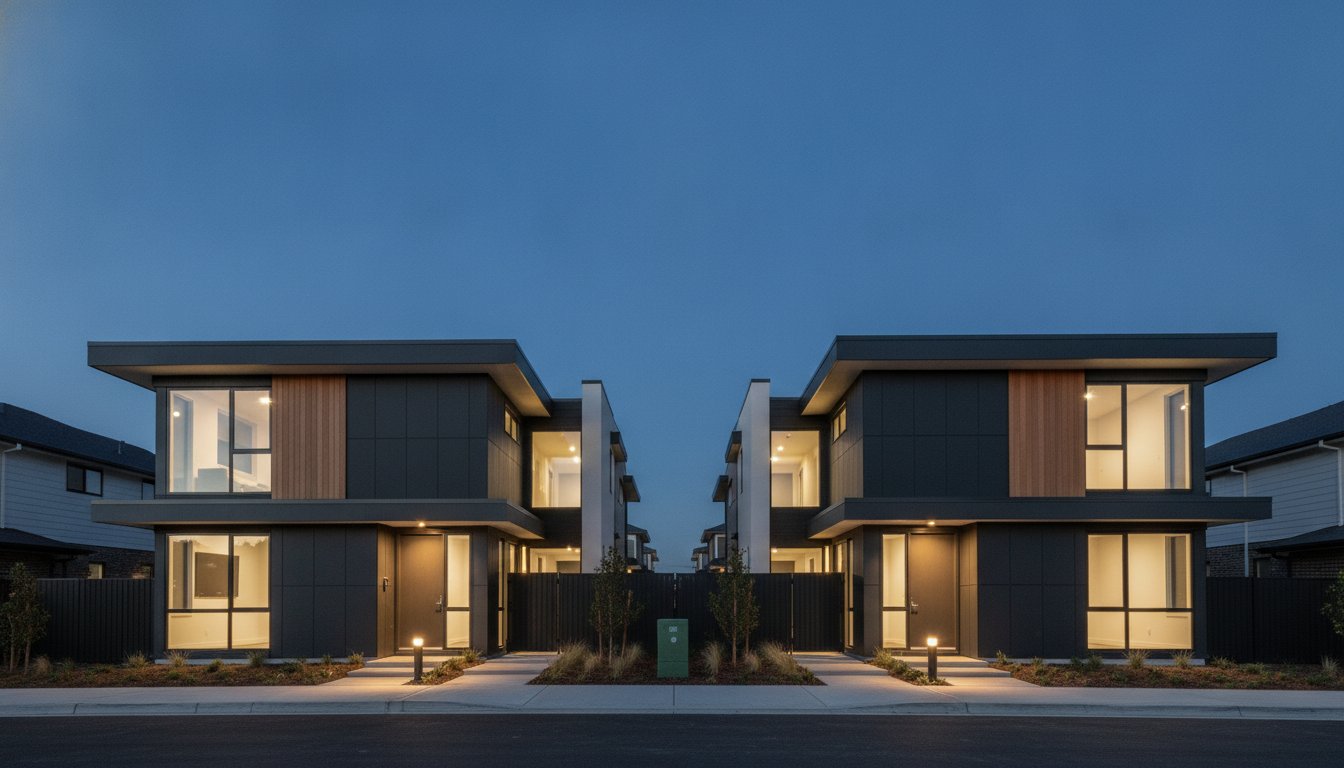
The most successful developers in the 2026 residential market aren't necessarily those with the largest land banks; they're the ones with the most agile capital stacks. Relying on traditional regional bank cycles often means missing the window for high-demand Build-to-Rent projects. If you've encountered lending caps or rigid recourse requirements lately, you know that securing reliable financing for middle-market home builders requires more than just a strong balance sheet. It demands a strategic partner who understands the nuances of the entire project lifecycle from acquisition to stabilization.
We understand that waiting months for underwriting to catch up with market reality isn't just an inconvenience. It's a direct risk to your project's viability. This guide explores how sophisticated developers are now utilizing structured capital and non-recourse debt to scale their portfolios without the typical constraints of institutional giants. You'll learn how to leverage the 2026 BTR shift, access higher leverage options, and significantly increase your speed to market. We'll examine the specific strategies that allow middle-market firms to pivot between for-sale and rental models while maintaining absolute control over their capital structure.
The Evolution of Middle-Market Home Builder Financing in 2026
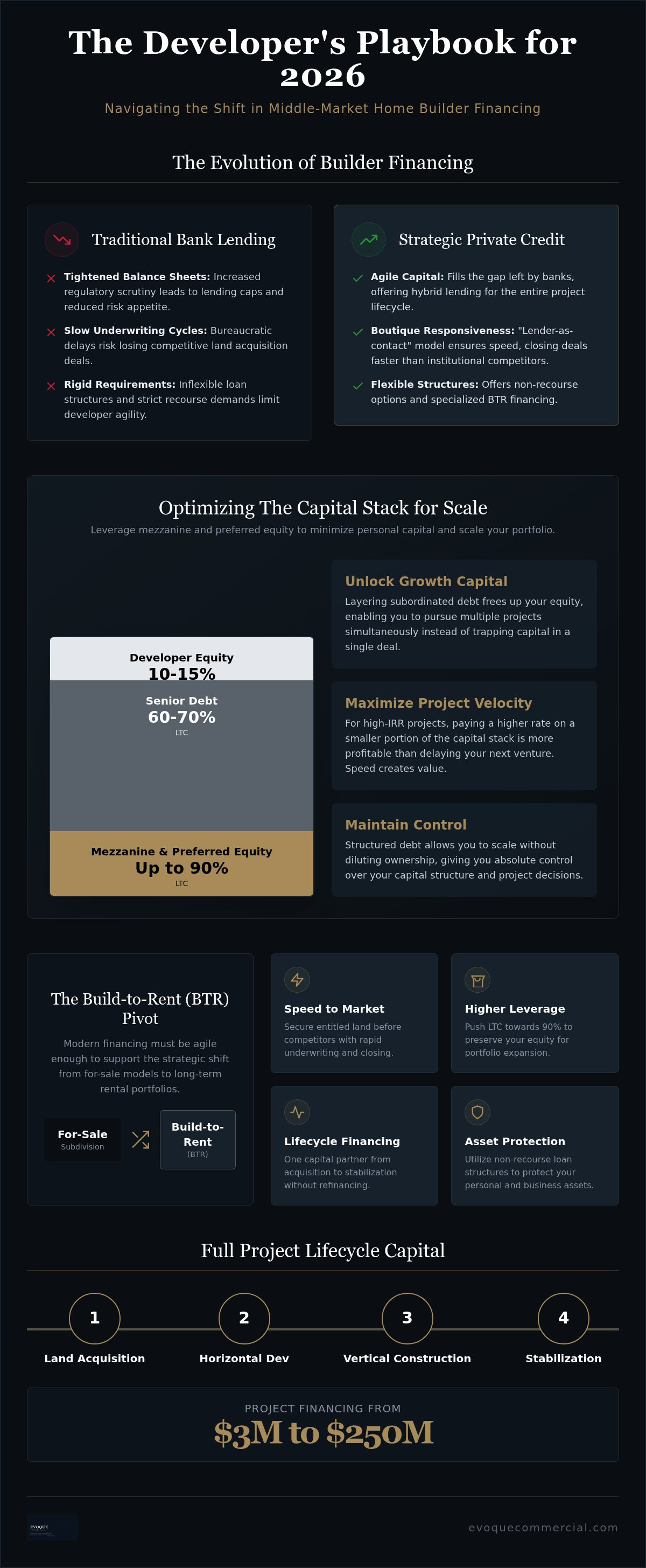
Middle-market builder financing has matured into a distinct and specialized asset class. It sits firmly between the restricted lending limits of local community banks and the rigid, high-barrier entry points of institutional equity. As we move through 2026, the reliance on regional banks has diminished significantly. These institutions have tightened their balance sheets due to increased regulatory scrutiny, leaving a significant gap for private credit to fill. For projects ranging from $3M to $250M, a standard bank loan is often insufficient to cover the entire development lifecycle. This environment requires a hybrid lending approach that addresses three core components: land acquisition, horizontal infrastructure development, and vertical construction. Success in this tier depends on securing a capital partner who can bridge these phases without requiring a total refinance at every milestone.
Current Market Dynamics and Interest Rate Impacts
The 2026 rate environment continues to dictate builder margins and overall project feasibility. While the extreme volatility of previous years has stabilized, carry costs remain a primary concern for developers managing long-term subdivisions. Most financing for middle-market home builders now utilizes floating-rate debt structures paired with mandatory interest rate caps. This structure provides a necessary balance of flexibility and risk mitigation. Despite the elevated cost of capital compared to historical lows, the persistent national housing supply shortage has maintained strong lender appetite. Lenders are increasingly comfortable funding spec builds, provided the developer can demonstrate a disciplined path from entitled land to stabilization.
Institutional Capital vs. Boutique Responsiveness
Large institutional banks often struggle with the agility required for middle-market project timelines. Their underwriting cycles are frequently too slow for competitive entitled land acquisitions where speed is a closing requirement. Boutique firms have emerged as the preferred alternative by offering a "lender-as-contact" model. This approach ensures that the person evaluating the project is the same one troubleshooting issues during the construction phase. By leveraging deep institutional relationships, these boutique partners can fund projects exceeding $100M while maintaining the responsiveness of a dedicated team. This model allows builders to access high-ceiling capital without the bureaucratic delays inherent in massive financial institutions. It's a strategic partnership that values project velocity as much as the developer does.
Navigating the Capital Stack: Beyond Senior Debt for Scale
The capital stack serves as the structural foundation for any significant residential project. For many developers, the primary challenge isn't simply finding a loan; it's optimizing the layers of debt to minimize personal equity requirements. While traditional senior debt typically covers 60% to 70% of the loan-to-cost (LTC), relying solely on this layer can trap a builder's liquid capital in a single project. Strategic financing for middle-market home builders involves layering mezzanine debt or preferred equity to push total leverage toward 85% or 90% LTC. This approach is particularly critical during the initial phases, where land acquisition and development loans provide the necessary runway to reach vertical construction.
Builders must decide between high-leverage and low-cost debt based on their Internal Rate of Return (IRR) targets. If a project yields a high IRR, paying a higher rate for subordinated debt to preserve equity for a second concurrent project is often the more profitable choice. It's about project velocity rather than just the interest rate on a single line of credit. A well-structured stack ensures that capital is deployed where it generates the most value across the entire portfolio.
Leveraging Mezzanine Debt and Preferred Equity
Mezzanine financing and preferred equity function as the bridge between senior debt and the developer's skin in the game. Mezzanine debt is typically secured by a pledge of equity interests, while preferred equity sits directly in the ownership entity. Using these tools allows builders to maintain cash flow across multiple sites. The trade-off is clear: while the cost of capital is higher for these layers, the ability to break ground on three projects instead of one significantly increases the enterprise value of the firm.
Non-Recourse vs. Recourse Financing Structures
Scaling a portfolio requires a shift away from personal liability. Recourse loans tie a developer's personal assets to project performance, whereas non-recourse options limit recovery to the collateral itself. This protection is essential for builders managing multiple concurrent sites. You must understand "bad boy" carve-outs, which trigger liability for specific prohibited acts like fraud or environmental negligence. Transitioning to these structures is a hallmark of the structured capital solutions that define modern growth.
The Build-to-Rent (BTR) Pivot: A Strategic Growth Trend
The 2026 residential landscape is defined by the massive institutional appetite for single-family rentals. Middle-market developers are increasingly pivoting toward this model to mitigate the sales velocity risks associated with high-interest consumer mortgages. Unlike traditional for-sale subdivisions, financing for build-to-rent communities relies on projected net operating income (NOI) and long-term yield rather than individual lot closings. Lenders often view BTR as a lower-risk profile because it provides a steady cash flow hedge against market volatility. This shift has transformed financing for middle-market home builders into a more complex, multi-stage process that requires a dedicated bridge-to-stabilization strategy.
Securing capital for these projects requires a clear exit strategy. While a for-sale project ends at the final closing, a BTR project's value is realized through stabilization and subsequent refinancing or portfolio sale. This necessitates a lender who understands the nuances of horizontal apartment development and the specific timelines required to lease up a new community. The ability to structure a loan that carries through the lease-up phase is what separates successful 2026 builders from those struggling with traditional bank constraints.
Structuring BTR Construction-to-Permanent Loans
Transitioning from vertical construction to a permanent loan requires precise timing. Most BTR loan agreements now include specific stabilization milestones; usually achieving a set occupancy percentage for a consecutive 90-day period. Lenders require a comprehensive property management plan and a proven leasing strategy before the first draw. It's not just about building the homes; it's about proving the operational viability of the entire community to ensure a smooth takeout. Builders must ensure their capital partner can support this lifecycle without requiring a total refinance at every milestone.
Townhome and Horizontal Apartment Trends
Horizontal apartments have become a preferred BTR asset class. These are essentially single-story detached rentals with private yards that offer the density of multifamily with the lifestyle appeal of a single-family home. Financing these high-density residential subdivisions involves unique nuances in how land is entitled and how infrastructure is phased. Market demand drivers show that renters are willing to pay a premium for the privacy these units offer. This makes them a highly attractive target for institutional capital partners looking for stable, long-term residential yields.
Underwriting for Speed: Securing Early-Stage Capital
In the 2026 residential market, the ability to close on entitled land often determines which developers secure the most profitable sites. Institutional underwriting frequently feels like a black box where projects stall for months; however, middle-market firms don't have the luxury of waiting. Securing financing for middle-market home builders requires a critical path that moves from initial review to a firm commitment in weeks, not quarters. This speed is achieved through boutique-style underwriting that prioritizes direct communication and deep sector expertise over bureaucratic committee layers. By providing a clear roadmap of required documentation early, such as detailed pro formas, site plans, and entitlement status reports, developers can fast-track the review process and move toward shovel-ready status with confidence.
The transition from land acquisition to horizontal development is where most project delays occur. Pre-development financing acts as the essential bridge, allowing builders to maintain momentum while finalizing the last of their permits or environmental clearances. A responsive capital partner understands that project velocity is the most effective tool for managing carry costs. If your current lender's committee is slowing your acquisition timeline, it's time to explore structured capital solutions designed for market responsiveness.
Managing Entitlement and Pre-Development Risk
Lenders evaluate entitled land with a significantly different risk profile than unentitled parcels. While unentitled land offers a lower entry price, the horizontal work required for grading, utilities, and infrastructure demands a capital partner who understands local regulatory hurdles. Bridge capital is often the most effective tool for securing a site before a competitor can outbid you. This early-stage funding ensures you have the liquidity to manage horizontal infrastructure costs without depleting your equity reserves before vertical construction even begins. It's about protecting your cash flow during the most vulnerable phase of the project lifecycle.
The Power of Direct Lender Access
Direct access to decision-makers is a structural necessity for maintaining project velocity. When you can speak directly to the person approving your draw schedules, you eliminate the friction that leads to site delays and frustrated subcontractors. This responsiveness has a direct impact on your project's completion and exit timing. Speed-to-funding allows middle-market builders to compete with much larger national firms by offering sellers a guaranteed, fast closing. In a market where prime residential sites are scarce, being the most reliable buyer is often more valuable than being the highest bidder.
Scaling with Strategic Capital Partners: The Evoque Approach
Evoque Commercial occupies a unique position in the capital markets. We focus specifically on the $3M to $250M range, providing the specialized financing for middle-market home builders that larger institutions often overlook. Our "Boutique Institutional" model combines the personalized attention of a dedicated partner with the significant capital capacity required for large-scale residential developments. We don't just provide a loan; we provide a strategic framework that supports your project from initial land acquisition through to inventory financing and the final exit. This continuity is essential for developers who need to maintain focus on construction and sales rather than constant capital restructuring.
Our approach is built on the belief that a lender should be a strategic asset. By offering full-lifecycle support, we help builders navigate the transitions between horizontal infrastructure and vertical construction. This eliminates the friction of switching lenders mid-project, which often leads to costly delays. Whether you're managing a single luxury estate or a multi-phase development, our team provides the stability and responsiveness necessary to keep your project on schedule.
Tailored Financing Paths for Complex Projects
Every project has unique structural requirements that a standard bank loan can't always address. Whether you're developing high-density luxury infill or exploring single family subdivision financing, our team tailors the capital stack to match your specific IRR targets and cash flow needs. Our national scope allows us to support diversified developers across various markets, ensuring consistency even as local conditions shift. We've successfully utilized structured capital to rescue stalled middle-market projects by replacing rigid, restrictive debt with flexible, non-recourse solutions that allow builders to finish the vertical phase and reach stabilization.
Getting Started with a Project Review
We respect the timeline of a developer. Our project review process is designed for clarity and speed. When you submit a project for evaluation via Evoque Lending, you aren't entering a months-long queue. You can expect a meaningful response and initial technical feedback within the first 48 hours of engagement. This high-touch service ensures that you have the information needed to move forward with land options or construction contracts without the lingering uncertainty of institutional delays. We're ready to analyze your pro forma and help you build a capital structure that supports your firm's long-term growth.
Request a Project Review with Evoque Commercial
Securing Your Project Velocity in the 2026 Market
The 2026 residential landscape rewards developers who prioritize capital agility over traditional bank relationships. By optimizing the capital stack with structured debt and pivoting toward Build-to-Rent models, middle-market firms can scale without the typical constraints of institutional giants. High-leverage, non-recourse structures are no longer reserved for the nation's largest firms; they're essential tools for any builder managing projects between $3M and $250M.
Securing the right financing for middle-market home builders requires a partner who understands the entire lifecycle from land acquisition to stabilization. Evoque Commercial combines a national lending scope with the boutique responsiveness your timeline demands. We provide the institutional capital necessary for complex projects while maintaining direct access to decision-makers. It's time to move past slow underwriting cycles and secure the funding your project deserves.
Request a Project Review for Your Next Residential Development and let's discuss how we can support your project's velocity.
Frequently Asked Questions
What is the typical project size for middle-market builder financing?
Typical project sizes for middle-market builder financing range from $3M to $250M. This bracket represents a specialized tier where developers require more capital than local banks can provide, yet need more flexibility than massive institutional funds offer. We structure these deals to cover the full development lifecycle. This range allows for everything from boutique luxury infill projects to large-scale single-family subdivisions and multifamily complexes across the nation.
How does BTR financing differ from traditional construction loans?
Build-to-Rent (BTR) financing differs from traditional construction loans primarily in the underwriting exit strategy. Traditional loans rely on the velocity of individual home sales to pay down the debt. In contrast, BTR underwriting focuses on the projected Net Operating Income (NOI) and long-term yield of the stabilized community. This requires a lender who understands property management hurdles and the specific lease-up timelines necessary for a successful permanent debt takeout.
Can I get financing for land acquisition before it is fully entitled?
You can secure financing for land acquisition before it is fully entitled, though it requires a structured approach. We often utilize bridge capital to help developers lock in prime residential sites while they finalize their permits and environmental clearances. While unentitled land carries a different risk profile, providing a clear path to shovel-ready status allows builders to maintain project momentum and outcompete buyers who are restricted by rigid institutional requirements.
What are the benefits of non-recourse construction loans for developers?
Non-recourse construction loans protect your personal assets by limiting the lender's recovery to the project collateral itself. This structure is essential for developers who want to scale their portfolios across multiple concurrent sites without overextending personal liability. While these loans include specific carve-outs for prohibited acts, they provide the financial insulation necessary to manage high-leverage projects. It's a hallmark of institutional-grade financing for middle-market home builders.
How much equity do builders typically need to bring to the capital stack?
Builders typically need to bring 10% to 30% of the total project cost as equity, depending on how the capital stack is structured. By integrating mezzanine debt or preferred equity, we can often push total leverage to 85% or 90% of the loan-to-cost. This strategic layering allows developers to preserve their liquid capital for other opportunities. The exact requirement depends on project risk, entitlement status, and the developer's track record.
What is bridge-to-stabilization financing and when is it used?
Bridge-to-stabilization financing is a short-term loan used to cover the gap between project completion and permanent refinancing. It's most common in Build-to-Rent or multifamily projects where the developer needs time to reach a specific occupancy threshold. This capital allows you to pay off the construction loan and manage the property's operational phase until it generates enough consistent income to qualify for long-term, lower-interest permanent debt that replaces the construction facility.
How quickly can a middle-market construction loan be closed?
A middle-market construction loan can typically be closed within several weeks once a complete documentation package is received. Our boutique-style underwriting removes the bureaucratic layers found in large commercial banks; instead, it provides direct access to decision-makers. This speed is critical for developers facing expiring land options or tight construction windows. We prioritize a 48-hour initial technical review to ensure the financing for middle-market home builders meets our structural requirements before moving forward.
Does Evoque Commercial provide financing for luxury spec home projects?
Evoque Commercial provides dedicated financing for luxury spec home projects and high-end residential estates. We understand that luxury developments require specialized underwriting that accounts for higher finish costs and longer absorption periods. Our structured capital solutions are designed to support these high-margin projects from the initial ground-up phase through to final sale. We focus on providing the leverage and responsiveness necessary for builders to execute their vision in the luxury residential market.