
If your 2026 pro forma still relies on 2024 pre-sale benchmarks, your project might be dead on arrival at the credit committee. The reality of today's market is that securing condo development construction loans requires more than just a solid site and a reputable builder. You're facing a landscape where interest rates remain stubbornly elevated and traditional banks demand pre-sale velocities that can stall a project before the first shovel hits the dirt. It's a high-stakes environment where the difference between a groundbreaking and a stalled site often comes down to the sophistication of your capital stack.
We understand that managing the friction between stringent HOA reserve requirements and your internal rate of return is a constant balancing act. This article provides a strategic checklist designed for middle-market and luxury developers who need to master these complexities. You'll learn how to structure your financing to secure non-recourse or limited recourse debt while optimizing your debt-to-equity ratio for maximum efficiency. We'll examine the specific documentation needed to clear the latest Fannie Mae "Full Review" hurdles and fast-track your path to capital approval. From land acquisition to the final certificate of occupancy, this is your roadmap to project viability.
Understanding the Landscape of Condo Development Construction Loans
Condo development construction loans are specialized, short-term debt instruments designed specifically for vertical residential projects. Unlike standard commercial mortgages, these loans are project-specific and focused on the transition from raw land or a cleared site to a finished high-density asset. The 2026 market is defined by a sharp divide in demand. Developers are currently balancing the insatiable appetite for high-end luxury units with the rising need for middle-market affordability. This requires a capital partner who understands that the loan lifecycle isn't just about the build. It starts with strategic acquisition, moves through pre-development and vertical construction, and finally concludes with the structured exit of individual unit sales. Precision at each stage is mandatory for capital approval.
Condo vs. Apartment Financing: Key Strategic Differences
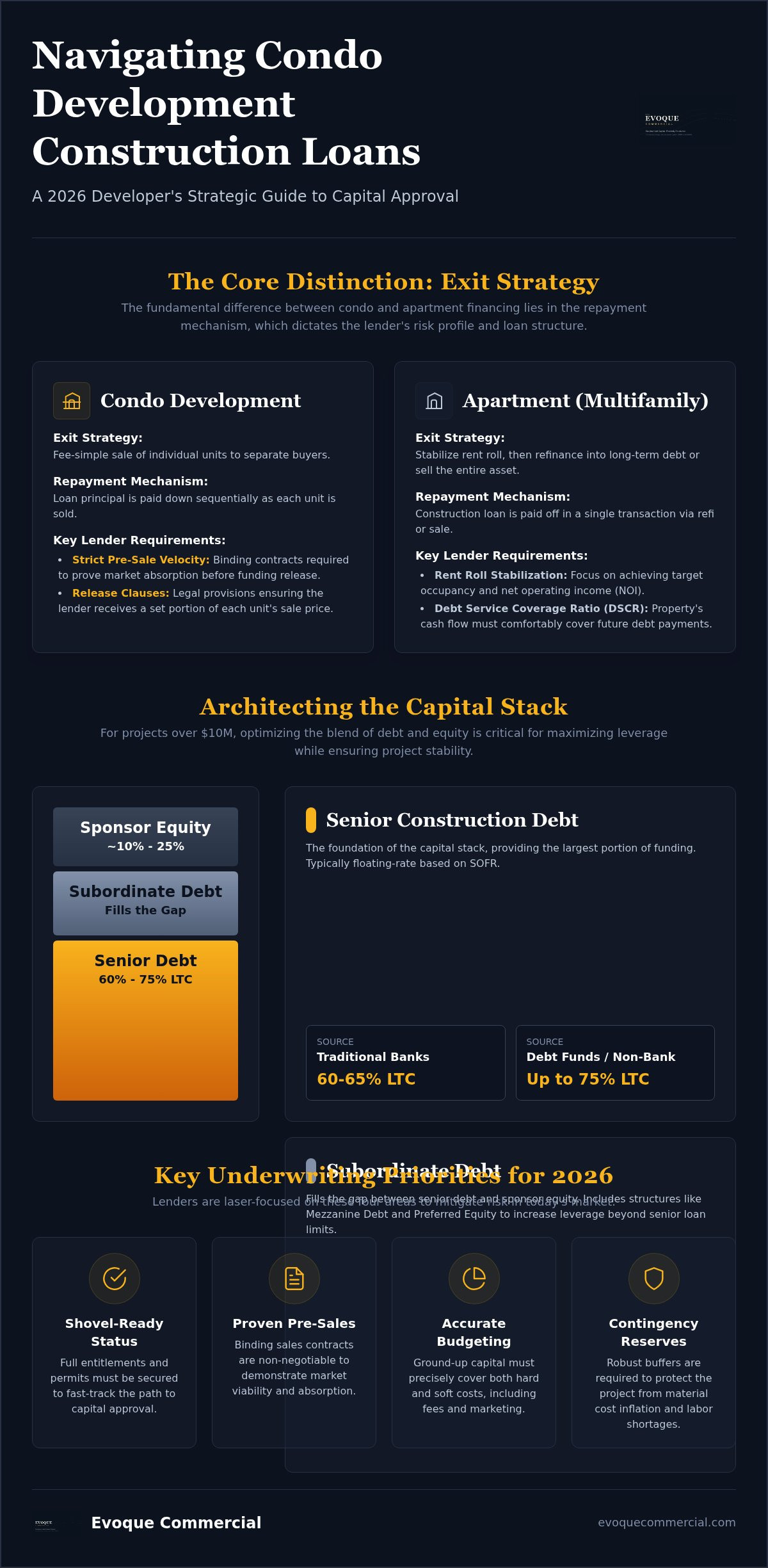
The primary distinction between apartment and condo financing lies in the exit strategy. Multifamily projects aim for rent roll stabilization followed by a long-term refinance or sale of the entire asset. In contrast, condo developers operate under a condominium ownership structure where the goal is the fee-simple sale of individual units. This structural difference dictates the lender's risk profile and the loan's repayment mechanism. Lenders utilize release clauses, which are specific legal provisions that ensure the bank receives a predetermined portion of each unit's sale price to pay down the principal. Because the debt is repaid through sales rather than rental cash flow, lenders in 2026 are increasingly strict about pre-sale requirements. You'll need to prove market absorption by securing binding contracts for a significant portion of the project's value before vertical funding is fully released.
The Role of Ground-Up Construction Capital
Ground-up capital is the engine that drives vertical development. This financing covers the hard costs of the build, from the foundation and structural frame to the high-end interior finishes that define a luxury project. However, a well-structured loan also accounts for the soft costs that can drain a developer's liquidity if not properly leveraged. This includes architectural fees, engineering reports, and the significant marketing budgets required to hit those critical pre-sale targets. Given the supply chain volatility observed in 2026, robust contingency reserves are no longer optional. Lenders now expect to see built-in buffers that protect the project from sudden spikes in material costs or labor shortages. Accuracy in these budget line items is what separates a successful capital approval from a project that stalls in underwriting.
Structuring the Capital Stack for Condo Developments
Structuring a resilient capital stack for projects exceeding $10M requires a disciplined hierarchy of funding. For developers today, the objective is rarely just finding a loan. It's about optimizing the blend of senior debt, subordinate layers, and sponsor equity to maximize leverage while maintaining project stability. As many developers are currently struggling to finance new construction due to elevated costs and shifting bank requirements, the precision of this structure becomes your primary competitive advantage. A well-organized stack ensures that the project isn't just funded, but protected against the liquidity pinches that can occur during vertical development.
Senior Construction Debt: Terms and Limits
Senior debt serves as the foundation of condo development construction loans, typically providing the largest portion of the capital. In the 2026 credit environment, traditional banks and credit unions generally cap their exposure at 60% to 65% Loan-to-Cost (LTC). For developers seeking higher leverage, non-bank lenders and debt funds often extend up to 75% LTC, though this usually comes with a higher interest premium. These structures frequently utilize floating rates based on SOFR; however, some institutional partners offer fixed-rate options for multi-year builds to provide budget certainty. Understanding these nuances is similar to the process for Multifamily Construction Loans: The 2026 Developer’s Buying Guide, but with a tighter focus on the unit-by-unit repayment schedule and release prices.
Subordinate Debt: Mezzanine and Preferred Equity
When senior debt and sponsor equity leave a gap, subordinate capital layers become essential. Mezzanine debt sits directly behind the senior loan, secured by a pledge of the developer’s ownership interest rather than a mortgage on the real property. It's a powerful tool for reducing the developer’s cash-in-deal, allowing capital to be redeployed across multiple projects. Alternatively, preferred equity offers a more flexible structure. It functions as a "last-in, first-out" capital layer that often lacks the rigid foreclosure rights associated with mezzanine debt, making it an attractive choice for luxury high-rise projects with longer absorption timelines. Choosing between these options requires a deep dive into your project's specific risk profile. You can find more detail on these trade-offs in our Debt vs Equity: Real Estate Developer’s Strategic Guide.
By utilizing structured capital solutions, developers can bridge these funding gaps without diluting their ownership stake excessively. This strategic layering ensures the project remains fully funded through the vertical construction phase, providing the peace of mind that comes from a fully committed capital commitment.
Key Underwriting Metrics: What Condo Lenders Measure
Lenders evaluating condo development construction loans look past the architectural renderings to the underlying financial mechanics. While a multifamily project relies on recurring lease revenue, a condo project is a liquidation play. This fundamental difference shifts the underwriting focus toward metrics that measure speed, efficiency, and cost control. Institutional partners prioritize the actual capital required to reach completion, making Loan-to-Cost (LTC) the primary benchmark. While Loan-to-Value (LTV) is considered, it remains a secondary, speculative projection until the market validates your pricing through unit closings.
Profitability is often hidden within the project's efficiency ratio. Lenders scrutinize the net saleable square footage against the gross building area to ensure the floor plan isn't weighted down by excessive non-revenue space. Furthermore, Debt Service Coverage Ratio (DSCR) and Debt Yield are analyzed as "Plan B" contingencies. Lenders ask whether the asset could survive as a rental project if the sales market softens. A healthy debt yield provides the assurance that the project remains viable even if the exit strategy must shift from unit sales to long-term stabilization.
The Pre-sale Requirement: The Ultimate Risk Mitigant
The pre-sale quota is the most significant hurdle for developers seeking capital approval in 2026. Lenders typically require between 30% and 50% of the units to be under contract before vertical funding is fully released. However, not all contracts are viewed equally in the eyes of an underwriter. Lenders distinguish between "hard" deposits, where cash is held in a third-party escrow account, and "soft" reservations or letters of intent. Institutional capital demands significant, often non-refundable hard deposits to count a unit as a valid sale. Strong pre-sale velocity doesn't just unlock funding; it often results in more favorable interest rates because the market absorption risk is partially mitigated before the first shovel hits the dirt.
Construction Risk Management and Draw Schedules
Lenders don't just fund projects; they fund the teams capable of delivering them. An experienced general contractor (GC) with a proven track record in high-density residential builds is a non-negotiable requirement. Underwriters look for bonded contracts and a history of delivering complex projects on time and within budget. The funding process itself is managed through a rigorous cycle of inspections and lien waivers to ensure every dollar is accounted for. A Draw Schedule is the primary mechanism for mitigating construction-phase risk by ensuring funds are only released as verified milestones are achieved. This systematic approach protects the lender's position and ensures the developer has the liquidity needed to maintain momentum throughout the entire build lifecycle.
The Developer’s Checklist for Condo Loan Approval
Securing capital for condo development construction loans requires a high degree of organizational discipline. Lenders in the current credit environment prioritize projects that are "shovel-ready," meaning every entitlement is secured and every risk is accounted for in a comprehensive data room. In 2026, a developer's ability to demonstrate execution readiness is just as important as the project's location. You'll need to present a realistic pro forma that includes significant inflation buffers and a third-party market study to validate your unit pricing and absorption projections. Lenders also scrutinize the track record of your entire team, from the lead architect to the general contractor and the sales agency.
Phase 1: Pre-Development and Acquisition Documents
Before vertical funding begins, the lender must verify the site's physical and legal viability. This starts with the Purchase and Sale Agreement (PSA) for the land and extends to Environmental Phase I and II reports. Geotechnical studies are equally vital to ensure no unforeseen subsurface issues disrupt your foundation budget. For a deeper look at the initial stages of securing a site, refer to our Land Acquisition & Development Loans: Developer’s Guide. These documents establish the baseline for the project's risk profile and are the first items reviewed during the due diligence process.
Phase 2: Construction and Execution Readiness
Institutional lenders require absolute certainty on costs before approving condo development construction loans. You'll need final architectural plans and Site Improvement Permits (SIPs) in hand to prove the project can proceed without delay. A fixed-price construction contract with a Guaranteed Maximum Price (GMP) is often the deciding factor for approval. This contract protects the project from the labor and material fluctuations that have characterized the 2026 market. Additionally, you must provide a detailed marketing plan that outlines your unit release strategy and demonstrates a clear path to hitting the pre-sale targets required by your senior lender.
Phase 3: Financial and Legal Structure
Your legal foundation must be institutional grade to satisfy credit committees. This includes your operating agreement and the specific entity structure, typically an LLC or LP, along with clear proof of equity and a verified source of funds. Finally, the lender will review your condominium documents, including HOA bylaws, CC&Rs, and public offering statements. These documents ensure the project is legally prepared for individual unit sales and that the exit strategy is executable. If you are ready to move your project from the planning phase to the build phase, contact our team to review your 2026 project checklist today.
Evoque Lending: Structured Capital for High-Density Condo Projects
Evoque Lending bridges the gap between institutional capital resources and the boutique responsiveness that middle-market developers require. While large banks often struggle with the nuances of high-density residential subdivisions, our team focuses on the specific mechanics of condo development construction loans. We provide financing paths ranging from $3M to $250M, ensuring that both luxury infill projects and large-scale vertical developments have access to the liquidity they need. Our role extends beyond simple lending; we act as a strategic partner throughout the project lifecycle, from the initial site clearing to the final unit closing.
Our expertise is particularly valuable when navigating complex financial scenarios that traditional lenders often avoid. We specialize in construction completion financing and project recapitalization, providing solutions for developers facing stalled timelines or shifting market conditions. Whether your project requires a bridge-to-stabilization loan or a complex mezzanine debt layer to optimize your equity, we provide the structural discipline needed to maintain momentum. We prioritize the project's viability and the sponsor's track record, ensuring that capital is deployed where it can generate the highest impact. Our national reach allows us to support ground-up builds across the United States with professional precision.
Boutique Service with Institutional Reach
Developers working with Evoque Lending gain direct access to decision-makers, which significantly accelerates the project review timeline. We don't believe in a one-size-fits-all approach to vertical development. Instead, we craft tailored financing structures that adapt to your project's specific pre-sale velocity and absorption projections. This flexibility is essential in 2026, as market drivers continue to shift between luxury demand and middle-market necessity. You can explore these dynamics further in our 2026 Strategic Capital Guide for Middle-Market Builders, which details how we help sponsors navigate the current credit environment.
Getting Started: The Project Review Process
The path to capital approval begins with our methodical project review intake. To provide a preliminary quote and a clear term sheet, we analyze your current entitlements, detailed pro forma, and the track record of your development team. This disciplined process ensures that every stakeholder understands the milestones required for a successful closing. We respect your timeline and move with the agility required to meet groundbreaking deadlines. If you're ready to secure the funding for your next vertical residential project, request a project review for your condo development today and experience a partnership built on professional precision.
Executing Your 2026 Vertical Development Strategy
Success in the current vertical market depends on your ability to align project milestones with institutional credit requirements. You've seen that mastering the nuances of the capital stack and strictly adhering to pre-sale benchmarks are non-negotiable for capital approval. By maintaining a shovel-ready status and securing fixed-price contracts, you position your project as a low-risk asset for lenders. Navigating the complexities of condo development construction loans requires a partner who understands that timing is as critical as the t-account.
Evoque Lending provides the specialized ground-up residential expertise and national US capital coverage needed to move from pro forma to groundbreaking. We offer financing from $3M to $250M, ensuring your project has the liquidity it deserves without the institutional rigidity of a traditional bank. If you're ready to advance your development, request a structured capital proposal for your condo development. Your vision deserves a capital partner that values precision and responsiveness as much as you do.
Frequently Asked Questions
What is the typical interest rate for a condo development construction loan in 2026?
Interest rates for condo development construction loans generally range from 6.5% to 9.5% for traditional bank financing. Higher-risk projects or more flexible lending structures typically see rates between 9% and 12% or higher. Non-bank lenders and debt funds often start their pricing at 8% depending on the sponsor's track record. These rates fluctuate based on the project's specific leverage and the overall credit environment.
How much equity do I need to provide for a condo construction loan?
Traditional banks and credit unions typically require between 35% and 40% developer equity, which results in a 60% to 65% Loan-to-Cost (LTC) ratio. Non-bank lenders are often more flexible, providing financing with approximately 25% equity. While some federal programs allow for lower contributions in the multifamily sector, condo developments usually demand more significant "skin in the deal" to mitigate market absorption risks.
Are condo construction loans typically recourse or non-recourse?
Most bank-led construction financing includes full or partial recourse to the developer. However, institutional capital and specialized debt funds offer non-recourse or limited-recourse options for projects with exceptional pre-sale velocity and high equity positions. These structures often include "bad boy" carve-outs and completion guarantees. Securing non-recourse debt depends heavily on the sponsor's experience and the project's overall risk profile.
Can I get financing for a condo project without pre-sales?
Securing condo development construction loans without any pre-sales is extremely difficult in the current market. Most lenders require a pre-sale quota of 30% to 50% of the units to be under binding contract with hard deposits before vertical funding is released. While some private lenders might consider "spec" builds, they'll demand significantly higher equity and interest premiums to offset the lack of verified market demand.
What is the difference between a condo construction loan and a bridge loan?
A condo construction loan is a long-term facility designed to fund the vertical build and hard costs of a project through completion. A bridge loan is a shorter-term solution used to "bridge" a specific gap, such as land acquisition or project recapitalization. Bridge loans are often used to stabilize an asset or provide liquidity while a developer works toward a construction loan or a final exit.
How long does it take to close a $10M+ condo construction loan?
The closing timeline for a $10M+ facility typically ranges from 60 to 90 days. This period is necessary for the lender to conduct thorough due diligence, including third-party appraisals, environmental reviews, and legal audits of the condominium documents. Developers who provide a complete and organized data room can often fast-track this process. Speed is also influenced by the project's entitlement status and execution readiness.
What happens to the construction loan if unit sales are slower than projected?
If unit sales fall behind the absorption schedule, the lender may require a loan rebalancing or additional equity to maintain the agreed-upon Loan-to-Cost ratio. Slow sales can also impact the interest reserve, potentially requiring the developer to seek construction completion financing or a bridge-to-stabilization loan. Lenders monitor sales velocity closely to ensure the debt is repaid according to the projected unit release prices and timelines.
Do lenders finance the acquisition of the land and the construction in one loan?
Yes, many institutional partners offer "Acquisition and Construction" (A&C) loans that combine land purchase and vertical building costs into a single facility. These loans are structured with multiple funding phases, starting with the land draw and followed by milestone-based construction draws. This structure provides the developer with capital certainty from the initial site purchase through the final certificate of occupancy and unit closings.