
The most successful developers in 2026 don't view bridge loans for multifamily projects as a desperate last resort; they see them as a sophisticated lever for capital efficiency. Waiting for a traditional bank to approve a time-sensitive acquisition often means losing a shovel-ready site to a more agile competitor. It's frustrating to watch a project stall because an original lender exited or because your own capital is locked in a property awaiting stabilization.
We understand that in high-stakes development, speed and structure are just as vital as the interest rate itself. This article details the strategic mechanics of multifamily bridge financing and how to leverage short-term capital to accelerate your project from acquisition to stabilization. You'll learn about current 2026 underwriting standards, the benefits of non-recourse structures, and the precise steps required to bridge the gap to permanent agency financing. By aligning your capital stack with the project's natural lifecycle, you can maintain momentum and secure the path to long-term profitability.
Defining the Role of Bridge Capital in Multifamily Development
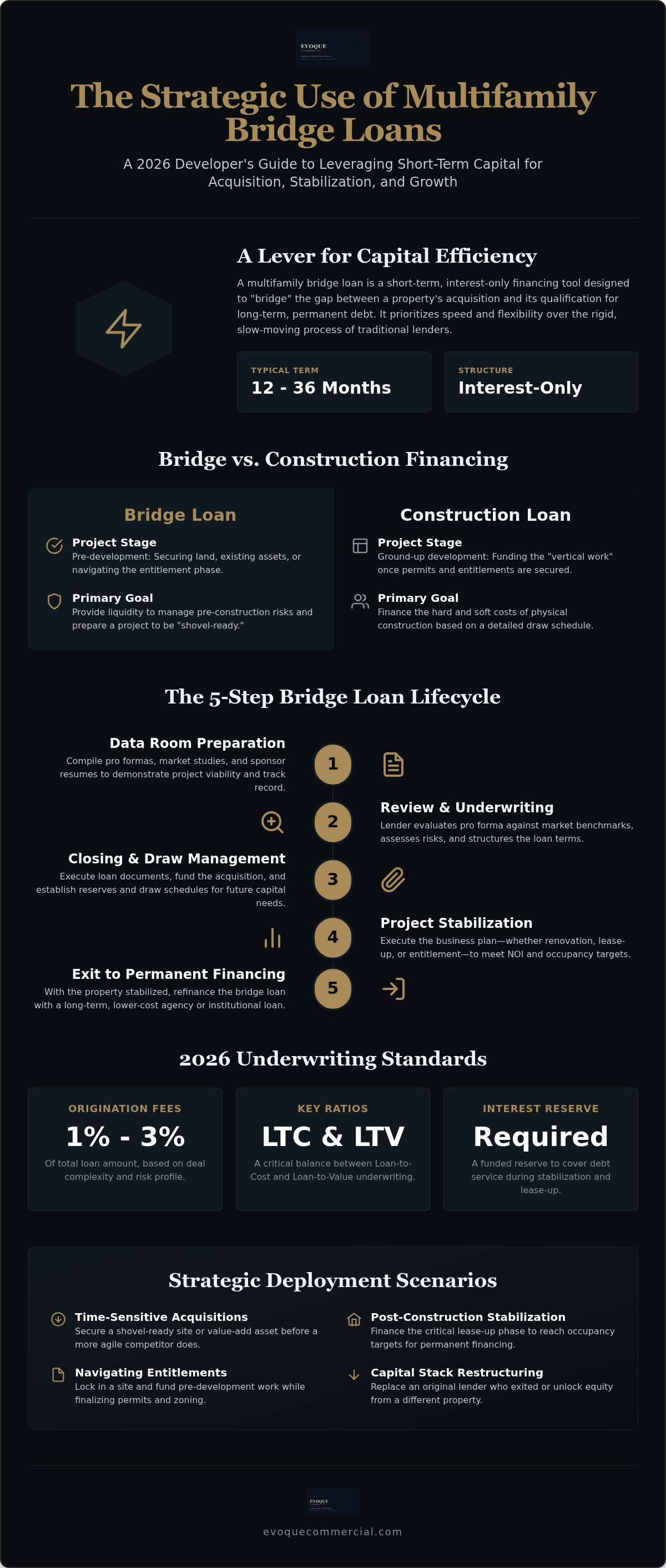
A bridge loan in the multifamily sector is a short-term, interest-only financing solution used to bridge the gap until a project qualifies for permanent debt. In 2026, the typical timeframe for this capital is 12 to 36 months. Unlike traditional senior bank financing, which often moves at a bureaucratic pace, bridge loans for multifamily projects are built for speed. Developers prioritize this responsiveness because market opportunities don't wait for committee-led approval cycles. The goal isn't just to secure funds, but to ensure the project remains on its critical path toward stabilization.
Bridge Loans vs. Multifamily Construction Financing
The distinction between these two capital sources lies in the project's lifecycle stage. You'll typically deploy a bridge loan to secure land or an existing asset during the entitlement phase. This allows you to lock in the site while finalizing permits. Once you're ready for vertical work, you'll transition to a multifamily construction loan. Bridge debt is specifically designed to handle pre-development risks that traditional construction lenders might find unpalatable. It provides the necessary liquidity to clear entitlement hurdles, ensuring the project is 'shovel-ready' before the heavy lifting of vertical construction begins.
The Institutional Boutique Advantage
Middle-market developers often find themselves caught between rigid institutional lenders and small-scale local banks. The institutional boutique model solves this by providing the capital depth of a major firm alongside the specialized attention of a dedicated partner. This structure is essential for complex, structured capital needs where 'off-the-shelf' loan products fail to meet project requirements. Certainty of execution is defined as the lender's unwavering commitment to closing on the original terms and timeline, serving as the developer's primary risk mitigant in 2026. This reliability ensures that your project moves from acquisition to completion without the threat of a funding exit at a critical juncture.
How Do Bridge Loans Work? The 5-Step Lifecycle
The lifecycle of bridge loans for multifamily projects is a disciplined progression from initial data aggregation to the final execution of a take-out loan. To secure institutional-grade capital in 2026, developers must present a comprehensive data room. This package needs to include granular pro formas, localized market demand studies, and detailed sponsor resumes. Your track record as a sponsor serves as the primary credibility marker; lenders prioritize your experience in navigating the complexities of multifamily stabilization and your ability to execute on the stated business plan.
Phase 1: Project Review and Underwriting
This phase begins with a high-level feasibility check. We evaluate your pro forma against current 2026 rental benchmarks and projected Net Operating Income (NOI). It's not enough to have a viable site; the unit mix and floor plans must align with modern tenant preferences for hybrid work and high-efficiency living. Identifying potential deal breakers early, such as entitlement delays or unforeseen environmental remediation, prevents wasted time and capital. A strategic partner looks for ways to mitigate these risks through structured solutions rather than simply rejecting the deal based on surface-level metrics.
Phase 2: Closing and Draw Management
Once the commitment is signed, the focus shifts to the mechanics of closing and ongoing liquidity. Origination fees in 2026 typically range from 1% to 3% of the loan amount, depending on the complexity of the deal structure. A critical component of the loan is the interest carry reserve. This reserve acts as a safety net, ensuring the project can meet its debt service obligations even during the peak of renovation or lease-up. For value-add bridge loans for multifamily projects, we implement a rigorous draw schedule. This process ensures that capital is deployed in sync with project milestones, maintaining momentum while protecting the project's collateral. If you're looking for a partner that understands this balance, exploring structured capital solutions can help align your financing with your development timeline.
Managing the relationship during the loan term requires consistent reporting and transparency. As the project approaches stabilization, the focus shifts toward the exit. The bridge lender and developer work in tandem to ensure the asset is positioned for permanent financing. This proactive management prevents the "bridge to nowhere" scenario, ensuring a smooth transition to agency or long-term institutional debt once the project hits its target occupancy and income levels.
Key Financial Metrics and Underwriting Criteria for 2026
Underwriting bridge loans for multifamily projects in 2026 requires a shift from static asset evaluation to dynamic risk management. While traditional banks obsess over current cash flow, bridge lenders prioritize the project's future viability. Loan-to-Cost (LTC) has become the primary metric for developers, often capping at 75% to 80% for those with proven track records. This focus on cost rather than current value allows for the inclusion of renovation and interest carry reserves within the loan structure. Conversely, Loan-to-Value (LTV) remains a critical ceiling, typically capped at 65% to 75% of the property's as-is value to ensure a sufficient equity cushion.
The 2026 market operates on floating rates tied to the Secured Overnight Financing Rate (SOFR). You'll find spreads commonly ranging between 350 and 650 basis points over SOFR, reflecting a disciplined approach to risk. Because these projects are often in transition, a Debt Service Coverage Ratio (DSCR) of 1.25x isn't always required at closing. Instead, underwriting focuses on the projected Net Operating Income (NOI) at stabilization. To protect your broader portfolio, institutional-grade bridge debt is frequently structured as non-recourse, limiting the lender's reach to the asset itself rather than your personal balance sheet.
Optimizing the Capital Stack
Bridge debt serves as the foundation of the capital stack, but it rarely acts alone in large-scale developments. It sits below mezzanine debt and preferred equity, providing the bulk of the senior leverage. When structuring bridge loans for residential development, you must balance the total leverage against the overall cost of capital. High-leverage stacks can accelerate project timelines but require a precise understanding of how each layer impacts your Internal Rate of Return (IRR). A well-structured stack ensures that the senior bridge debt remains the cheapest and most flexible component of your financing.
The Importance of the Exit Strategy
Your exit strategy isn't just a part of the application; it's the most critical underwriting factor. A lender won't approve bridge loans for multifamily projects without a clear, documented "Take-Out" plan. This usually involves transitioning to permanent agency financing or a property sale once stabilization is achieved. We specialize in projects ranging from $3 million to $250 million, where the complexity of the exit requires institutional-grade planning. Whether you're aiming for a long-term hold or a strategic disposition, the bridge loan's terms must be reverse-engineered from your final objective.
Strategic Use Cases: When Developers Deploy Bridge Financing
Bridge financing serves as a high-velocity tool in a developer’s arsenal. It's often the difference between securing a prime site and losing it to a more liquid competitor. In the 2026 market, acquisition and land financing allow you to lock in properties before every entitlement is finalized. This speed is critical for luxury residential developments and multifamily subdivisions where land values fluctuate rapidly. Additionally, recapitalization provides a path to release trapped equity. If a project has appreciated but hasn't reached its final performance targets, a bridge loan can pull capital out to fund your next acquisition without selling the asset prematurely.
Bridge-to-Stabilization for Multifamily Assets
The period between receiving a Certificate of Occupancy and reaching 90% stabilization is a vulnerable phase. Permanent agency lenders like Fannie Mae or Freddie Mac typically require a history of stabilized income before they'll commit to a 10-year term. Bridge-to-stabilization loans manage this gap, providing interest-only payments while your leasing team hits their targets. For Build-to-Rent (BTR) communities, this is especially vital. BTR projects often lease up in phases; a bridge structure accounts for this staggered income growth. Bridge-to-stabilization is a tactical bridge toward long-term yield. This structure ensures you aren't forced into a permanent loan prematurely at a lower valuation.
Construction Completion and Stalled Project Rescue
Market shifts in 2026 have led some original lenders to exit projects mid-construction. When a bank pulls back or unexpected cost overruns exhaust the original budget, the project stalls. This is where rescue capital becomes essential. Using bridge loans for multifamily projects to finish construction protects your existing equity from being wiped out by a foreclosure. It provides the necessary funds to cross the finish line and reach the point where the property can be refinanced or sold. If you're facing a stalled timeline or a lender exit, securing construction completion financing can stabilize your project and preserve your portfolio's value.
The strategic deployment of this capital isn't about desperation. It’s about maintaining control over the project’s timeline and ensuring that temporary market friction doesn't derail long-term development goals. By utilizing bridge debt for specific milestones, you keep your capital stack agile and your equity working across multiple fronts. This approach allows you to navigate the complexities of 2026 with institutional-grade confidence.
Navigating the Exit: From Bridge to Permanent Financing
The exit strategy isn't just the final step; it's the anchor for your entire capital plan. Sophisticated developers reverse-engineer their bridge loans for multifamily projects by starting with the specific requirements of the take-out lender. This take-out loan, typically permanent agency debt or long-term institutional financing, provides the liquidity required to retire the bridge facility. In the 2026 market, where national median rents reached $1,390 in August, your exit plan must account for precise operational benchmarks. Whether you choose a property disposition or a long-term refinance, the decision hinges on the asset's performance relative to the cost of permanent capital. Extension options serve as a critical safety net during this period. These provisions allow for 6 to 12-month buffers, protecting the project from temporary market volatility or leasing delays.
Qualifying for the Take-Out
To transition successfully, you must hit specific financial milestones that traditional lenders demand. Agency lenders like Fannie Mae and Freddie Mac require sustained occupancy rates, often 90% or higher, alongside strict Net Operating Income (NOI) and debt yield targets. Appraisal timing is a high-stakes variable in this process. An appraisal conducted too early may fail to capture the full value of your stabilization efforts; waiting too long might expose the project to interest rate shifts. Evoque Lending acts as a strategic partner during this phase, helping you time the market and align your data room with the expectations of permanent lenders. This boutique-style responsiveness ensures that the transition from short-term debt to long-term stability is seamless.
Conclusion: The Strategic Advantage of Bridge Debt
Bridge financing is far more than a temporary fix; it's a powerful growth engine for developers who understand how to manage project lifecycles. When structured correctly, bridge loans for multifamily projects provide the necessary runway to reach institutional-grade stabilization. By utilizing institutional-grade capital with the agility of a boutique firm, you can acquire, renovate, and stabilize assets that traditional banks would overlook. This approach minimizes personal liability through non-recourse structures and maximizes your ability to scale a portfolio across the United States. When you align your development milestones with a disciplined capital stack, you transform financing from a hurdle into a competitive advantage. Request a project review with Evoque Lending today.
Strategic Capital for the Next Phase of Development
The 2026 landscape demands more than just capital; it requires a disciplined approach to the entire development lifecycle. By integrating bridge loans for multifamily projects into your broader strategy, you ensure that acquisition speed and stabilization timelines remain under your control. You've seen how these structures provide the necessary runway to navigate entitlement risks and transition smoothly into permanent agency debt. Protecting your portfolio through non-recourse structures and institutional-grade underwriting remains the hallmark of a sophisticated developer.
Evoque Lending provides the national coverage and institutional relationships required for large-scale projects, delivered with the responsiveness of a boutique partner. We specialize in structured capital solutions ranging from $3M to $250M, ensuring your project has the financial backbone it needs to succeed. Whether you're acquiring land or rescuing a stalled construction site, our team is ready to analyze your project's unique requirements. Secure Your Multifamily Project's Future with Evoque Lending Bridge Capital and move forward with the confidence that your vision is supported by expert strategy.
Frequently Asked Questions
What is the typical interest rate for a multifamily bridge loan in 2026?
Multifamily bridge loan interest rates in 2026 typically range from 9.0% to 10.5% for high-quality assets. Most institutional lenders structure these as floating rates tied to the Secured Overnight Financing Rate (SOFR) with spreads between 350 and 650 basis points. The final rate depends on the sponsor's track record and the project's specific risk profile. This floating structure provides flexibility during the 12 to 36-month term required for project stabilization.
Can I use a bridge loan for ground-up multifamily construction?
Yes, you can use bridge capital for the pre-development and land acquisition phases of ground-up projects. While vertical construction typically requires a dedicated multifamily construction loan, bridge financing is the ideal tool for securing a site before entitlements are finalized. It bridges the gap between land purchase and the start of vertical development. This allows developers to lock in strategic locations while final construction permits are still in the approval process.
What is the difference between recourse and non-recourse bridge financing?
Recourse financing requires a personal guarantee from the sponsor, making them personally liable if the project defaults. Non-recourse bridge financing limits the lender's recovery to the collateralized asset itself, protecting the developer's personal balance sheet and broader portfolio. We specialize in non-recourse structures for large-scale multifamily developments. This institutional-grade approach is preferred by experienced developers who need to insulate their other holdings from the specific risks of a single project.
How fast can a commercial bridge loan close for a multifamily project?
Commercial bridge loans for multifamily projects can close in as little as 14 to 30 days, depending on the complexity of the capital stack. This speed is significantly faster than traditional bank financing, which often requires 60 to 90 days for committee approval. Strategic developers use this responsiveness to secure time-sensitive acquisitions or to prevent project stalls when an original lender exits. The streamlined underwriting process focuses on asset viability and the sponsor’s exit strategy.
What are the typical origination fees for a development bridge loan?
Origination fees for multifamily bridge debt generally range from 1% to 3% of the total loan amount. These points are paid at closing and cover the costs of structuring, underwriting, and capital deployment. Some lenders may also charge an exit fee or extension fees if the project requires more time to reach stabilization. It's essential to evaluate these costs against the project's projected IRR to ensure the financing remains a viable lever for growth.
Do bridge loans require a minimum occupancy for multifamily assets?
No, bridge loans for multifamily projects typically don't require a minimum occupancy rate at the time of closing. Unlike permanent agency financing, which demands 90% stabilization, bridge capital is specifically designed for assets in transition. Underwriters focus on the property's projected Net Operating Income (NOI) and the viability of the lease-up plan. This flexibility allows developers to acquire underperforming properties or finish construction without the immediate pressure of stabilized cash flow requirements.
Can bridge capital be used as rescue capital for stalled projects?
Bridge capital is an effective form of rescue capital for projects that have stalled due to cost overruns or original lender exits. We provide construction completion financing to bridge the gap between a project's current state and its final Certificate of Occupancy. This tactical infusion of capital protects the developer's equity position and prevents foreclosure. It ensures the project reaches the stabilization point required to qualify for long-term, permanent agency debt or a strategic sale.
What happens if I cannot secure permanent financing before the bridge loan expires?
If you can't secure permanent financing before the initial term expires, most bridge loans include extension options. These typically provide an additional 6 to 12 months of runway in exchange for an extension fee, often 0.5% to 1%. This safety net is crucial for navigating temporary market shifts or slower-than-expected leasing periods. Strategic planning during the initial underwriting phase ensures these options are available, providing the developer with the necessary flexibility to reach their exit milestones.