
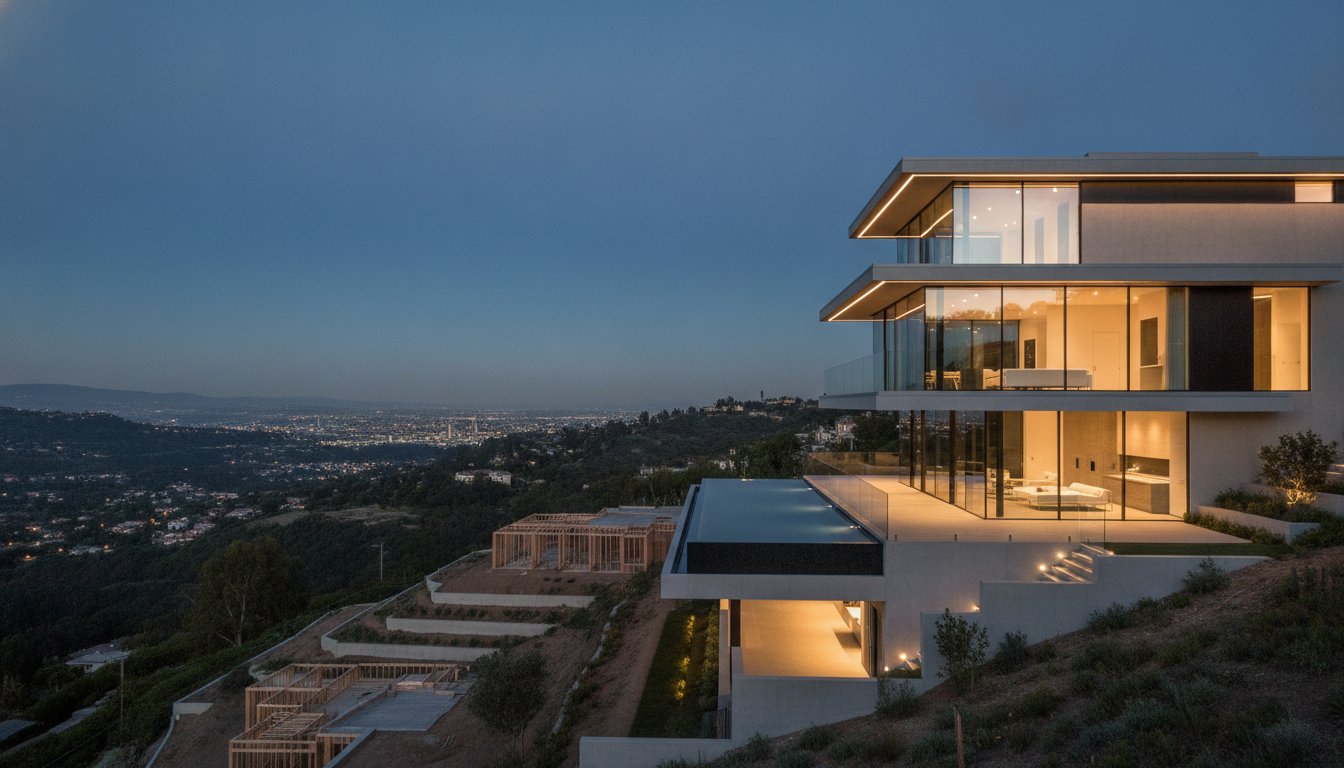
A $50 million luxury subdivision cannot be financed with the same rigid templates used for suburban tract housing. You've likely felt the frustration of institutional lenders who demand excessive equity or stall construction with glacial draw processes. While the median luxury home price has climbed to $1.37 million as of mid-2026, the capital markets for high-end projects remain fragmented. Securing luxury residential development loans requires more than just a strong balance sheet; it demands a lender who treats your capital stack as a strategic asset rather than a simple checklist.
We understand that your primary objective is maximizing loan-to-cost (LTC) to preserve equity for your next high-value acquisition. This guide provides a comprehensive roadmap to mastering structured capital for spec estates and vertical construction in 2026. You'll learn how to navigate current interest rate spreads, leverage non-recourse options, and secure the boutique responsiveness necessary to keep your timeline on track. From land acquisition to construction completion, we're breaking down the mechanics of high-leverage debt in a market where luxury homes now average 319 days to sell. Our goal is to help you build a financing structure that is as sophisticated as the architecture you develop.
What Defines Luxury Residential Development Loans in 2026?
Luxury residential development loans represent a specialized credit market, distinct from traditional commercial or mid-market residential financing. In 2026, the luxury tier is defined by high cost-per-unit and premium market positioning that prioritizes architectural distinction over density. Traditional commercial banks often retreat from these projects, especially luxury spec estates, because they view the lack of a pre-signed buyer as an unacceptable risk concentration. Securing luxury residential development loans involves navigating a landscape where the collateral's value is as much about aesthetics as it is about square footage. Private capital providers have stepped into this void, offering structured solutions for developments from $3 million to $250 million. These lenders prioritize the developer's track record and the project's unique value proposition rather than relying on rigid credit boxes. The Real estate development process for luxury assets is inherently complex, requiring a financing partner who understands the nuances of high-end construction.
Market Sensitivity and Absorption Risks
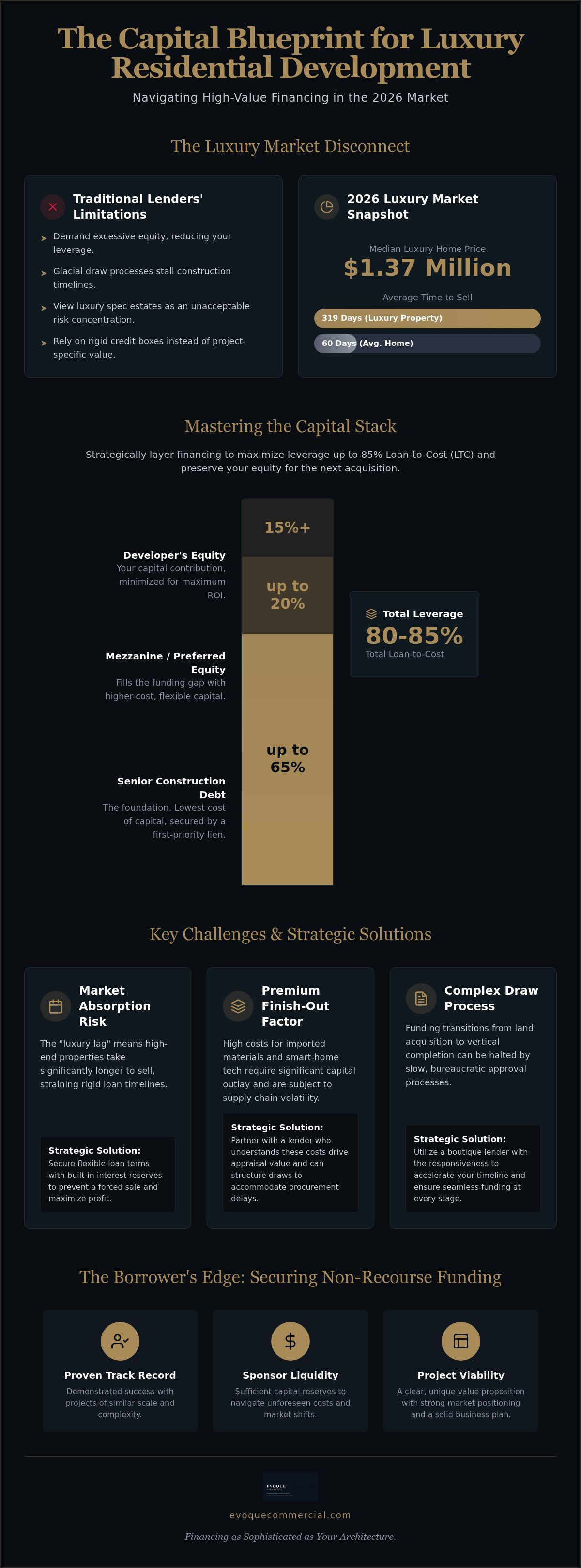
High-end real estate cycles often experience a 'luxury lag,' where sales velocity doesn't align with broader market trends. While the average home might sell in 60 days, luxury properties in 2026 average 319 days on the market. Lenders evaluate absorption rates for multi-unit luxury subdivisions by looking at specific demographic wealth transfers and local inventory levels. Luxury absorption is the rate at which high-end units are sold relative to market inventory. This prolonged timeline requires interest reserves and flexible loan terms that prevent the developer from being forced into a premature sale before the market reaches its peak.
The Premium Finish-Out Factor
Capital requirements for luxury projects are heavily weighted toward interior finishes and custom architectural elements. Financing high-end materials, from imported stone to integrated smart-home ecosystems, requires a lender who understands that these costs drive the eventual appraisal value. These finishes significantly impact Loan-to-Value (LTV) and Loan-to-Cost (LTC) ratios, often necessitating a higher initial capital outlay. Given the global supply chain volatility of 2026, developers must account for procurement delays in their budgets. A responsive lender will structure the loan to accommodate these fluctuations, ensuring that a delay in specialized materials doesn't halt the entire construction draw schedule. This strategic approach ensures that the project moves from land acquisition to vertical completion without unnecessary financial friction.
Optimizing the Capital Stack for High-End Projects
Structuring the capital stack for high-end projects requires a disciplined approach to risk and return. At the foundation, senior debt provides the bulk of the funding, typically covering up to 65% of the total project cost. Above this sits the mezzanine layer or preferred equity, which fills the gap before reaching the developer's own capital. Effectively utilizing luxury residential development loans means understanding how these layers interact to maximize your internal rate of return. Every layer has a specific function. The goal is to minimize your personal equity while maintaining a manageable debt service coverage ratio.
Senior Construction Debt vs. Mezzanine Layers
Senior debt offers the lowest cost of capital but demands the highest security through a first-priority lien. In contrast, mezzanine financing carries higher interest rates but allows developers to push their total leverage higher, often up to 80% or 85% Loan-to-Cost (LTC). This is particularly useful for luxury infill projects where land costs are disproportionately high. For developers transitioning between phases, integrating a Bridge Loans for Residential Development: Strategic Guide can provide the necessary liquidity to secure sites before long-term construction debt is finalized. It's a matter of timing and leverage.
Preferred Equity: The Silent Partner in Luxury Growth
Preferred equity acts as a flexible gap solution, sitting between senior debt and common equity. Unlike mezzanine debt, it's not always secured by a pledge of ownership interests but offers a priority return. Many large-scale developers use this to preserve their own cash for multiple simultaneous projects. This structure is common in multifamily construction loans for high-end vertical developments. It often includes an equity kicker, giving the lender a small percentage of the project's upside in exchange for the higher risk profile. This aligns the interests of the lender and the developer.
Choosing between recourse and non-recourse debt is a critical strategic decision. While non-recourse loans offer protection for your personal assets, they often come with lower leverage or higher pricing. In the 2026 market, many developers prioritize non-recourse structures for luxury residential development loans to mitigate the impact of longer absorption periods. If you're looking to scale your portfolio without overextending your personal liability, discussing structured capital solutions with an agile partner can help you find the right balance between leverage and risk. The right structure protects your future projects while funding your current vision.
Luxury Spec vs. Custom Estate Financing Strategies
Financing a luxury spec project is fundamentally different from a custom build for a specific end-user. With a spec estate, you're asking the lender to share the risk of a market that currently sees a 319-day average for luxury sales. Track record is the primary currency here. Lenders providing luxury residential development loans for spec projects prioritize sponsors who've navigated similar cycles and possess the liquidity to carry high-interest reserves. Without a pre-sold contract, the underwriting focus shifts from the buyer's credit to the developer's execution history and the project's unique architectural appeal. It's a test of market intuition and financial discipline.
Risk Mitigants for Luxury Spec Development
Your loan package must include a sophisticated sales and marketing plan that accounts for the 'luxury lag' inherent in high-end real estate. Interest reserves are non-negotiable; they provide the runway needed to complete the build and reach a successful closing without financial strain. Many developers use land acquisition and development loans to secure prime, high-demand sites before seeking vertical construction debt. This two-step approach allows you to finalize entitlements and permits, making the vertical loan more attractive to institutional-grade lenders who prefer 'shovel-ready' luxury assets.
Custom estate financing introduces a triangular relationship between the lender, the developer, and the high-net-worth end-user. The underwriting process often mirrors a high-limit jumbo loan but requires a builder's risk component. In these scenarios, the lender isn't just betting on the market; they're betting on the buyer's continued liquidity and the developer's ability to deliver complex designs on budget. Exit strategies for custom builds are usually straightforward, but spec projects often require a bridge-to-stabilization loan if the initial construction term expires before a buyer is found. This flexibility is essential for maintaining control over the asset's price point.
High-End Infill and Custom Estate Logistics
Luxury infill projects often involve acquiring expensive teardowns in established, high-value neighborhoods. Financing these acquisitions requires speed and a lender who understands land value over existing structure value. Vertical draws for these projects are complex, often involving specialized subcontractors and long-lead-time materials that don't fit into standard bank draw schedules. If a project stalls due to unforeseen cost overruns or supply chain shifts, rescue capital can provide the bridge needed to reach completion. This structured capital layer prevents foreclosure and protects the equity already deployed in the ground. It's a tactical tool for developers who need to pivot in a shifting 2026 market.
Underwriting and Managing the Luxury Draw Process
The underwriting phase for luxury residential development loans is where a project's structural integrity is truly tested. Lenders aren't just looking at the final appraisal; they're scrutinizing the pre-development hurdles that can derail a timeline before the first slab is poured. Entitlements, permits, and horizontal works represent the highest risk period for any developer. Managing this requires a deep understanding of local regulatory environments and a capital partner who recognizes the value of early-stage milestones. Precision during this phase ensures that the transition from land acquisition to vertical construction remains seamless.
Navigating Entitlement and Pre-Development Risk
Financing land before it reaches 'shovel-ready' status is a specialized niche. The entitlement status directly dictates loan pricing and the available leverage. A parcel with final plat approval commands significantly better terms than raw land because the primary execution risk has been mitigated. For developers managing large luxury parcels, strategizing single-family subdivision financing early in the process ensures that horizontal infrastructure—roads, utilities, and grading—is fully funded. This foundational work de-risks the project for future vertical construction lenders.
Optimizing the Draw Cycle for Speed to Market
Speed is a critical factor in retaining high-quality subcontractors. A draw schedule is the pre-negotiated timeline for releasing loan proceeds based on construction milestones. If funding cycles are slow, momentum dies, and the best crews move to other sites. Luxury builds often involve bespoke architectural requirements that don't fit standard bank draw templates. Managing contingency funds becomes vital here. High-end cost overruns are common when sourcing rare materials, and having a pre-approved buffer prevents work stoppages that can cause luxury residential development loans to fall out of compliance.
Lenders conduct regular site inspections to verify progress before releasing any funds. Luxury developers must prepare for these visits by having all lien waivers, updated permits, and local inspection reports organized for immediate review. This level of transparency builds institutional trust and significantly accelerates the next funding round. If your current lender's rigid draw process is delaying your construction timeline, it's time to explore structured capital solutions that prioritize boutique responsiveness. A partner who understands the specific rhythm of high-end construction can be the difference between a timely market exit and a costly, stalled build.
Partnering with Evoque Commercial for Luxury Capital
Securing a partner who understands the nuances of a high-end build is as important as the architectural design itself. Evoque Commercial bridges the gap between rigid institutional lenders and the agile needs of modern developers. We provide luxury residential development loans that are structured to meet the specific demands of projects valued between $3 million and $250 million. Our role is to serve as a strategic ally, ensuring that your capital stack is resilient enough to handle the long absorption periods typical of the luxury sector. We don't just provide debt; we provide the structural certainty required to bring complex visions to life.
The Evoque Lending Advantage: Beyond the Terms
We specialize in ground-up construction and complex acquisition financing across the national US market. Our team understands that middle-market developers often find themselves in a difficult position. Their projects are too large for local credit unions but too specialized for the automated underwriting of massive commercial banks. We provide institutional-grade capital with a boutique level of responsiveness. This means you get the certainty of a $250 million capacity combined with a team that actually answers the phone when a construction milestone requires an immediate draw. We focus on the entire project lifecycle, from land acquisition to the final certificate of occupancy. Our experience with luxury spec and custom estates allows us to anticipate funding needs before they become delays.
Next Steps: Your Luxury Development Roadmap
To begin the process, we recommend preparing a loan package that highlights your execution history and the specific market demand for your luxury project. Lenders in 2026 prioritize sponsors who demonstrate a clear path to exit, whether through a traditional sale or a bridge-to-stabilization strategy. Your package should detail the entitlement status, architectural plans, and a realistic construction timeline that accounts for potential supply chain volatility. We look for developers who treat their capital stack as a strategic asset. Once your documentation is ready, we facilitate a streamlined project review to determine the most effective capital structure for your needs. This methodical approach ensures that your luxury residential development loans are aligned with your long-term growth objectives.
Explore our Luxury Residential Development Loans and request a project review today.
Strategic Capital for the Next Generation of Luxury Assets
The luxury market in 2026 demands a departure from standard lending practices. You've seen how optimizing the capital stack and managing the extended absorption periods for spec estates are critical for preserving equity. Success in this tier depends on a lender who views the draw process as a catalyst for momentum rather than a bureaucratic hurdle. Securing luxury residential development loans shouldn't mean sacrificing speed for scale. It's about finding a partner who understands that high-end architecture requires a high-end financial structure.
At Evoque Commercial, we provide the institutional strength of capital solutions up to $250 million with the boutique responsiveness your custom projects require. Our national US coverage ensures that your vision has the necessary backing from acquisition through to the final sale. We're ready to help you structure a financing path that respects your timeline and maximizes your project's potential. Your next development deserves a capital partner as dedicated to precision as you are.
Request a Luxury Project Review from Evoque Commercial and let's build your next landmark together.
Frequently Asked Questions
What is the typical loan size for luxury residential development?
Typical loan sizes range from $3 million to $250 million. These capital solutions are designed for developers who have outgrown local credit unions but require more agility than global banks provide. Whether your project involves a single $5 million spec estate or a $200 million vertical luxury development, the financing is structured to match the specific lifecycle of the asset. This range ensures that middle-market developers have access to institutional-grade capital across the country.
Can I get a non-recourse loan for a luxury spec home?
Non-recourse luxury residential development loans are available for sponsors with significant experience and a verified track record. Lenders evaluate the developer's liquidity and the project's specific market positioning to determine the recourse structure. While many standard bank loans require personal guarantees, structured capital solutions can offer limited-recourse or non-recourse terms to protect your personal assets. This is particularly valuable for developers managing multiple high-value projects simultaneously in today's market.
What is the maximum LTC (Loan-to-Cost) for luxury construction?
Maximum Loan-to-Cost (LTC) for high-end residential construction typically reaches up to 85% for 1-4 unit projects. For larger vertical developments or subdivisions, the total leverage is often capped at 70% of the Gross Development Value (LTGDV). Financing up to 100% of construction costs is possible if the land was acquired with significant equity. These ratios are carefully calibrated to ensure the developer maintains enough skin in the game to see the project through completion.
How do luxury residential development loans differ from standard commercial loans?
Luxury residential development loans prioritize premium market positioning and high cost-per-unit over the density metrics found in standard commercial lending. Standard commercial loans often rely on pre-leasing or immediate cash flow, whereas luxury financing accounts for the luxury lag and longer absorption periods. Underwriting for these assets focuses on architectural distinction and the developer's ability to execute complex, high-end finishes that drive premium appraisal values in the 2026 market environment.
What happens if a luxury project exceeds its original budget?
If a project exceeds its budget due to material cost volatility or design changes, developers can utilize construction completion financing or rescue capital. These structured solutions provide the necessary gap funding to reach the certificate of occupancy without halting work. Most luxury loan packages include a pre-negotiated contingency buffer, but having a responsive capital partner allows for quick adjustments to the draw schedule when unforeseen architectural or supply chain hurdles arise during construction.
Do you provide financing for luxury residential subdivisions?
Yes, we specialize in single-family subdivision financing for luxury developments across the United States. This includes funding for land acquisition, horizontal infrastructure like private roads and utilities, and the subsequent vertical construction of individual estates. These loans are structured to accommodate the phased nature of large parcels, allowing developers to release units as they are sold while maintaining the liquidity needed to finish the remaining lots within the community.
What are the requirements for a luxury development bridge loan?
Requirements for a bridge-to-stabilization or development bridge loan include a clear exit strategy and a strong credit story. Lenders look for developers who have already secured entitlements or permits but need immediate capital to seize a prime site or finish a project. You'll need to provide a detailed project plan, current liquidity statements, and evidence of the site's market demand. These short-term solutions are essential for projects transitioning between acquisition and vertical debt.
How long does the underwriting process take for a $50M luxury project?
The underwriting timeline for a $50 million luxury project depends on the completeness of your loan package and the project's entitlement status. Unlike rigid institutional banks that may take months, a boutique-style approach prioritizes responsiveness to meet tight closing deadlines. While a thorough review of architectural plans and market absorption is required, the process is streamlined to avoid the glacial delays that often stall high-end developments. Speed to market remains a primary objective.