
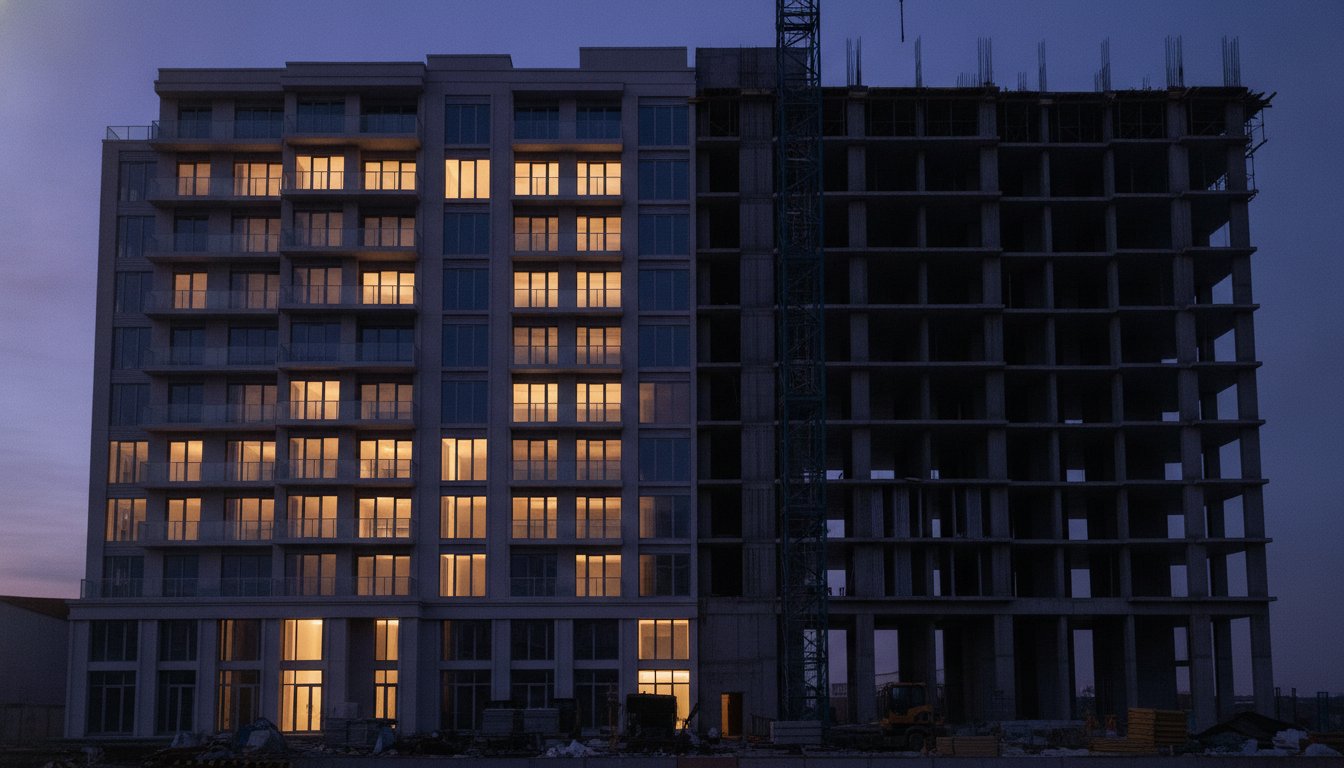
The most significant threat to a developer's equity isn't found during the initial site clearing, but within the final twenty percent of the construction phase. You've managed the complexities of a nationwide housing shortage and navigated a tightening labor market, yet your project sits 80% complete while your current lender has frozen funding draws. It's a high-stakes position to be in. When market volatility or shifting lender appetites threaten your exit strategy, construction completion financing becomes the vital tool needed to protect your investment. You've invested years into this high-end residential development, and the risk of losing your equity due to temporary capital constraints is a reality many sponsors face in today's disciplined lending environment.
We believe a stalled project requires more than just a loan; it requires a strategic recapitalization. This article will show you how to restructure a complex capital stack and satisfy the increased scrutiny of modern underwriters to secure the final funding needed to bring your project to the finish line. We'll explore the transition from completion to bridge-to-stabilization loans, ensuring your vision reaches its intended conclusion despite current decreases in national construction spending. By the end of this guide, you'll have a clear roadmap for navigating the final stages of development with confidence and precision.
Understanding Construction Completion Financing as Rescue Capital
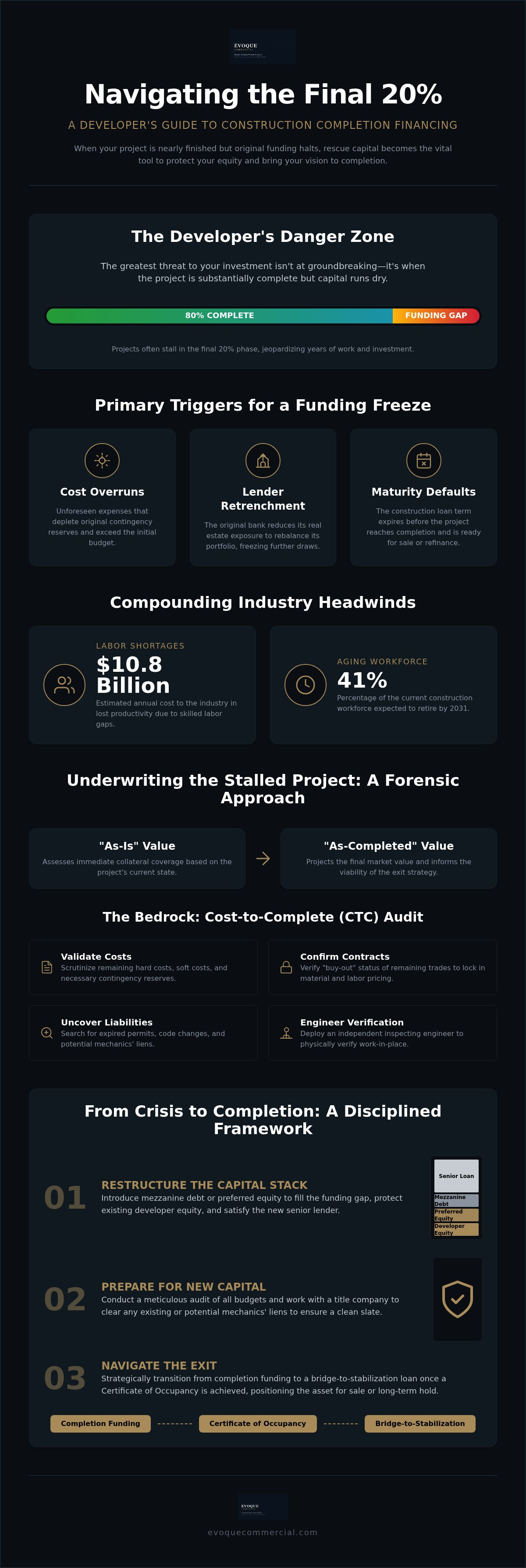
Construction completion financing represents a specialized tier of the capital stack designed specifically for residential projects that have reached the 50% to 90% completion mark. While a standard ground-up loan covers the entire lifecycle from site preparation to final finish, completion financing serves as a targeted intervention. It's often required when the original lender reaches their exposure limit or when the project's timeline exceeds the initial loan maturity. Standard lenders frequently pull back during the final 20% of a build because their risk models aren't built to handle the variables of a stalled site. They prefer clean, predictable disbursements; they don't typically have the appetite to underwrite the complexities of a mid-stream rescue.
The primary triggers for needing this capital include:
- Unforeseen cost overruns that exceed the original contingency reserves.
- Lender fatigue or institutional retrenchment where the bank chooses to reduce exposure.
- Maturity defaults when the construction loan term expires before the project is ready for sale or refinance.
Why Projects Stall in the Final Phase
In the 2026 construction landscape, projects face unique pressures. Labor shortages are estimated to cost the industry over $10.8 billion annually in lost productivity, while nearly 41% of the workforce is nearing retirement by 2031. These macro factors lead to schedule slippage and cost escalations that the original budget didn't anticipate. We're also seeing significant institutional retrenchment. Many banks are reducing their real estate exposure mid-project to rebalance their portfolios, leaving developers with a funding gap between remaining loan proceeds and the actual cost to reach the finish line.
The Strategic Role of Completion Funding
Choosing to recapitalize isn't a sign of project failure; it's a disciplined move to protect sunk costs. Completion funding maintains project momentum, which is critical for retaining reliable subcontractors and keeping the title clear of mechanics' liens. This capital layer acts as the necessary bridge to a bridge to stabilization loan, allowing the developer to secure a Certificate of Occupancy and transition to a more permanent financing structure. It's about moving from a state of crisis to a position of strength. By restructuring the debt now, you ensure that the final 10% of the work doesn't jeopardize the 90% already achieved.
Underwriting the Stalled Project: What Lenders Evaluate
Underwriting for construction completion financing requires a forensic approach. Standard lenders focus on projections, but rescue capital providers focus on the physical and financial reality of the site as it stands today. The process begins with a dual valuation strategy. Lenders assess the "As-Is" value to understand their immediate collateral coverage, then contrast it with the "As-Completed" value to project the final exit. This delta reveals the true risk profile of the investment. Understanding the underlying mechanics of How Construction Loans Work helps sponsors realize why completion underwriting is significantly more rigorous than initial ground-up funding.
A thorough review of existing sub-contractor liens and payment histories is equally vital. Title companies and lenders work together to ensure that previous draws were distributed correctly and that no mechanics' liens threaten the new capital layer. This forensic accounting ensures that the new lender has a clear path to a senior or protected position within the capital stack. Without a clean title and a verified payment history, securing secondary or replacement capital becomes nearly impossible.
The Cost-to-Complete Audit
A Cost-to-Complete (CTC) audit is the bedrock of the transaction. It involves validating remaining hard costs, soft costs, and necessary contingency reserves. Underwriters scrutinize the "buy-out" status of remaining trades to confirm that material prices and labor contracts are locked in. They also search for hidden liabilities such as expired permits or updated building codes that might require costly modifications. An independent inspecting engineer is usually deployed to verify that the project's physical status matches the developer's draw history and accounting records. Any discrepancy here can stall the funding process immediately.
Sponsor and Project Viability
Project viability hinges on the sponsor's ability to execute under pressure. Lenders evaluate the developer's experience in finishing complex, high-end residential builds that have faced similar hurdles. The proposed exit strategy must be realistic. Whether the plan is a bulk sale of units or a transition to a bridge-to-stabilization loan, the underwriting must reflect current market absorption rates and demand. If you're navigating a mid-build funding gap, exploring structured capital solutions can provide the strategic clarity needed to reach the finish line.
Structuring the Capital Stack for Project Completion
Successfully navigating a stalled project requires more than a simple cash injection; it demands a surgical reconfiguration of the capital stack. In a rescue scenario, the primary goal is to inject liquidity while managing existing debt obligations. Most institutional-grade projects utilize a combination of senior debt, mezzanine debt, and preferred equity. While senior debt remains the cheapest capital, it's often the least flexible when a project deviates from its original timeline. Mezzanine debt and preferred equity provide the necessary "rescue" layer, allowing developers to bypass the rigid constraints of a traditional bank that may have stopped funding draws.
A critical component of construction completion financing is the Last-In, First-Out (LIFO) structure. This arrangement ensures that the new capital injected to finish the build is the first to be repaid upon the sale of units or a successful refinance. This hierarchy is codified through an Intercreditor Agreement. This legal instrument defines the relationship between the new completion lender and the existing senior lender, outlining payment priorities, notice requirements, and cure rights. Without a well-negotiated intercreditor agreement, the risk of a total project freeze remains high, as competing lienholders may clash over the remaining collateral value.
Rescue Capital vs. Senior Debt Refinance
Developers must decide whether to keep their existing senior loan or pursue a full refinance. Adding a mezzanine completion layer is often the fastest route, provided the original lender is cooperative and willing to sign an intercreditor agreement. This approach preserves the lower interest rate of the senior debt. If the original lender is adversarial or has issued a notice of default, a full refinance into a new bridge-to-completion loan may be necessary. While more expensive, a full refinance provides a clean slate, replacing the exhausted lender with a strategic partner aligned with the project's new timeline.
Equity Protection Strategies
The primary objective of structured capital is to prevent a total equity wipeout. High-end projects, which frequently utilize luxury residential development loans, often rely on mezzanine structures to protect the sponsor's initial investment during market volatility. By establishing robust interest reserves within the new financing, developers ensure the project reaches the finish line without further capital calls. Additionally, inventory financing can be used to release capital from already completed units within a subdivision, providing the necessary liquidity to finish the remaining phases without diluting the developer's ownership stake.
How to Secure Completion Financing: A Step-by-Step Framework
Securing capital mid-build requires a methodical approach that mirrors the technical complexity of the project itself. It's about presenting a solution rather than just a problem. Lenders in the 2026 market are highly selective; they're looking for sponsors who've already identified every friction point and developed a clear path to the finish line. Following a disciplined framework ensures that your project stands out as a viable recapitalization opportunity.
- Step 1: Internal Audit. Reconcile every dollar spent against remaining milestones. This includes a forensic review of hard costs, soft costs, and a realistic contingency that reflects current labor and material escalations.
- Step 2: Title Remediation. Resolve outstanding mechanics' liens or payment disputes. A clean title is mandatory for any new capital layer to enter the project.
- Step 3: The Rescue Package. Compile a narrative that explains the stall, the current status, and the definitive path to completion. This package should address the "why" behind the delay and the "how" of the recovery.
- Step 4: Third-Party Verification. Engage an independent engineer for a fresh site assessment and an appraiser to establish current values. These reports provide the objective data underwriters need.
- Step 5: Structural Negotiation. Finalize intercreditor agreements or payoff letters to define the new hierarchy of the capital stack.
Preparing the Documentation
The quality of your documentation determines the speed of your funding. You'll need updated draw schedules and budget-to-actual reports that show exactly where the capital has gone. A current subcontractor list is essential, and every trade must provide signed lien waivers for work completed to date. Additionally, include a revised marketing plan for the finished units. Lenders want to see that your exit strategy accounts for the shifting demand builders reported in early 2026. This level of transparency builds the institutional trust required for high-stakes rescue scenarios.
Negotiating with Existing Lenders
Approaching your current bank about bringing in outside construction completion financing requires transparency. Often, an overextended lender is relieved to see a new capital partner take on the remaining risk. You must obtain a "consent to subordinate" if you're adding a mezzanine layer, or a clear payoff letter if you're refinancing entirely. Managing the transition of the construction escrow account is a delicate process; it requires coordination between the old lender, the new lender, and the title company to ensure a seamless handoff of funding responsibilities.
If your project is 70% complete but stalled due to lender retrenchment, our team can help you restructure. Contact Evoque Lending to discuss a tailored completion financing solution for your development.
Navigating the Exit: From Completion to Stabilization
Successfully finishing the physical structure marks a critical pivot point in the project's lifecycle, but it doesn't represent the final financial milestone. The true objective of construction completion financing is to bridge the gap until the asset reaches a state of operational stability. Once the build is finished, the developer's risk profile changes fundamentally. The issuance of a Certificate of Occupancy (CO) is the catalyst for this shift, moving the project from a speculative construction phase into a stabilized phase where traditional, lower-cost debt becomes accessible. This transition is vital for protecting the equity recovered during the rescue stage.
For luxury multifamily builds or large-scale subdivisions, the "Bridge-to-Exit" strategy provides the necessary time to execute a disciplined marketing plan. Rushing to sell units or lease up an apartment complex under the pressure of an expiring construction loan can lead to significant value leakage. By restructuring the debt after construction is complete, sponsors can maintain pricing integrity and wait for the optimal market conditions. This strategic cushion is what allows a project to move from a state of distress to a position of maximum valuation.
The Role of Bridge-to-Stabilization Loans
Once construction risk is removed, the cost of capital should decrease. Bridge-to-stabilization loans offer a mid-term solution that provides the runway needed for unit sales or apartment lease-ups. This financing layer replaces the high-yield completion debt with a structure that reflects the asset's new status as a completed building. It prepares the development for long-term permanent financing by allowing it to reach target occupancy or sales velocity without the immediate threat of a maturity default. This phase is about optimizing the asset's cash flow and creditworthiness before the final exit or permanent refinance takes place.
Choosing the Right Strategic Partner
In time-sensitive rescue scenarios, the value of a boutique partner cannot be overstated. While institutional capital provides the necessary scale for projects between $3M and $250M, it's the responsiveness of the underwriting team that determines whether a project meets its deadlines. Evoque Lending manages this entire lifecycle, from the initial injection of rescue capital to the final stabilization and payoff. We prioritize strategic alignment, ensuring that the financing structure supports the developer's long-term goals rather than just solving a short-term liquidity crisis. If you're ready to secure your project's future, review your stalled project with Evoque Lending to find the most efficient path to stabilization.
Strategic Recapitalization for the Final Finish
A stalled project doesn't have to result in a total equity wipeout. Success in the final 20% of a build requires a shift in perspective, moving from crisis management to a disciplined, strategic recapitalization. By leveraging a forensic Cost-to-Complete audit and restructuring your capital stack with construction completion financing, you can maintain critical project momentum and protect your initial investment. As we've explored, the transition from completion capital to a bridge-to-stabilization loan ensures that your development reaches its full market potential without the pressure of an exhausted or adversarial senior lender.
We specialize in complex structured capital for residential projects ranging from $3M to $250M. Our team at Evoque Lending combines boutique responsiveness with deep institutional capital relationships to provide the rescue capital needed for nationwide developments. We understand the technical and financial hurdles of mid-build financing and offer the precision required to navigate them successfully. Don't let temporary capital constraints jeopardize your vision or your sunk costs. Request a Strategic Project Review from Evoque Lending today to secure the final funding your project deserves. Your path to a successful exit begins with a strategic partner who understands the finish line.
Frequently Asked Questions
What is the typical LTC for construction completion financing?
Typical Loan-to-Cost (LTC) ratios for construction completion financing generally range between 65% and 75% of the total project cost. This leverage depends heavily on the project's current status and the verified cost to complete. Lenders evaluate the "As-Completed" value alongside remaining hard costs to determine the optimal debt structure. In complex rescue scenarios, structured capital solutions can provide additional cushion beyond standard senior debt limits to ensure the project reaches the finish line.
Can completion financing be used to pay off existing mechanics' liens?
Yes, clearing mechanics' liens is a critical step in the project rescue process. Most completion lenders require a clean title before funding the first draw; therefore, the initial proceeds are often used to satisfy outstanding subcontractor claims and payment disputes. This ensures the new lender maintains a protected lien position. Resolving these title issues is essential for restoring project momentum and securing the cooperation of necessary trades for the final build phase.
How long does it take to close a construction completion loan?
The closing timeline typically ranges from 30 to 45 days. This duration is necessary to perform a forensic Cost-to-Complete audit and conduct updated third-party inspections. While ground-up loans may take longer, rescue scenarios require a higher level of responsiveness. Boutique lenders prioritize these time-sensitive transactions to prevent further project decay. The speed of closing depends on how quickly the sponsor can provide an updated budget and clear any existing title encumbrances.
Do I need to replace my current senior lender to get completion funding?
Not necessarily. You can often keep your existing senior lender by adding a mezzanine debt or preferred equity layer to the capital stack. This requires an intercreditor agreement to define payment priorities and cure rights between the two capital providers. However, if the current lender is adversarial or has stopped all funding draws, a full refinance into a new bridge-to-completion loan may be the more efficient path to project stabilization.
What happens if my project is already in maturity default?
Maturity default is a common trigger for seeking construction completion financing. In this situation, the lender conducts a thorough diagnosis of the delay and evaluates the sponsor's revised exit strategy. We focus on providing the capital needed to satisfy the defaulted loan or restructure the debt to provide additional runway. The goal is to move the project from a state of default into a functional completion phase, ultimately leading to a successful sale or refinance.
Is completion financing available for luxury spec homes?
Yes, this capital is specifically designed for high-end residential developments, including luxury spec homes and subdivisions. These projects often face higher sensitivity to market volatility and labor cost escalations. We provide structured capital solutions that account for the premium finishes and longer marketing periods typical of the luxury sector. This allows developers to maintain their pricing integrity and finish the build to the high standards expected by institutional buyers or high-net-worth individuals.
What are the minimum project sizes for Evoque's completion capital?
Evoque Commercial specializes in residential development and construction projects ranging from $3 million to $250 million. This project size allows us to deploy institutional-scale capital while maintaining a boutique level of personal attention and responsiveness. Whether you are finishing a multifamily complex or a high-end subdivision, our focus remains on projects that require sophisticated underwriting and structured capital solutions to bridge the gap from stalled construction to a successful exit.