

In 2026, relying solely on traditional bank loans for your townhome project financing is no longer a path to growth; it's a bottleneck that forces middle-market developers to over-leverage their own equity. You've likely felt the friction of rigid draw schedules that don't account for the realities of phased construction, or the frustration of lenders that refuse to fund land acquisition alongside vertical development. It's a common struggle where the capital structure feels like a constraint rather than a catalyst for your project's success.
This guide provides a blueprint for mastering the complexities of structured capital tailored for the current market. We'll show you how to transition from restrictive lending to institutional-grade strategies that optimize your loan-to-cost (LTC) ratios and protect your liquidity. By the end of this article, you'll have a clear understanding of the 2026 capital stack, from senior debt currently ranging between 6.5% and 9.5% to strategic mezzanine layers that bridge the gap. We'll explore how to align your financing with the project's lifecycle, ensuring a seamless path from the initial land purchase through to the final unit sale.
The Evolution of Townhome Project Financing in 2026
The 2026 market marks a definitive pivot toward townhome developments in suburban rings. While high-rise multifamily projects face saturation in urban cores, townhomes are outperforming traditional apartments by offering the privacy of a single-family home with the efficiency of higher-density land use. This trend has moved townhomes from a niche product to a primary target for institutional capital. Developers who previously focused on single-family subdivisions are now scaling into multi-unit townhome communities to meet the demand for "missing middle" housing.
Securing townhome project financing at this level is fundamentally different from obtaining consumer mortgages; while developers navigate institutional capital stacks, residential specialists like Morgan Financial handle the individual buyer financing that completes the development lifecycle. It's about managing a complex capital stack that supports a project from the initial site work through to the final unit release. The current environment favors a "Boutique Institutional" approach. This model combines the deep pockets of traditional funds with the agility of a strategic partner who understands phased construction nuances. Speed and certainty of execution have become the primary currencies for middle-market builders.
Market Drivers for Townhome Developments
The rising cost of land and construction has made townhomes a logical solution for both developers and municipalities. Build-to-Rent (BTR) models have become a magnet for institutional equity; investors value the lower turnover rates and higher rent premiums compared to garden-style apartments. In the 2026 interest rate environment, senior debt spreads have stabilized between 6.5% and 9.5%. Developers must factor these costs into their pro formas early to ensure project viability. Success now depends on the ability to fund the entire real estate development process without the constraints of traditional bank rigidness.
The Developer’s Financing Lifecycle
The financing journey for a townhome community is a multi-stage process. It starts with acquisition and land financing, moves into horizontal infrastructure, and culminates in vertical construction. Identifying the "Capital Gap" is often the most difficult step for middle-market builders. As traditional banks retreat from residential construction due to tightening regulatory requirements, private capital fills the void. These partners provide the structured solutions that traditional lenders often overlook, such as funding land acquisition alongside vertical draws.
Key metrics for 2026 success include:
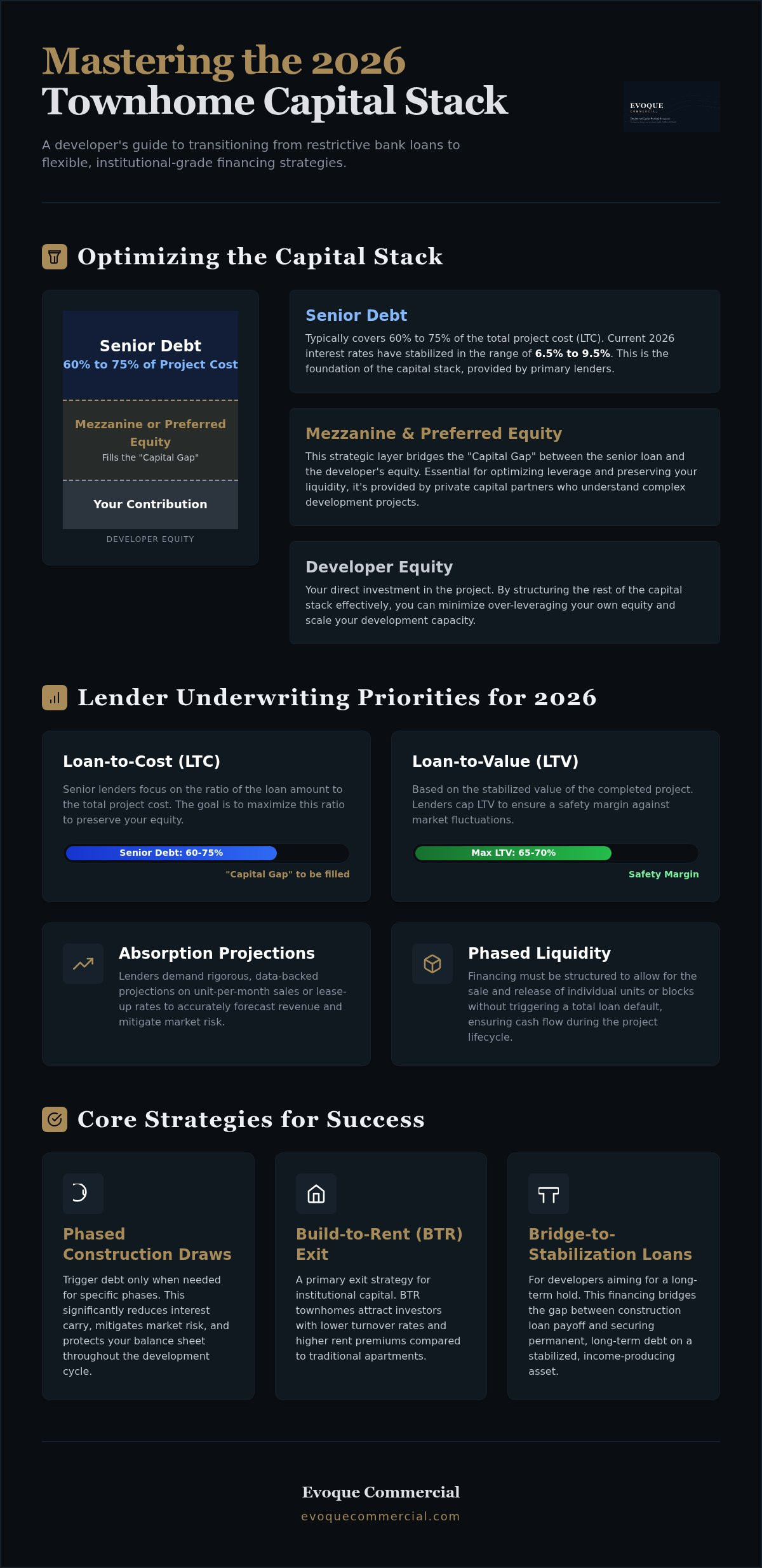
- Loan-to-Cost (LTC): Senior debt typically covers 60% to 75% of the project, requiring additional layers like mezzanine debt to fill the gap.
- Loan-to-Value (LTV): Underwriting focuses on stabilized value, often capping at 65% to 70% to ensure a safety margin.
- Absorption Projections: Lenders now demand rigorous data on unit-per-month sales or lease-up rates to mitigate market risk.
- Phased Liquidity: Financing structures must allow for the release of individual units or blocks without triggering a total loan default.
Structuring Phased Construction Loans for Townhome Communities
Townhomes offer a unique advantage over high-density apartments: the ability to build in distinct, manageable stages. Phased townhome project financing allows developers to trigger debt only when needed, effectively reducing interest carry and mitigating market risk. This structure prevents the "all-or-nothing" pressure of a single massive build. Instead, it enables a rolling production line where the revenue from Phase 1 can potentially support the equity requirements of later phases. It's a method that prioritizes liquidity and protects the developer's balance sheet during the multi-year development cycle.
Large-scale sites often benefit from being underwritten as multifamily construction loans, providing the institutional scale necessary for horizontal infrastructure while maintaining the flexibility of individual unit releases. Coordinating land acquisition with these vertical draws requires a lender that understands the timing of entitlements and site work. A strategic partner will structure the loan to cover the initial land purchase and the subsequent vertical construction in a way that minimizes the "Capital Gap" between these milestones.
Designing the Draw Schedule
A disciplined draw schedule is the backbone of any successful project. Lenders in 2026 typically prefer milestone-based funding over a simple percentage-of-completion model. This ensures that capital is only released once specific, verifiable progress is made, such as foundation completion or roofing. Adhering to FDIC guidance on residential tract development, institutional lenders focus heavily on loan-to-value limits and the developer's ability to manage soft costs. Third-party inspections provide a layer of certainty, ensuring that fund control remains transparent and disciplined throughout the construction lifecycle.
Phased Release and Inventory Financing
Managing the transition from construction to sale is where many developers face liquidity crunches. A "Unit-by-Unit" release clause is essential, allowing for partial loan pay-downs as individual townhomes are sold. If a phase completes but sales are slower than projected, inventory financing can bridge the gap. This prevents a project from stalling and allows the developer to move capital into the next phase. It's about maintaining a clear path from acquisition to exit, which is why structured capital solutions are vital for navigating these transitions without losing momentum.
Optimising the Capital Stack: Senior Debt, Mezzanine, and Preferred Equity
A sophisticated townhome project financing strategy relies on the precise layering of capital to balance cost against control. In 2026, the capital stack is rarely a single-source solution. Instead, it's a hierarchy where each layer serves a specific function in the project's lifecycle. At the foundation, senior debt provides the bulk of the funding, typically covering 60% to 75% of the total project cost. For middle-market developers, the primary objective is to maximize this low-cost capital while minimizing the equity required to break ground.
Senior debt benchmarks for market-rate townhome projects currently sit between 6.5% and 9.5% for bank-led financing. If a project requires more flexibility or carries a higher risk profile, flexible construction lending rates can reach 12% or higher. Strategic developers use a mix of debt vs equity financing to protect their long-term returns. By using structured debt to fill the gap, builders preserve their ownership stake and avoid the dilution that comes with heavy reliance on outside equity partners.
Mezzanine and Preferred Equity Integration
When senior debt doesn't cover the full "Capital Gap," mezzanine debt or preferred equity becomes essential. Mezzanine debt in the 2026 market typically carries interest rates between 12% and 20%, offering a high-leverage path for developers with strong track records. Preferred equity provides a similar bridge, often with annual preferred returns ranging from 6% to 10%. Understanding the "Waterfall" distribution is critical here; these structures define how cash flow is prioritized from the first unit sale to the final exit. Developers often trade limited recourse for these higher-leverage layers to maintain liquidity across their entire portfolio.
Acquisition and Land Financing
The transition from a raw site to a build-ready lot is the most capital-intensive phase. Securing land acquisition and development loans is the first step, with underwriting priorities shifting based on whether a site is entitled or unentitled. Financing the horizontal phase involves grading, utilities, and infrastructure, which traditional lenders often view as high-risk. Structured capital partners provide the bridge between land purchase and vertical construction, ensuring that site work doesn't stall while waiting for the main construction draw. This continuity is vital for maintaining the construction momentum discussed in previous sections.
Effective capital optimization involves:
- Layering: Using mezzanine debt to push total leverage toward 85% LTC.
- Cost Management: Refinancing high-cost land debt into lower-cost construction loans as soon as entitlements are secured.
- Risk Mitigation: Structuring limited recourse to protect the developer's personal assets while securing institutional funds.
- Precision: Aligning the cost of each capital layer with the projected absorption rate of the townhome units.
Underwriting for Success: A Case Study in Risk Mitigation
A 40-unit luxury townhome project represents the ideal middle-market development, yet it frequently encounters a financing vacuum. Traditional retail banks often view this scale as too concentrated for their risk appetite, while massive institutional REITs typically ignore projects below the $50 million mark. This highlights why financing for middle-market home builders requires a more nuanced approach than standard institutional funding. Success in townhome project financing hinges on a lender's ability to underwrite the developer's specific track record and the project's unique velocity rather than just following a rigid corporate checklist.
Middle-market builders don't have the luxury of "infinite" balance sheets, so every line item in the proforma must be defensible. In 2026, lenders aren't just looking at the asset; they're looking at the developer's "staying power." This means evaluating your liquidity throughout the construction lifecycle and your ability to manage multiple phases without overextending. A strategic partner acts as an extension of your team, identifying potential bottlenecks in your draw schedule before they become liquidity crises.
Analyzing Market Absorption and Comps
In the 2026 climate, generic market reports are no longer sufficient. Underwriters now demand deep sub-market analysis that accounts for hyper-local demand. For our 40-unit case study, a lender would evaluate absorption rates within a tight three-mile radius, specifically looking at how similar townhome products performed during seasonal dips. While some lenders mandate a 30% pre-sale requirement before triggering vertical construction draws, a strategic partner might offer more flexibility. They may accept a verified reservation list or rely on the developer's proven ability to maintain sales momentum in that specific corridor.
Contingency and Cost Overrun Management
Labor costs remain the most volatile variable in 2026 proformas. A standard 5% contingency, once the industry norm, is now often viewed as inadequate by institutional-grade lenders. Modern underwriting typically looks for 10% to 15% contingencies on labor-intensive phases to protect the project from sudden market shifts. A robust "Construction Completion" guarantee is essential; it provides the lender with the certainty that the project won't stall halfway through a phase. In one notable instance, a structured capital solution saved a stalled project by providing a bridge-to-completion loan when the original lender's rigid draw schedule failed to account for a 12% spike in material costs. If you are facing similar pressures, consult with a strategic capital partner to review your current proforma and identify potential risk gaps.
Executing Your Exit Strategy: From Completion to Stabilization or Sale
The final phase of townhome project financing is the execution of a well-defined exit strategy. In 2026, developers typically follow one of three primary paths: the traditional for-sale model, a Build-to-Rent (BTR) hold, or a strategic recapitalization. While the for-sale model offers immediate liquidity, many middle-market builders are turning to BTR or recapitalization to build long-term wealth. Recapitalization allows you to pull a significant portion of your equity out once the project reaches a specific milestone, such as the completion of the first phase. This provides the capital needed to seed your next development without waiting for the final unit sale.
Bridging the gap between construction completion and a permanent exit requires a specialized approach. Bridge-to-stabilization loans are essential for rental townhome communities that need time to reach target occupancy levels. These loans replace high-cost construction debt with more flexible, medium-term capital, allowing the developer to focus on the lease-up process. When preparing for a permanent loan, long-term lenders in 2026 prioritize stabilized cash flow, professional property management agreements, and a clear history of tenant demand in the sub-market.
Build-to-Rent (BTR) Exit Paths
Rental townhome projects require a different valuation logic than for-sale developments. Instead of focusing on individual unit retail prices, institutional buyers and permanent lenders evaluate the project based on cap rates and Net Operating Income (NOI). Financing the lease-up period is a critical step in this transition. Developers must ensure their debt structure allows for the time needed to achieve market-leading rents. Once stabilization is reached, the project can be moved into permanent agency financing or sold to an institutional fund as a single, stabilized asset.
Partnering with Evoque Lending for National Scale
Managing the complexities of structured capital requires a partner that offers both institutional depth and boutique responsiveness. Evoque Lending provides the national scale necessary for large developments, with a capacity for projects ranging from $3 million to $250 million. We specialize in the "missing middle" that traditional banks often overlook, providing the certainty of execution that middle-market builders demand. Our team understands the nuances of phased townhome developments and the critical importance of a seamless transition from acquisition to exit.
To move your project forward, the process begins with a strategic capital review. We look beyond the basic proforma to understand the underlying logic of your development and the strength of your local market. Moving from a proforma to a finalized term sheet is a disciplined process that prioritizes your time and your project's momentum. If you are ready to optimize your capital stack for a 2026 townhome community, submit your project details to our team to discuss your structured financing options.
Mastering the 2026 Capital Stack
Successful townhome project financing in today's environment requires more than just a loan; it demands a strategic alignment of capital and construction milestones. By layering senior debt with mezzanine or preferred equity, you can optimize your LTC ratios while preserving the liquidity necessary to manage phased releases. Whether your exit strategy involves a retail sell-out or a Build-to-Rent hold, your financing must be as agile as your development team. Securing a structure that supports your project's lifecycle ensures that you don't just complete a build, but maximize your return on equity.
Evoque Lending specializes in providing these structured residential capital solutions for projects nationwide. With a financing range from $3M to $250M, we offer the institutional depth you need combined with the boutique responsiveness your project deserves. We're ready to review your proforma and help you navigate the complexities of the current market. Request a Strategic Project Review with Evoque Lending to secure a partner committed to your development from acquisition to exit. Your next project deserves a capital structure that acts as a catalyst for growth.
Frequently Asked Questions
What are the typical interest rates for townhome project financing in 2026?
In the 2026 market, senior debt for bank-led construction typically falls between 6.5% and 9.5%. For more flexible or higher-risk townhome project financing, rates often range from 9% to 12% or more. These spreads are influenced by the prime rate, which stood at 6.75% in late 2025. Developers should also factor in mezzanine debt costs, which currently sit between 12% and 20% for the higher layers of the capital stack.
Can I get non-recourse construction financing for a townhome development?
Yes, non-recourse options are available, though they are typically reserved for experienced developers with significant equity and high-quality projects. Most institutional lenders require limited recourse carve-outs covering "bad boy" acts or completion guarantees. In 2026, many middle-market builders trade a higher interest rate or lower leverage for non-recourse terms. This allows them to maintain personal liquidity while managing the risks inherent in large-scale residential development projects.
What is the minimum loan amount for townhome project financing at Evoque?
Evoque Lending specializes in financing projects between $3 million and $250 million. This range allows us to serve middle-market developers who require more attention than a major bank provides but need more capital than a local lender can offer. By focusing on this sweet spot, we provide structured capital solutions that address the specific needs of ground-up construction, land acquisition, and bridge-to-stabilization scenarios across the country.
How does phased financing work for a multi-unit townhome community?
Phased financing breaks the project into distinct funding stages rather than a single massive draw. This structure allows you to trigger debt only as each phase begins, which significantly reduces your interest carry. It's a disciplined approach where the revenue from Phase 1 unit sales can be reinvested into the equity layer of Phase 2. This rolling production model protects your balance sheet and ensures construction momentum remains steady throughout the project lifecycle.
Do lenders require pre-sales before funding vertical construction on townhomes?
Requirements vary by lender and market. Traditional banks often mandate pre-sales of 30% or more to mitigate risk before releasing vertical draws. However, strategic capital partners in 2026 are often more flexible. They may prioritize a developer's track record, verified reservation lists, or deep sub-market absorption data instead of hard pre-sale quotas. This flexibility is vital for maintaining the construction schedule when market conditions fluctuate during the pre-development phase.
What is the difference between a townhome construction loan and a multifamily loan?
The primary difference lies in the exit strategy and legal structure. Townhome loans are often underwritten for individual unit sales, requiring "unit-by-unit" release clauses and phased certificates of occupancy. Multifamily loans usually treat the entire project as a single stabilized asset intended for rental income. However, for large-scale Build-to-Rent townhome communities, many developers utilize townhome project financing structured like a multifamily loan to achieve institutional scale and better permanent financing options.
How much equity do I need to bring to a townhome development project?
Most senior lenders in 2026 cap their loan-to-cost (LTC) ratios at 60% to 75%. This traditionally requires developers to provide 25% to 40% equity. To preserve liquidity, many builders use structured capital solutions like mezzanine debt or preferred equity to fill the gap. By layering these products, developers can often reduce their direct cash requirement to 10% or 15% of the total project cost while concentrating their returns on the equity layer.
How long does it take to close a townhome project loan with a boutique lender?
Boutique lenders typically move faster than traditional banks, often closing loans within 30 to 60 days. The timeline depends heavily on the complexity of the capital stack and the status of project entitlements. While the negotiation of intercreditor agreements for mezzanine layers can add time, an agile team focuses on efficiency. This speed is a competitive advantage for developers who need to secure land or move into vertical construction without long delays.