

For the modern residential developer, the lowest interest rate on a term sheet is often the most expensive way to fund a project. While traditional bank debt looks attractive on paper, the hidden costs of a 90 day underwriting cycle and rigid recourse requirements can stall your momentum and cause you to miss prime acquisition opportunities. You know that in a volatile market, certainty of execution is far more valuable than a few basis points of interest. It's a reality where slow capital becomes a liability rather than an asset.
This guide will show you how to master high leverage private financing to scale your residential development portfolio with institutional grade capital. We'll explore how professional builders use hard money construction loans for builders as a tactical tool to achieve up to 85% Loan-to-Cost, preserving their equity for the next deal. You'll learn the mechanics of non-recourse structures for large scale builds and how flexible draw schedules can keep your vertical construction moving without interruption. By the end of this article, you'll have a roadmap for navigating the 2026 lending environment, from initial land acquisition to a successful project exit.
Why Professional Builders Pivot to Private Construction Capital
The landscape of residential development financing has fundamentally shifted. Regional banks, once the backbone of mid-market construction, continue to pull back due to regulatory scrutiny and capital adequacy requirements. This retrenchment has created a critical financing gap for professional builders who require agility to secure entitled land and maintain project momentum. In this environment, private capital has transitioned from a niche alternative to a primary strategic tool.
Professional builders increasingly utilize hard money construction loans for builders to bypass the bureaucratic inertia of traditional institutions. Speed is the primary currency here. While a bank might take months to review a file, a private lender can underwrite the project's feasibility and close in a fraction of that time. This responsiveness allows developers to capture shovel-ready opportunities that would otherwise be lost to competitors with more liquid capital structures.
The Opportunity Cost of Traditional Bank Debt
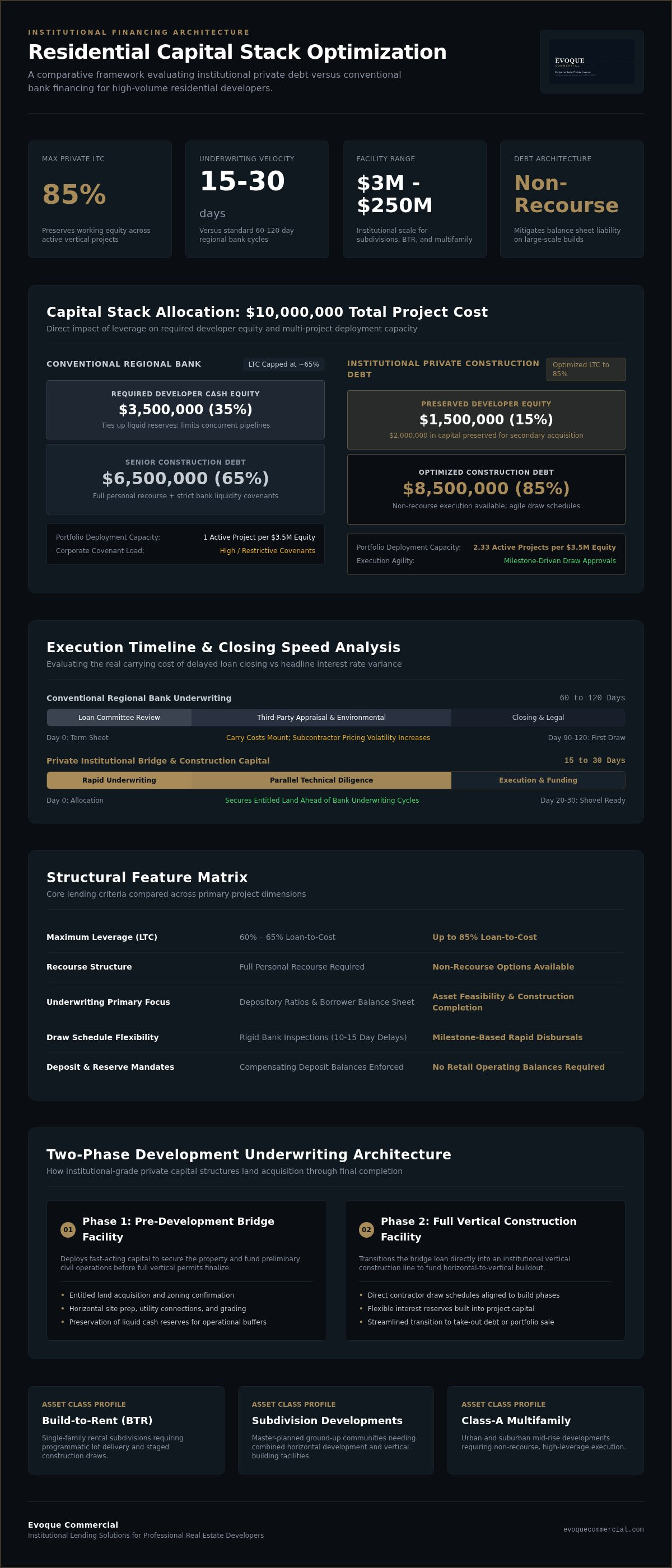
Choosing a lender based solely on the lowest headline interest rate often ignores the true cost of capital. Traditional commercial banks typically require 60 to 120 days from term sheet acceptance to the initial draw. During this window, land carry costs mount and subcontractor availability shifts. A project that sits idle for three months doesn't just lose time; it loses market position.
Beyond the timeline, banks impose several structural hurdles:
- Restrictive covenants that limit operational flexibility.
- Heavy deposit requirements that tie up liquid reserves.
- Full personal recourse on large-scale builds.
Professional builders recognize that a higher Loan-to-Cost (LTC) allowance from a private lender allows them to deploy less out-of-pocket equity. This capital recycling is essential for scaling a portfolio across multiple residential subdivisions simultaneously. When evaluating hard money construction loans for builders, the focus shifts from the interest rate to the velocity of capital.
Hard Money vs. Commercial Bridge Capital
It is vital to distinguish between retail fix-and-flip lenders and institutional-grade private debt. High-end residential development requires a partner who understands the complexities of both horizontal site work and vertical construction. While basic hard money lending mechanics focus on physical collateral, institutional private debt considers the entire project lifecycle.
Strategic developers often utilize bridge loans for residential development during the pre-development phase. This allows for the acquisition of land and the completion of entitlements before transitioning into a full construction facility. This tiered approach ensures that capital is deployed precisely when needed, from the first shovel in the ground to the final certificate of occupancy.
Evaluating the Capital Stack: Hard Money vs. Traditional Debt
For high-volume developers, the capital stack is a dynamic puzzle where equity efficiency often outweighs the nominal cost of debt. Traditional financing remains constrained by stringent commercial real estate lending regulations, which force banks to prioritize deposit safety over project growth. This regulatory environment frequently leads to conservative leverage caps that can stifle a developer's ability to scale. Professional builders recognize that the strategic use of private debt is a primary driver of project velocity.
The decision between institutional banks and private funds centers on the distinction between Loan-to-Cost (LTC) and Loan-to-Value (LTV). While banks focus on the appraised value, private lenders prioritize the actual cost to complete the build. This shift allows for a more aggressive real estate capital stack optimization, where debt does the heavy lifting. By reducing the cash equity required for a single project, builders can maximize their Internal Rate of Return (IRR) and deploy remaining capital into secondary and tertiary developments.
LTC Thresholds and Equity Preservation
The disparity in leverage between conventional and private sources is stark. Conventional banks typically cap their participation at 55% to 65% LTC. This requires the developer to provide 35% or more in cash equity or subordinated debt. In contrast, hard money construction loans for builders frequently reach 75% to 85% LTC. This 20% difference in leverage is the margin that allows a builder to initiate three starts instead of one. Leveraging existing land equity for horizontal development further enhances this effect, turning "dead" equity into active construction capital. If you are managing a growing pipeline, structured capital solutions can help bridge these leverage gaps effectively.
Recourse vs. Non-Recourse Structures
Risk management is the second pillar of the capital stack evaluation. Traditional bank facilities almost universally require full personal recourse, creating a significant liability for the developer's personal balance sheet. In luxury residential development, where project timelines can extend, this exposure is often unacceptable. Private institutional lenders often offer non-recourse or limited-recourse options for well-capitalized projects. These structures shift the lender's focus toward project-level risk and exit feasibility rather than personal net worth. While completion guarantees remain a standard requirement, the absence of full personal liability provides the breathing room necessary to navigate complex, multi-year builds without compromising personal financial security.
Key Selection Criteria for High-Leverage Construction Loans
Selecting a capital partner for a residential project exceeding $10 million requires a focus on liquidity and certainty of execution. For professional developers, the lender's balance sheet is just as important as the leverage they provide. A lender with institutional depth but boutique responsiveness ensures that funding remains available from the initial site acquisition through the final unit exit. This continuity prevents the friction of transitioning between different debt providers as the project moves from horizontal work to vertical construction.
Asset class experience is a non-negotiable criterion. Financing a high-end luxury spec home involves different risk profiles than a 200-unit Build-to-Rent (BTR) subdivision. Professional builders should prioritize lenders who maintain in-house underwriting teams specifically for multifamily construction loans and complex residential structures. This internal expertise allows for a more nuanced understanding of local submarket absorption and contractor track records, leading to more flexible loan terms than a generic debt fund could offer.
Draw Schedule Management and Speed
Operational efficiency during the build phase is the difference between a project that finishes on schedule and one that suffers from compounding delays. Subcontractors in the current market prioritize developers who pay promptly. Consequently, a lender's ability to process draws within 48 to 72 hours is a critical competitive advantage. When evaluating construction loan draw schedules, builders must look for transparency in the inspection process. Whether the lender uses third-party inspectors or an in-house team, the workflow must be predictable. Stalled capital during vertical construction leads to idle job sites and increased carry costs, which can quickly erode the benefits of high-leverage hard money construction loans for builders.
Lender Flexibility with Entitlement and Permitting
The transition from land acquisition to vertical starts is rarely a linear process. Developers often face unexpected delays in permitting or site-work complications. A strategic capital partner understands these hurdles and offers structured solutions like land acquisition and development loans that account for horizontal risk. This flexibility is vital for "shovel-ready" projects that may still require final municipal sign-offs. Furthermore, the availability of rescue capital for mid-construction financing gaps ensures that stalled projects can be revived without losing equity. When utilizing hard money construction loans for builders, the ability to pivot the financing structure as entitlements evolve is a hallmark of a sophisticated lending partner.
Navigating the Underwriting Process for Ground-Up Developments
Underwriting for institutional-grade residential projects is a methodical progression. It moves from high-level feasibility to granular technical due diligence. Unlike the simplified "submit and lock" models of retail lenders, professional private debt requires a deep dive into the project's lifecycle. This process ensures that once the loan closes, the capital is reliable and structured to withstand market shifts. It's about building a foundation of certainty before the first shovel hits the dirt.
The underwriting cycle typically follows four distinct phases:
- Phase 1: Initial Feasibility. We assess the submarket absorption and the developer's exit strategy to ensure the project meets core investment criteria.
- Phase 2: Technical Due Diligence. This involves a line-by-line audit of construction budgets, architectural plans, and municipal permits.
- Phase 3: Capital Structuring. We define the senior debt and any necessary mezzanine layers to optimize the developer's equity and maximize the project's IRR.
- Phase 4: Final Approval. This stage confirms the certainty of funding and prepares the interest reserve for the initial draw.
When utilizing hard money construction loans for builders, the speed of this process is a primary benefit. However, that speed depends on the quality of the developer's preparation. A well-organized file can move from initial review to a firm commitment in a matter of days.
The Documentation Checklist for Builders
Professional builders need more than a credit score to secure high-leverage debt. A detailed Pro Forma must reflect 2026 market conditions, accounting for labor volatility and material lead times. A "Resume of Experience" is equally vital, especially for developers seeking non-recourse options. This document proves you've successfully navigated and exited similar projects in the past. We also require current environmental and geotechnical reports to mitigate site-specific risks during the horizontal phase. If your project documentation is ready for a professional review, you can submit your project details to our underwriting team today.
Managing the Appraisal and Value-Add Component
Private lenders prioritize the "As-Completed" value over the current "As-Is" state of the land. This forward-looking metric determines the total facility size and leverage. For single-family subdivision financing, the appraisal must factor in monthly absorption rates to ensure the debt service remains sustainable during the sales cycle. We mitigate interest rate risk by underwriting an interest reserve into the loan. This ensures that carry costs are covered even if the vertical build timeline extends. Professional hard money construction loans for builders use these reserves to protect the project's liquidity from the first draw to the final certificate of occupancy.
Evoque Lending: Institutional-Scale Financing for Residential Growth
Evoque Lending occupies a unique position in the 2026 lending market. We provide the institutional depth required for high-stakes projects while maintaining the responsiveness of a boutique firm. Our team specializes in financing residential developments ranging from $3 million to $250 million. This scale allows us to support everything from single luxury builds to large-scale multifamily complexes. By offering hard money construction loans for builders that are backed by institutional relationships, we ensure your project has the capital it needs from groundbreaking to the final exit. We don't just provide a loan; we provide a structured capital solution that grows with your portfolio.
We understand that professional builders don't just need a lender; they need a strategic partner who understands the lifecycle of a build. Our national reach allows us to fund projects across diverse markets, focusing exclusively on residential growth. Whether you are developing a high-end estate or a 100-unit subdivision, our approach to luxury residential development loans focuses on the technical nuances of your specific asset class. We prioritize the project's feasibility and your track record over the rigid, one-size-fits-all criteria used by traditional banks. This focus on the asset and the sponsor allows for higher leverage and greater execution certainty.
Tailored Financing Paths for Complex Projects
Residential development in 2026 requires specialized capital structures that account for shifting market dynamics. We design customized paths for Build-to-Rent (BTR) subdivisions and multifamily assets, ensuring the debt aligns with your stabilization timeline. Beyond ground-up construction, we offer inventory financing solutions. These facilities allow builders to release equity from completed, unsold units to fund the next phase of development without waiting for retail closings. If your project is nearing completion, our bridge-to-stabilization options provide the necessary runway for lease-up or refinancing, protecting your project from maturity defaults during the most critical phase of the exit.
Requesting a Project Review
Our underwriting team evaluates both shovel-ready projects and pre-development opportunities with a focus on speed and clarity. We take a consultative approach to every request, helping you structure a capital raise that optimizes your internal rate of return and preserves your cash equity. We look for projects with clear entitlements, verified budgets, and experienced general contractors. By removing the friction from the financing process, we enable you to focus on vertical construction and project delivery. If you're looking for hard money construction loans for builders that offer both agility and institutional scale, our review process is the first step toward securing a reliable capital partner for your 2026 pipeline.
Strategic Capital for Your 2026 Residential Pipeline
Success in the 2026 residential market depends on the speed and structure of your capital stack. We've explored how professional developers use private debt not as a last resort, but as a strategic tool to capture land and maintain vertical momentum. By utilizing hard money construction loans for builders, you can achieve higher leverage than traditional banks allow; this effectively recycles your equity to scale your portfolio across multiple projects simultaneously.
Navigating this landscape requires a partner who offers both institutional depth and boutique responsiveness. Evoque Lending specializes in financing projects from $3 million to $250 million, covering the full lifecycle from acquisition to final exit. Our national reach and deep expertise in multifamily, BTR, and luxury residential developments ensure that your next build is supported by reliable, structured capital that meets institutional standards.
Request a Project Review with Evoque Lending today. We're ready to help you structure a financing path that aligns with your development timeline and long-term growth objectives. Your vision deserves a partner who values precision and execution certainty as much as you do.
Frequently Asked Questions
What is the typical interest rate for hard money construction loans for builders in 2026?
Industry averages for private construction debt typically track at a premium over conventional bank rates to account for speed and higher leverage. While banks might price based on SOFR plus a margin, private lenders focus on the total cost of capital and the project's risk profile. These rates are interest-only and calculated strictly on the drawn balance. Builders prioritize these facilities when the cost of delay exceeds the interest premium during vertical construction.
Can I get a non-recourse construction loan for a residential subdivision?
Yes, non-recourse options are available for well-capitalized residential subdivisions with experienced sponsors. These structures shift the lender's focus to the project's collateral and exit feasibility rather than the developer's personal balance sheet. While standard "bad-boy" carve-outs and completion guarantees remain mandatory, non-recourse debt protects your personal assets during complex builds. This is a common requirement for professional builders scaling multiple large-scale developments across their national portfolio.
How much equity do I need for a $10 million ground-up construction project?
Equity requirements for a $10 million project depend on the Loan-to-Cost (LTC) threshold of the lender. For hard money construction loans for builders, leverage often reaches 75% to 85% LTC. This means a developer needs to provide 15% to 25% in cash equity or land value. In contrast, traditional banks often require 35% or more. Utilizing higher leverage allows you to preserve your capital for other acquisition opportunities in your development pipeline.
What is the difference between LTC and LTV in construction financing?
Loan-to-Cost (LTC) measures the loan amount against the total cost of the project, including land and vertical construction. Loan-to-Value (LTV) or "As-Completed" value compares the loan to the projected market value once the build is finished. Private lenders prioritize LTC to ensure the project is fully funded through completion. Banks often focus on LTV; this can result in lower initial funding if the appraisal is conservative during the pre-development phase.
How fast can a private lender fund a shovel-ready project?
A private lender can fund a shovel-ready project in as little as 7 to 21 business days. This timeline depends on the completeness of your documentation, including permits, architectural plans, and a line-item budget. Unlike traditional banks that require 60 to 120 days for underwriting, private capital providers use in-house teams to expedite technical due diligence. This speed allows builders to maintain subcontractor momentum and capitalize on time-sensitive market opportunities without unnecessary delays.
Do hard money lenders fund land acquisition and horizontal development?
Yes, many private lenders provide financing that covers the entire lifecycle from land acquisition through horizontal site work. These loans allow developers to secure the site and complete entitlements before transitioning into a vertical construction facility. This structure is essential for large-scale residential subdivisions where the horizontal phase involves significant capital risk. By bridging this gap, builders can move projects to a "shovel-ready" state without exhausting their primary liquid reserves early in the process.
What happens if my construction project is stalled and needs rescue capital?
If a project is stalled due to a financing gap or a lender withdrawal, you can seek construction completion financing or rescue capital. These loans are sized to the verified cost-to-complete and are designed to stabilize the project through to exit. Private lenders evaluate the remaining work and the project's end value to structure a solution that prevents equity loss. This is a vital tool for developers facing mid-construction hurdles or subcontractor volatility during a build.
Are there specific requirements for multifamily vs. single-family developments?
Multifamily projects require a deeper focus on absorption rates, lease-up timelines, and long-term stabilization metrics. Single-family developments, particularly luxury spec homes, prioritize local sales comps and retail exit velocity. Hard money construction loans for builders are tailored to these specific asset classes through specialized underwriting. While multifamily builds often require more complex draw schedules, single-family subdivision financing focuses on the builder's ability to recycle capital as individual units are sold and released from the facility.