

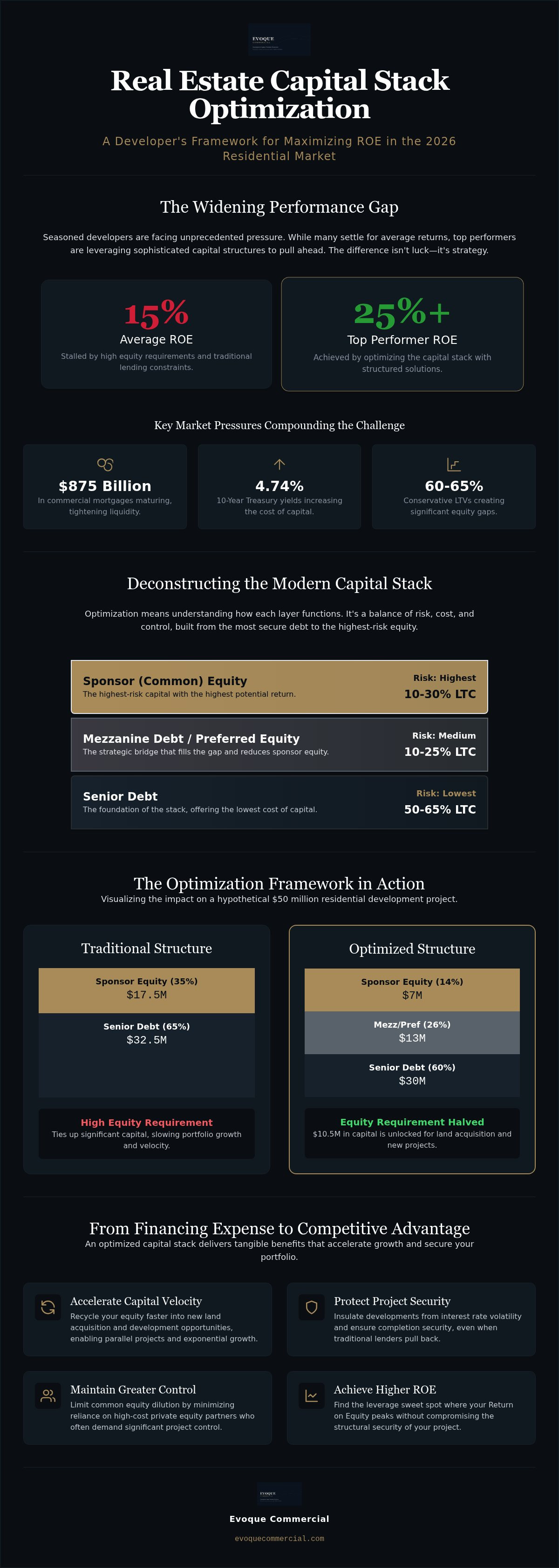
Why are seasoned residential developers still settling for 15% ROE when the industry's top performers are hitting 25% using the exact same senior debt? The difference isn't just the interest rate; it's the architecture of the deal. With 10-year Treasury yields hovering near 4.74% and $875 billion in commercial mortgages maturing this year, the pressure to perform has never been higher. You likely feel the strain of traditional lenders pulling back to conservative LTV ratios, leaving you with a massive equity gap that stalls your portfolio's growth.
This guide delivers a strategic framework for real estate capital stack optimization tailored for the 2026 residential market. We'll show you how to layer debt and equity to maximize your return on equity while ensuring your project remains insulated from interest rate volatility. We'll examine the specific roles of structured capital solutions, analyze the impact of the upcoming September Federal Reserve meeting, and provide a clear roadmap for coordinating multiple capital providers without losing control of your development. It's time to move beyond simple leverage and start engineering your capital for maximum velocity.
What is Real Estate Capital Stack Optimization in 2026?
Capital stack optimization isn't just about finding the cheapest loan; it's the strategic blending of debt and equity layers to achieve the lowest Weighted Average Cost of Capital (WACC). In the current market, the traditional 65/35 debt-to-equity ratio often fails to account for the tighter liquidity and 4.74% 10-year Treasury yields we see today. Developers who rely on rigid formulas find their internal rate of return (IRR) suppressed by high equity requirements. Real estate capital stack optimization is a tool for scaling residential development portfolios without increasing personal risk.
The Role of WACC in Residential Development
Calculating WACC requires multiplying the cost of each capital layer by its percentage of the total project financing structure. While minimizing this number is a priority, it isn't the only goal. Sometimes a slightly higher WACC is acceptable if it increases capital velocity. If a mezzanine layer allows you to keep 10% more of your own cash, you can deploy that capital into a second project sooner. The relationship between cost and timeline is critical; expensive capital that closes quickly is often more valuable than debt that takes months to underwrite.
Why Optimization
is a Growth Strategy
Optimization functions as a lever for growth. By using structured capital solutions to bridge the gap between senior debt and sponsor equity, you reduce your reliance on high-cost private equity partners who often demand significant project control. Consider a $50 million residential development. A traditional structure might require $15 million in sponsor equity. An optimized stack, utilizing mezzanine debt or preferred equity, could lower that requirement to $7 million. This doesn't just improve your ROE; it doubles your capacity to acquire land or start new phases.
Key benefits of a strategic approach include:
- Recycling equity faster into land acquisition and development loans.
- Maintaining higher ownership stakes by limiting common equity dilution.
- Protecting project completion security during periods of interest rate volatility.
- Mitigating the impact of the $875 billion in commercial debt maturing this year.
By engineering the stack with precision, you ensure that every dollar of equity works harder. This disciplined approach transforms financing from a project expense into a competitive advantage.
Deconstructing the Layers: From Senior Debt to Preferred Equity
A successful real estate capital stack optimization strategy requires a granular understanding of how each financing layer behaves during the construction lifecycle. Each tier carries distinct rights, costs, and risks. Senior debt provides the foundation, typically covering 50% to 65% of the Loan-to-Cost (LTC). Above this, mezzanine debt and preferred equity act as the bridge to common equity. While common equity offers the highest potential returns, it's also the first to be wiped out if the project underperforms. Balancing these layers is what determines your final Return on Equity (ROE).
Senior Construction Financing: The Anchor
In 2026, securing ground up construction financing requires more than just a strong balance sheet. Institutional lenders have tightened their underwriting standards, often capping senior leverage at 60% LTC to account for market volatility. Many developers make the mistake of chasing the lowest interest rate while ignoring the impact of rigid draw schedules. A bank offering a lower rate but a slower funding process can destroy your project timeline. In the current environment, non-recourse senior debt is becoming rarer; sponsors must weigh the security of limited personal liability against the higher costs and stricter covenants typically associated with these structures.
Mezzanine Debt vs. Preferred Equity
The choice between mezzanine debt for residential development and preferred equity is a central pillar of real estate capital stack optimization. While both fill the gap between senior debt and common equity, their legal structures differ significantly. Mezzanine debt is secured by a pledge of the developer's ownership interest in the project entity. This allows for a faster foreclosure process than a mortgage, which is a critical risk factor to monitor. Preferred equity, conversely, is an ownership stake with a fixed return. It sits above common equity in the payment waterfall but doesn't usually involve an intercreditor agreement with the senior lender.
For shorter-term projects, mezzanine debt is often preferable because the interest is typically tax-deductible and doesn't involve complex equity transfers. For larger, multi-phase developments, preferred equity may offer more flexibility as it doesn't always require monthly debt service payments, allowing cash to stay within the project. Evaluating these nuances is essential for maintaining structural security. If you are struggling to bridge the gap between your senior loan and available cash, exploring structured capital solutions can provide the necessary liquidity without diluting your long-term upside.
Common equity remains the most expensive capital in the stack. By layering mezzanine or preferred equity effectively, you reduce the amount of common equity required. This increases your leverage but also amplifies your ROE. The goal isn't to maximize debt at all costs, but to find the precise point where the cost of the additional layer is lower than the value of the equity it frees up.
The Optimization Framework: Balancing Leverage, Cost, and Control
Achieving the ideal real estate capital stack optimization requires identifying the "Leverage Sweet Spot." This is the specific point where your return on equity (ROE) peaks before the incremental cost of subordinate debt or the risk of default becomes asymmetric. In the 2026 market, top-tier developers prioritize capital velocity over the simple cost of funds. By utilizing structured layers, you can recycle your equity into new land acquisition and development loans much faster than if you were tied to a high-equity, low-leverage model. A 60% LTC stack offers maximum autonomy but traps substantial capital, whereas a 90% structured stack maximizes capital velocity at the cost of shared project governance and tighter performance covenants.
Control is the silent trade-off in this framework. While higher leverage through preferred equity or mezzanine debt increases your ROE, it often comes with stricter governance and oversight from capital providers. You must determine how much project governance you're willing to cede to reach your desired leverage level. This balance is critical because over-leveraging can lead to a loss of control if the project hits a minor delay, especially with the $875 billion in commercial debt set to mature this year.
Evaluating Leverage Ratios (LTC vs. LTV)
Loan-to-Cost (LTC) remains the primary metric for optimization during the construction phase. It measures the loan amount against the actual hard and soft costs of building. However, planning your bridge-to-permanent strategy requires a focus on "as-completed" LTV. In 2026, luxury residential builds typically see senior debt capped at 60% LTC, while multifamily projects might reach 65% to 70%. Optimization allows you to bridge the remaining gap up to 85% or 90% LTC using subordinate layers, provided the projected cash flows support the debt service.
Cost of Capital vs. Equity Dilution
Calculating the true cost of equity is often overlooked. While common equity from a partner might technically carry a 0% interest rate, the profit splits and promotes can make it the most expensive capital in the stack. A 12% mezzanine loan is often significantly cheaper than giving away 30% of your project's upside to an equity partner. The table below outlines the relationship between cost, priority, and control for the primary layers in 2026.
Layer
Typical Cost (2026)
Payment Priority
Level of Control
Senior Debt
6.7% - 8.7%
First (Primary Lien)
High (Restrictive Covenants)
Mezzanine Debt
12% - 15%
Second (Pledge of Equity)
Moderate (Step-in Rights)
Preferred Equity
14% - 18%
Third (Ownership Stake)
Low to Moderate
By comparing these costs against your projected IRR, you can determine if the additional leverage is accretive. If the cost of the mezzanine layer is lower than the project's IRR, the leverage is working in your favor, effectively amplifying the returns for the common equity holders.
Tactical Execution: Solving Common Funding Gaps
The $875 billion of commercial debt maturing in 2026 has created a liquidity vacuum that often leaves developers stranded mid-construction. When a senior lender refuses to fund a cost overrun or pulls back during a re-appraisal, the resulting funding gap can paralyze a project. Real estate capital stack optimization serves as a defensive necessity in these scenarios. Instead of letting a project stall, sophisticated developers use construction completion financing to bridge the gap and reach the finish line. This is particularly vital for luxury residential development loans, where traditional banks have significantly reduced their appetite for high-spec, vertical risk.
Recapitalization Strategies Mid-Project
Recapitalization isn't a sign of failure; it's a strategic pivot to protect project equity. If early-stage equity becomes too expensive or a partner's capital is exhausted, bringing in fresh structured capital can stabilize the stack. Rescue capital functions as a preferred equity layer that takes priority over the original sponsor's equity but keeps the project moving. This prevents a default on the senior debt and avoids a total loss of the developer's skin in the game. It's about maintaining momentum when market conditions, like the current 4.74% Treasury yields, shift the underlying math of your original pro forma. Real estate capital stack optimization isn't just a planning exercise; it's a survival mechanism for high-stakes residential builds.
Inventory and Release Equity
Once units are completed, they shouldn't just sit as idle assets. Inventory financing allows you to unlock equity from unsold residential units to fund your next acquisition or vertical phase. This turns completed inventory into a revolving credit line, effectively acting as a stack optimizer. By negotiating favorable release prices with your senior lender, you ensure that a portion of every sale goes toward paying down the most expensive capital first. This increases your capital velocity and reduces the overall interest carry on the project.
If you're facing a funding gap that threatens your project's timeline, explore our structured capital solutions to secure the necessary completion funds. Bridge financing also plays a critical role in the entitlement phase. Bridging the gap between land acquisition and vertical construction ensures that you don't exhaust your high-octane equity before the shovel even hits the ground. This tactical execution ensures your project remains resilient regardless of broader market fluctuations.
Partnering with Evoque Commercial for Structured Capital
Large institutional banks often treat middle-market developers as entries on a spreadsheet. This bureaucratic approach leads to rigid structures that don't account for the unique pressure points of a 2026 residential build. Evoque Commercial provides a boutique advantage, combining the financial weight of institutional capital with the responsiveness of a strategic partner. We understand that real estate capital stack optimization is a dynamic process, not a static formula. By reviewing your project's specific metrics, we identify hidden opportunities to re-layer debt and equity, ensuring your capital works with maximum efficiency from the first shovel to the final exit.
Our access to a broad spectrum of capital relationships allows us to fund projects ranging from $3 million to $250 million. This versatility ensures that whether you're developing a single-family subdivision or a large-scale multifamily complex, your project receives the same level of technical precision. We act as the bridge between senior debt and sponsor equity, providing the structured solutions that traditional lenders often avoid in the current high-rate environment.
Tailored Financing Paths
Residential developers face unique ground-up risks that generic lenders often fail to price correctly. Our team structures deals specifically for the lifecycle of a residential project, accounting for entitlement delays, vertical construction milestones, and market absorption rates. We don't just provide a loan; we engineer a financing path that protects your project's internal rate of return. Requesting a project review is the first step toward optimization. During this process, we analyze your current stack to see if mezzanine layers or preferred equity can replace expensive common equity or bridge a funding gap left by a conservative senior lender.
The Evoque Lending Platform
Speed-to-market is a competitive necessity in today's landscape. Our lending platform features streamlined underwriting designed to move at the pace of your development schedule. You get the benefit of institutional-grade capital with the high-touch service levels of a boutique firm. This hybrid approach allows us to close complex transactions faster than traditional banks, giving you the liquidity needed to acquire land or start new phases without delay. We're committed to being your single strategic partner throughout the entire development cycle, providing the stability and expertise required to navigate shifting market realities. It's time to move beyond standard financing and start building with a partner that understands the art of the stack.
Explore Structured Capital Solutions with Evoque Commercial
Engineering Your Capital for the 2026 Residential Market
The landscape of residential development financing has fundamentally shifted. Relying on traditional bank leverage is no longer a viable strategy for developers aiming to scale in a market defined by 4.74% Treasury yields and tightening liquidity. Success now depends on real estate capital stack optimization, where each layer of debt and equity is precisely calibrated to maximize capital velocity and protect your project equity. By transitioning from a passive borrower to a strategic architect of your capital, you ensure that cost overruns or market shifts don't stall your momentum.
Evoque Commercial specializes in projects ranging from $3 million to $250 million. We provide the national structured capital expertise required for complex builds, combined with the boutique responsiveness your timeline demands. Whether you're breaking ground on a multifamily complex or navigating the final phases of a luxury subdivision, we act as the strategic bridge to your project's completion. We don't just provide funding; we offer the disciplined approach needed to navigate high-stakes transactions with confidence.
Request a Project Review for Your Next Residential Development. Your vision deserves a capital structure as resilient as the structures you build.
Frequently Asked Questions
What is the primary goal of real estate capital stack optimization?
The primary goal of real estate capital stack optimization is to achieve the lowest possible Weighted Average Cost of Capital (WACC) while maximizing the developer's Return on Equity (ROE). By strategically layering senior debt, mezzanine financing, and preferred equity, you reduce the amount of high-cost common equity required. This process ensures that capital is deployed efficiently, allowing for greater project velocity and the ability to start new developments without exhausting personal liquidity.
How does mezzanine debt differ from preferred equity in a capital stack?
Mezzanine debt is a loan secured by a pledge of the developer's ownership interest in the project entity, allowing for rapid foreclosure in a default scenario. Preferred equity represents an actual ownership stake with a fixed return and priority over common equity in the payment waterfall. While both fill the gap between senior debt and sponsor equity, mezzanine debt usually requires an intercreditor agreement with the senior lender, whereas preferred equity typically does not.
What is the typical leverage (LTC) for a residential development project in 2026?
In the 2026 market, most senior lenders cap their leverage between 60% and 70% Loan-to-Cost (LTC) for residential developments. However, through real estate capital stack optimization, developers can often reach a total leverage of 85% to 90% LTC by adding subordinate layers. These thresholds vary based on project type; luxury residential builds often see tighter senior LTVs due to market volatility, requiring more structured capital to bridge the gap between debt and equity.
Can a developer optimize the capital stack after construction has already started?
Stack optimization is a dynamic process that can occur mid-construction through recapitalization. If a project faces unexpected costs or if a senior lender pulls back, developers can bring in mezzanine debt or preferred equity to replace expensive early-stage capital. This protects the sponsor's original equity and ensures the project reaches completion. This approach is often used as a tactical response to shifting interest rates or liquidity constraints in the middle-market residential sector.
How does capital stack optimization impact the project's IRR?
Optimization directly increases the Internal Rate of Return (IRR) by reducing the total common equity the developer must commit. By replacing high-cost equity with lower-cost subordinate debt, the remaining equity earns a higher share of the project's profits. This leverage effect amplifies returns during the exit phase. However, developers must balance this against the increased debt service requirements and the higher risk profile associated with greater total leverage across the entire project lifecycle.
What happens to the capital stack if a project faces cost overruns?
If a project faces cost overruns, the capital stack must be rebalanced to maintain liquidity. Developers often turn to construction completion financing or rescue capital to bridge the new funding gap without diluting the primary sponsor. These structured solutions sit above the senior debt but below the common equity in terms of risk. This ensures that vertical construction continues while protecting the project's overall structural security and preventing a default on existing senior loan covenants.
Is structured capital available for luxury spec home developments?
Structured capital is highly relevant for luxury residential development loans, especially as traditional banks reduce their exposure to high-spec vertical risk. Specialized lenders provide mezzanine debt and preferred equity tailored for these high-margin projects. This allows luxury builders to maintain capital velocity and manage multiple high-end builds simultaneously. These solutions are particularly effective for projects ranging from $3 million to $250 million where institutional reach and boutique responsiveness are required to close.
How do bridge loans fit into an optimized capital stack?
Bridge loans act as a temporary layer that facilitates the transition between project phases. They are commonly used to fund land acquisition or pre-development costs before vertical construction financing is secured. In an optimized stack, bridge-to-stabilization loans also provide the necessary runway to reach occupancy targets after construction is finished. This prevents the developer from being forced into a premature exit or a high-interest refinance during a period of temporary market volatility or tighter credit.