

Relying solely on senior debt in the current market isn't just conservative; it's often a recipe for diluted ownership. With a $1.8 trillion wall of commercial debt maturing in 2026, senior lenders have tightened their underwriting, frequently capping contributions at 60% to 65% of Gross Development Value. You likely feel the pressure of this capital gap, making mezzanine debt for residential development a necessity rather than a luxury. The only other traditional alternative is bringing on high cost equity partners who demand a significant share of your hard earned profit.
We'll show you how to master these financing mechanics to bridge the gap and maximize your project's return on equity. This guide explores the strategic transition from senior debt to higher leverage, detailing how to reach up to 90% Loan to Value while managing complex intercreditor agreements. You'll learn to preserve your ownership and improve your internal rate of return through disciplined, structured capital solutions. By understanding the hierarchy of the capital stack, you can move from simple borrowing to sophisticated financial engineering that protects your bottom line.
The Role of Mezzanine Debt in Residential Project Finance
Mezzanine financing functions as a strategic bridge within the capital stack. It sits subordinately to senior debt and superior to developer equity. This hybrid layer, often referred to as mezzanine capital, allows developers to optimize their financial structure without surrendering significant control. While senior lenders provide the foundation, mezzanine debt for residential development provides the capital necessary to reach the project’s total funding requirements. It's a disciplined tool for developers who prioritize ownership preservation over the high cost of equity partners.
The primary utility of this debt is managing the weighted average cost of capital (WACC). By replacing expensive equity with lower-cost debt, the project’s overall financial efficiency improves. Developers use this tool for ground-up construction to minimize their initial cash outlay. It's also increasingly used for construction completion financing. This application is vital when unexpected costs or senior lender pullbacks threaten to stall a project near the finish line, providing a structured path to stabilization.
Bridging the LTC Gap in 2026
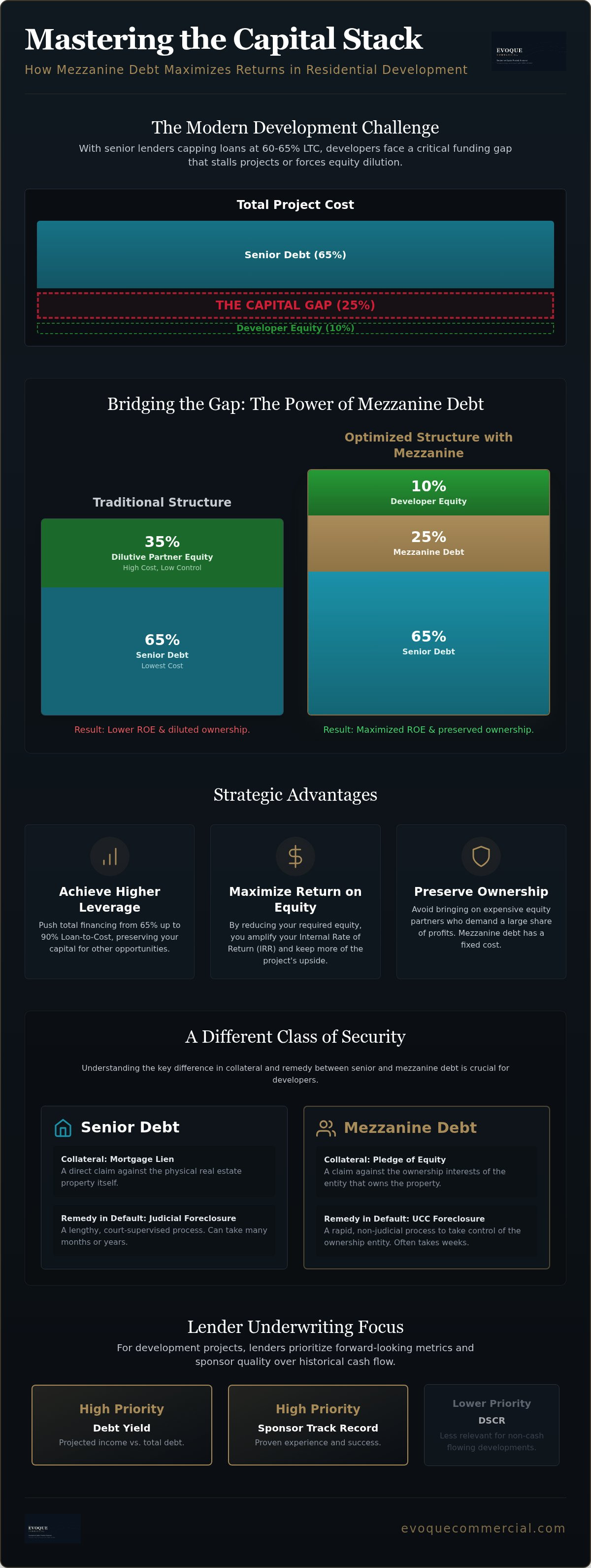
In the current credit environment, senior lenders have significantly reduced their risk appetite. Most traditional institutions cap their contribution at 60% to 65% Loan-to-Cost (LTC). This leaves a massive void in the capital stack that can stall even the most viable projects. Mezzanine debt fills this space, allowing developers to reach total leverage of 80% to 90% LTC. This structure preserves liquidity, enabling developers to allocate capital across multiple simultaneous projects rather than sinking all resources into a single site. The capital gap represents the shortfall between a senior lender's 65% LTC limit and the developer's available 10-15% equity contribution.
Mezzanine Debt
as a Tool for ROE Maximization
Financial performance in residential development often hinges on leverage. High-leverage structures amplify the Internal Rate of Return (IRR) by reducing the denominator of the equity equation. While mezzanine debt for residential development carries higher interest rates than senior facilities, it remains a more cost-effective solution than bringing in equity partners. Equity partners often demand 50% or more of the project's back-end profit. In contrast, mezzanine lenders only require fixed interest payments and fees, leaving the developer with the lion's share of the upside.
Consider the logic of a typical structure. A project funded entirely by equity requires a massive upfront commitment, diluting the developer's return across a large capital base. By integrating mezzanine debt, the developer keeps a larger share of the terminal value. The cost of debt is predictable; the cost of equity is often the most expensive capital a developer will ever use. This approach ensures that the rewards of the development stay with the party taking the primary execution risk.
Key Terms and Structural Nuances of Mezzanine Loans
Securing mezzanine debt for residential development requires a shift in how you view collateral. While a senior loan is secured by a first position mortgage lien on the physical property, a mezzanine loan is secured by a pledge of equity interests in the entity that owns the asset. This distinction is critical. In the event of a default, the mezzanine lender doesn't foreclose on the real estate; they execute a UCC foreclosure on the ownership interests. This process is significantly faster than traditional foreclosure, often taking weeks rather than months; it provides the lender with a powerful mechanism to protect their capital without the delays of the court system.
Strategic alignment of loan terms is equally vital for project stability. Maturity dates for mezzanine facilities typically mirror or slightly exceed the senior construction loan's term. This ensures that the developer isn't caught in a refinancing squeeze mid-build. Many developers also negotiate Payment-in-Kind (PIK) interest options. PIK interest allows a portion of the interest to accrue and be added to the principal balance instead of being paid out of pocket every month. It's a disciplined way to manage cash flow during the intensive construction phase when sales revenue has yet to materialize. Understanding these mezzanine debt in real estate structures helps you maintain liquidity throughout the development lifecycle.
The Intercreditor Agreement (ICA): A Developer's Checklist
The ICA is the legal framework governing the relationship between your senior and mezzanine lenders. For a developer, the most critical components are Cure Rights and Recognition Agreements. Cure rights allow the mezzanine lender to step in and fix a default on the senior loan, preventing a total project loss. You should also watch for standstill provisions. These prevent the mezzanine lender from taking action for a set period while the senior lender works through issues. Negotiating "Change of Control" triggers is also essential; you don't want a minor technical default to allow a lender to replace your development team without cause.
Recourse vs. Non-Recourse in Mezzanine Structuring
Most mezzanine debt for residential development is structured as non-recourse, but it's rarely "no-strings-attached." Lenders include "Bad Boy" carve-outs that trigger personal liability for specific acts like fraud, environmental issues, or filing for bankruptcy. While senior lenders might offer non-recourse construction loans for developers, mezzanine providers may require limited personal guarantees if the project's leverage is exceptionally high. Balancing these risks requires a partner who understands the nuances of the capital stack. If you're structuring a complex deal, it's worth consulting with a specialist who can align these terms with your long term goals.
Mezzanine Debt vs. Preferred Equity: Identifying the Optimal Structure
Deciding between mezzanine debt and preferred equity requires a deep look at your project’s legal structure and tax profile. Both instruments fill the capital gap, yet they operate under different legal frameworks. Mezzanine debt for residential development is a loan secured by a pledge of the developer’s ownership interest. Preferred equity is an actual investment in the entity, granting the provider a priority position during profit distributions. This subtle shift in positioning changes everything from tax treatment to how a default is handled.
Legal remedies represent the most significant divergence for a developer. If a project hits a hurdle, a mezzanine lender can initiate a UCC foreclosure to take control of the ownership entity. This process is typically faster than a judicial foreclosure on real estate. Preferred equity providers, however, don't "foreclose." Instead, they exercise rights within the operating agreement, such as manager removal or forced sale provisions. While these can be effective, they often involve more complex corporate litigation than a clean UCC sale.
Tax efficiency also plays a role in your choice. Mezzanine interest is generally deductible, reducing your project's taxable income. Preferred equity distributions are often treated as profit sharing, which is paid out of after-tax dollars. This difference can significantly impact your net return on equity. Your senior lender’s consent is also the ultimate gatekeeper. Some senior lenders view mezzanine as debt-on-debt and may restrict it to keep the leverage profile clean. In these cases, preferred equity is often the only path to higher leverage.
When to Choose Mezzanine Debt
Mezzanine debt is the optimal tool for high-margin luxury residential development loans with a defined exit. If your project has a clear timeline, such as a 30-month build-and-sell cycle, the fixed-rate nature of mezzanine provides cost certainty. It allows you to lock in your cost of capital early, protecting your margins from interest rate fluctuations. This structure is best when you have a strong senior relationship and a project that can support regular interest payments or accrued PIK interest without straining cash flow.
When Preferred Equity Makes More Sense
Preferred equity is often a necessity when a senior lender has strict prohibitions against subordinate debt. It's also better suited for build-to-rent communities where the stabilization date might be uncertain. Because equity is more flexible than debt, it can accommodate the longer, more variable timelines associated with leasing up a multi-phased project. It functions as a hybrid joint-venture partner, providing the capital you need while satisfying the senior lender’s requirement for an equity-heavy capital stack.
Underwriting Standards for Residential Mezzanine Financing
Underwriting for mezzanine debt for residential development is significantly more rigorous than senior debt analysis. While a senior lender focuses primarily on collateral value, a mezzanine provider evaluates execution risk through the "Three Pillars": Asset, Sponsor, and Structure. Because this capital sits in a higher risk position, every assumption in the pro-forma is stress-tested against market volatility. Lenders don't just look at the project's potential; they look at the probability of every milestone being met on time and within budget.
In development, traditional metrics like the Debt Service Coverage Ratio (DSCR) are often less critical because the asset produces no income during construction. Instead, lenders prioritize "Debt Yield." This is calculated by taking the projected Net Operating Income (NOI) at stabilization and dividing it by the total debt amount (senior plus mezzanine). A healthy debt yield provides the lender with a clear picture of the project's viability if they were forced to take over the asset. Documentation requirements are extensive, including fully vetted construction budgets, detailed entitlements, and third-party market feasibility studies that validate the exit strategy.
Asset-Level Due Diligence
Asset-level reviews focus on the project's "shovel-ready" status. Mezzanine lenders typically have zero appetite for entitlement risk; they want to see all permits in place before funding. For multifamily or single-family subdivisions, the lender will analyze local absorption rates and comparable sales to ensure the projected exit is realistic. This phase of due diligence often mirrors the deep dive required for land acquisition and development loans, ensuring the foundation of the deal is structurally sound before layering on subordinate debt.
Sponsor Requirements and Liquidity
The developer’s track record is the most vital component of the sponsor pillar. Lenders look for specific experience in the residential sub-sector being proposed. A developer with a history of luxury high-rise completions may not be viewed as favorably for a massive build-to-rent subdivision. Beyond experience, mezzanine lenders require "skin in the game," typically a minimum of 10-15% developer equity. Minimum Net Worth and Liquidity requirements are also strictly enforced. Generally, the sponsor’s net worth should equal or exceed the total loan amount, with enough liquidity to cover at least six to twelve months of debt service and project carry.
Evoque Commercial reviews team depth and past project performance to ensure the sponsor can navigate the complexities of a large scale build. If you are preparing a capital stack for a project between $3M and $250M, speak with our structured capital team to align your underwriting with institutional standards.
Strategic Implementation: Partnering with Evoque for Structured Capital
Implementing a complex capital structure requires more than just a lender; it requires a strategist who understands the lifecycle of a build. Evoque Commercial specializes in structuring mezzanine debt for residential development that aligns with the specific risk profiles of ground-up projects. We don't just provide a layer of capital. We ensure that this layer functions harmoniously with your senior debt facility to prevent structural friction. Our experience in loans up to $250 million allows us to handle high volume projects while maintaining the responsiveness of a boutique firm.
We tailor terms to the specific needs of each development. Whether you require construction completion financing to overcome a senior lender's pullback or a bridge-to-stabilization loan, we structure the debt to protect your project’s momentum. This integration is a core component of a broader real estate capital stack optimization strategy. By replacing high cost equity with disciplined mezzanine layers, we help you lower your weighted average cost of capital and keep your equity requirements manageable.
The Evoque Project Review Process
Our review process is methodical and disciplined. We move from initial inquiry to term sheet with precision, focusing on the feasibility of the residential sub-sector and the depth of the development team. A key part of our role involves coordinating with senior lenders. We manage the intercreditor process to ensure that standstill provisions and cure rights are negotiated fairly. This coordination prevents legal delays that could jeopardize your construction timeline. Our focus remains on projects between $3 million and $250 million, where professional mezzanine debt for residential development can make the difference between a stalled site and a successful delivery.
Next Steps for Developers
To begin a formal review, developers should prepare a comprehensive package for our team. This package must include a detailed pro-forma, current entitlement status, and a verified construction budget. In the 2026 market, transparency and readiness are your greatest assets. We evaluate how your project fits into current economic conditions, ensuring the leverage levels are sustainable for long term success. If you're ready to bridge the capital gap and preserve your project ownership, request a project review from Evoque Commercial today. We'll work with you to find the most efficient path from acquisition to completion.
Optimizing Your Capital Stack for Future Delivery
Modern residential projects require a disciplined approach to leverage that balances risk with return on equity. By strategically integrating mezzanine debt for residential development, you can bridge the funding gap left by conservative senior lenders and reach up to 90% Loan-to-Cost. This structured approach preserves your liquidity and protects your project's back-end profit from the high costs of traditional equity partners. Whether you are managing a luxury high-rise or a build-to-rent community, the right subordinate layer ensures your project moves from acquisition to completion without capital-induced delays.
Evoque Commercial provides the institutional capital relationships and specialized expertise in residential ground-up construction needed to navigate these complex arrangements. We offer tailored financing solutions from $3M to $250M; ensuring every term in your intercreditor agreement aligns with your long-term goals. Our methodical review process supports experienced developers who value both speed and precision. Structure your next project with Evoque Commercial's mezzanine solutions and take control of your financial future. Your vision deserves a capital partner that understands the realities of modern development.
Frequently Asked Questions
What is the typical term for mezzanine debt in residential development?
The term for mezzanine debt for residential development typically ranges from five to ten years; however, it often aligns directly with the senior construction loan's maturity. For most ground-up projects, the term covers the active build phase plus a brief window for stabilization or sale. Alignment is crucial to ensure the developer isn't forced into a premature refinance. These facilities often include extension options to account for minor construction or entitlement delays.
How does mezzanine debt differ from a second mortgage?
Mezzanine debt differs from a second mortgage primarily through its security structure. A second mortgage is a direct lien on the real property, whereas mezzanine debt is secured by a pledge of ownership interests in the entity holding the asset. This means the mezzanine lender sits behind the senior lender but ahead of the developer's equity. This positioning allows for higher leverage without cluttering the property's title with multiple real estate liens.
Can mezzanine debt be used for luxury spec home construction?
Mezzanine financing is frequently used for luxury spec home construction; particularly when project costs exceed $3 million and senior lenders cap their leverage at 60% LTC. It allows developers to maintain liquidity for other sites while completing high-end builds. This structure is ideal for luxury residential development loans where the exit is a single high-value sale. It provides the capital necessary to finish premium interiors without bringing on expensive equity partners.
Will a senior lender always allow mezzanine debt in the capital stack?
Senior lenders don't always permit mezzanine debt in the capital stack. They prioritize the simplicity of their first-position lien and may view additional debt as a risk to the project's cash flow. If a senior lender prohibits subordinate debt, developers often pivot to preferred equity structures. Consent is formalized through an Intercreditor Agreement; which defines the rights and standstill provisions for both the senior and mezzanine providers.
What happens to the mezzanine debt if the project is delayed?
If a project faces delays, the mezzanine lender typically relies on the protections outlined in the Intercreditor Agreement. Interest may continue to accrue through a Payment-in-Kind (PIK) structure, which adds unpaid interest to the principal balance. The lender might also charge extension fees or exercise cure rights to fix senior debt defaults. Developers should negotiate these standstill periods carefully to ensure they have enough time to resolve construction or market issues.
Is mezzanine debt available for build-to-rent (BTR) communities?
Build-to-rent (BTR) communities are prime candidates for mezzanine debt for residential development. Since BTR projects often involve phased construction and long lease-up periods, mezzanine layers provide the flexible capital needed before permanent stabilization. This financing supports the developer until the project reaches a Debt Yield that allows for long-term refinancing. It's a common tool for institutional-scale BTR developments ranging from $3 million to over $250 million.
What are the typical loan-to-cost (LTC) limits for mezzanine financing?
Total Loan-to-Cost (LTC) limits for mezzanine financing generally reach between 80% and 85%; though some specialized structures allow for 90% leverage. Since senior lenders in the 2026 market often cap their contributions at 60% to 65% LTC, the mezzanine layer fills the critical 20% to 25% gap. This allows the developer to contribute only 10% to 15% in cash equity, significantly improving their internal rate of return on the project.
How does a 'UCC Foreclosure' work in mezzanine debt?
A UCC Foreclosure allows a mezzanine lender to seize the pledged ownership interests in the borrowing entity rather than the real estate itself. Because this process is governed by the Uniform Commercial Code rather than state real estate laws, it's significantly faster than traditional foreclosure. A lender can often take control of the development entity in a matter of weeks. This speed provides the lender with a powerful remedy if the developer defaults.