

Diluting your ownership to satisfy a senior lender's equity requirement isn't just a cost of doing business; it's often a strategic misstep that leaves your most profitable returns on the table. As construction costs remain elevated and senior debt providers tighten their leverage constraints, the gap between your available capital and the total project cost continues to widen. You likely recognize that bringing in common equity partners often means surrendering long-term control and a significant portion of the project upside. It's a frustrating trade-off that many developers accept simply because they lack a more sophisticated alternative.
There's a more disciplined path to closing that gap without sacrificing your autonomy. By integrating preferred equity for real estate developers into your capital stack, you can secure the necessary funding while keeping your GP interest intact. This article provides a strategic roadmap for utilizing structured capital to maximize leverage and retain project control in complex residential developments. We'll explore how this non-recourse solution functions as a bridge to completion, allowing you to optimize your returns and focus on what you do best: building high-quality projects.
The Role of Preferred Equity in the Real Estate Capital Stack
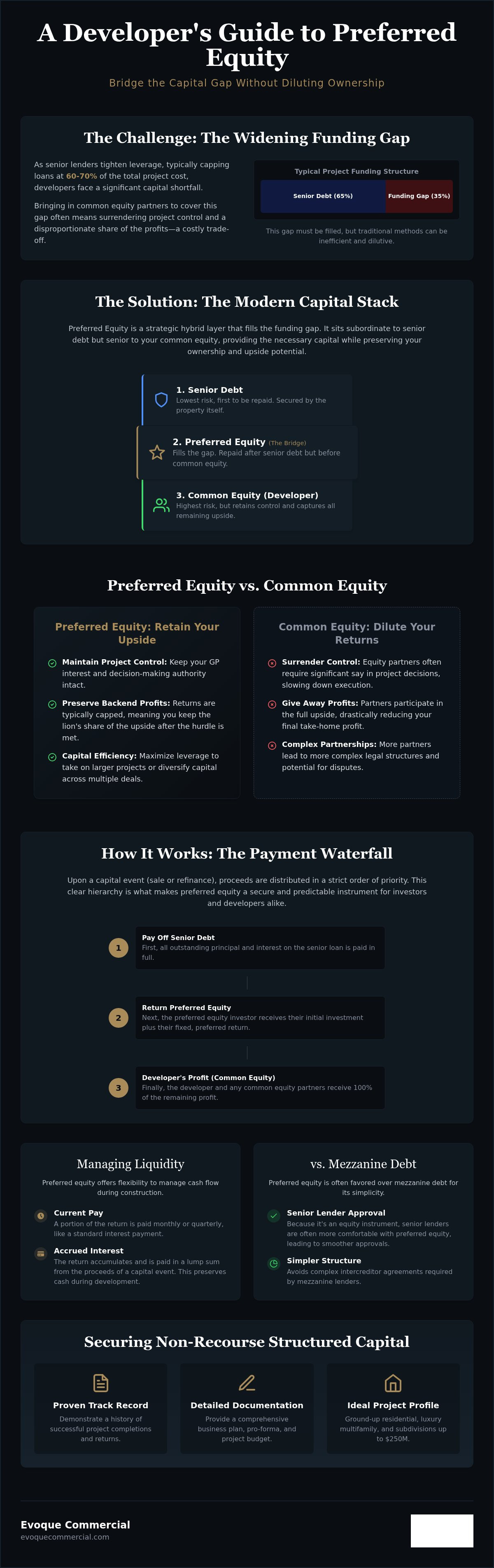
The capital stack for residential development is no longer a simple two-tier structure. As senior lenders maintain disciplined LTC limits, often hovering between 60% and 70%, developers face a significant capital shortfall. This is where preferred equity for real estate developers serves as a strategic hybrid layer. It occupies a unique position, sitting subordinate to the senior mortgage but senior to common equity. In many ways, it functions like Preferred stock in the corporate world, offering a fixed return and priority in the payment hierarchy without requiring the same level of ownership dilution as a traditional partner.
In the 2026 lending environment, institutional capital has shifted toward these structured solutions. This shift isn't merely a reaction to tightening senior debt; it's a move toward greater capital efficiency. By utilizing a hybrid layer, you can minimize your own cash-in-deal. This strategy allows you to diversify your portfolio across multiple projects rather than tying up all your liquidity in a single development. It's a method used by sophisticated developers to maximize project size while maintaining a manageable risk profile.
Bridging the Gap: Senior Debt vs. Total Project Cost
Traditional financing often leaves a void that personal liquidity cannot realistically cover. Senior lenders have become increasingly selective in 2026, focusing on high-quality properties and reliable cash flow. When a bank caps its contribution at 65% of the total project cost, the remaining 35% must be sourced elsewhere. Bringing in a common equity partner for that final 20% often results in a loss of project control and a disproportionate share of the profits. The gap is the difference between senior debt capacity and the developer's available liquidity. Utilizing structured capital allows you to maintain momentum without exhausting your own balance sheet or surrendering the management of your project.
Preferred Equity vs. Common Equity: Preserving the Upside
The primary motivation for choosing preferred equity for real estate developers is the preservation of the developer's back-end profits. While common equity partners participate in the full upside of the project, preferred equity investors typically have their returns capped at a specific internal rate of return (IRR) or a fixed multiple. This structure ensures that once the preferred return is met, you retain the lion's share of the remaining value. It's a calculated trade-off. You accept a higher current cost of capital in exchange for significantly lower long-term dilution. This approach is central to real estate capital stack optimization, allowing you to maximize your GP returns while securing the non-recourse capital necessary for large-scale residential developments. By limiting the number of equity partners, you keep the decision-making process streamlined and focused on project execution.
Mechanics and Structure: How Preferred Equity Functions
The operational framework of preferred equity for real estate developers is defined by its priority within the payment waterfall. Unlike common equity, which waits for the final residual profits, preferred equity holders are paid immediately after the senior debt obligations are met. This structure provides a clear hierarchy: senior debt receives interest and principal, preferred equity receives its defined return, and finally, common equity participants share the remaining upside. Understanding these mechanics is essential for structuring preferred equity investments that align with a project's specific cash flow profile.
Managing liquidity during construction requires a balance between current pay and accrued interest. Many developers opt for a structure where a portion of the return is paid monthly (current pay), while the remainder accumulates and is paid upon a capital event, such as a sale or refinancing (accrued). This flexibility prevents the capital stack from becoming a burden on the project's early-stage operations. Most agreements also include IRR hurdles or "look-back" provisions, ensuring the capital provider achieves a minimum return before the developer captures the performance-based promote. If you're evaluating how these triggers impact your specific development, a project review can help clarify the most efficient structure for your needs.
Hard Pref vs. Soft Pref: Understanding Your Obligations
The distinction between "Hard" and "Soft" preferred equity is often the most critical negotiation point for a developer. Hard preferred equity carries debt-like characteristics, including mandatory redemption dates and remedies that resemble a foreclosure. If a payment is missed, the investor may have the right to force a sale or take over management. Soft preferred equity, conversely, offers more flexibility. While the investor still holds priority in the waterfall, their remedies are typically limited to "blocking rights" or a higher return rate rather than immediate removal of the GP. Choosing between these depends on your project's risk profile and the senior lender's requirements.
The 'Change of Control' Trigger
A "Change of Control" provision is a standard safety mechanism for capital providers. It triggers if the developer fails to meet specific construction milestones or financial covenants. However, a disciplined partner will include "cure rights," giving you a window to rectify the issue before any drastic shift in management occurs. We focus on aligning these triggers with realistic project timelines to ensure the partnership remains stable through every phase of development. This alignment protects your GP position while providing the capital provider with the security necessary to fund complex, high-leverage residential projects across the country.
Preferred Equity vs. Mezzanine Debt: A Strategic Comparison
Choosing between mezzanine debt and preferred equity for real estate developers often comes down to the senior lender's tolerance for subordinate debt. While both occupy the middle of the capital stack, their legal foundations are distinct. Mezzanine debt is a loan secured by a pledge of the developer's ownership interests in the project entity. Preferred equity, however, is an actual ownership stake with priority rights. This distinction isn't merely academic; it dictates everything from the speed of closing to the remedies available if the project encounters delays.
The cost of capital also varies between these two layers. In the current market, mezzanine debt rates typically range from 9.5% to 14.5%, while preferred equity often commands 11.5% to 17.5%. Despite the higher nominal rate, developers frequently choose preferred equity because it offers higher total leverage. It can often push the total capital stack to 85% or 90% of the project cost, whereas mezzanine debt might cap out earlier. For a deeper look at the debt-side alternative, our guide on mezzanine debt for residential development details how those structures differ in practice.
The Intercreditor Advantage of Preferred Equity
Closing a mezzanine loan alongside a senior construction loan is notoriously complex. It requires a tri-party agreement that gives the mezzanine lender the right to "cure" defaults on the senior loan. Many traditional banks and agency lenders simply refuse to sign these documents, effectively blocking mezzanine debt from the project. The Intercreditor Agreement serves as the legal bridge between senior and subordinate capital, defining the rights of each party during the project's lifecycle. Because preferred equity is viewed as equity rather than debt, it often bypasses these rigid intercreditor requirements, making it much easier to integrate into a standard construction financing package.
Remedies and Rights: What Happens in a Default?
The path to recovery in a default scenario differs significantly for each structure. A mezzanine lender's primary remedy is a UCC foreclosure on the pledged ownership interests, a process that can be swifter than a traditional real estate foreclosure. Preferred equity investors rely on "forced sale" rights or management removal provisions within the operating agreement. To mitigate the risk of "vulture" capital, developers should negotiate specific cure periods and "buy-out" options. We work with developers to ensure these terms are balanced, protecting the GP's long-term interests while providing the security that institutional capital providers require.
How to Secure and Structure Preferred Equity for Your Project
Securing capital in the middle of the stack requires a shift from a borrower mindset to a partnership mindset. Capital providers aren't just looking at the asset; they're evaluating your ability to execute a complex business plan under shifting market conditions. To successfully secure preferred equity for real estate developers, your preparation must be as disciplined as your construction management. The process moves quickly, but only if the foundational documentation is institutional-grade from the outset.
The path to closing typically follows a methodical five-step sequence:
- Step 1: Sources and Uses. Provide a granular breakdown that accounts for every dollar, including contingency reserves and carrying costs.
- Step 2: GP Track Record. Demonstrate significant "Skin in the Game" and a history of completing similar residential projects on time and within budget.
- Step 3: Draw Schedule Alignment. Ensure the "Pref" funding sequence matches your senior debt requirements to avoid liquidity gaps during critical construction phases.
- Step 4: Redemption Negotiation. Define the "Buy-Out" price early, whether it's based on a fixed IRR hurdle or a specific equity multiple.
- Step 5: Closing. Finalize the legal documentation and intercreditor rights to ensure all parties are aligned before the first shovel hits the ground.
If you're ready to move forward with a specific development, you can initiate a project review to determine the optimal structure for your capital stack.
The Underwriting Package: What Providers Look For
Your pro-forma must go beyond basic projections. Providers expect a detailed sensitivity analysis that tests your exit pricing against potential interest rate fluctuations or shifts in cap rates. Entitlement status is equally critical; capital providers rarely move forward until the project is fully permitted or has a clear, de-risked path to approval. Finally, your exit strategy must be definitive. Whether you plan to stabilize and refinance into agency debt or execute a merchant-build sale, the path to redemption must be supported by current market data and comparable transactions.
Negotiating Key Terms for Maximum Flexibility
Flexibility is your best defense against the unpredictable nature of ground-up development. Negotiating extension options is vital. These shouldn't be punitive; they should provide a realistic window to handle weather delays or supply chain disruptions. You must also weigh the cost of prepayment penalties against minimum return multiples. While a multiple ensures the investor gets their "floor" return, it can be expensive if you sell earlier than expected. Clear definitions of "Major Decisions" are also essential. You want to retain control over daily operations while granting the investor a vote only on fundamental changes to the project scope or capital structure.
Optimizing Your Capital Stack with Evoque Commercial
Managing the capital stack for high-stakes residential projects requires more than just access to funds; it requires a partner who understands the developer's side of the ledger. Evoque Commercial provides preferred equity for real estate developers that bridges the gap between institutional requirements and boutique execution. We don't just provide funding. We offer a strategic perspective that recognizes the technical complexities of ground-up luxury developments and multifamily projects. Our team focuses on creating capital structures that align with your project's specific lifecycle, from the first draw to the final redemption.
Our firm manages transactions ranging from $3M to $250M with a national footprint across the United States. This scale allows us to bring institutional-grade capital relationships to every deal, while our boutique approach ensures that you receive personal attention and responsive service. We understand that in the 2026 market, capital efficiency is the primary driver of GP returns. By partnering with us, you gain access to a team that's as disciplined about risk management as you are about construction quality. We prioritize long-term stability and clear communication through every phase of the development process.
From Acquisition to Exit: A Comprehensive Capital Partner
We support developers through every critical milestone of their project. Whether you are managing land acquisition or seeking multifamily construction loans, we integrate structured capital solutions that maximize your leverage. Our expertise extends across luxury residential projects, single-family subdivisions, and build-to-rent developments. By placing preferred equity alongside senior debt, we ensure your capital stack remains cohesive and efficient. This integration minimizes the friction often associated with managing multiple lenders, allowing you to focus on site execution rather than capital coordination. We stay engaged from the initial funding through to construction completion and stabilization.
Streamlined Project Reviews
Our project review process serves as a low-friction entry point for developers seeking sophisticated capital solutions. We apply a methodical underwriting approach to every deal, focusing on the financial realities and entitlement status of your specific project. You won't deal with an anonymous credit committee. Instead, you'll have direct access to decision-makers who provide rapid, actionable feedback. This streamlined communication is essential for maintaining momentum in a competitive development environment. We value your time and respect the significance of your project, regardless of its volume. When you're ready to evaluate your options, submit your project for a confidential review with Evoque Commercial to see how our tailored structured capital can support your next major development.
Strategic Capital for the Next Phase of Development
Navigating the complexities of the current capital stack requires a disciplined approach to structured financing. By utilizing preferred equity for real estate developers, you can bridge the funding gap without the heavy dilution of common equity or the rigid intercreditor hurdles often associated with mezzanine debt. This hybrid solution provides the necessary leverage to scale your residential projects while ensuring you retain the majority of the project's long-term upside and operational control.
Evoque Commercial specializes in these complex structured capital solutions for ground-up construction and luxury developments across the United States. We manage projects ranging from $3M to $250M, providing the institutional capital relationships you need with the boutique responsiveness your timeline demands. Our team understands the technical milestones of development and works as a strategic partner to optimize your project's financial structure from acquisition through to a successful exit. If you're ready to secure capital that aligns with your specific goals, Request a Project Review for Structured Capital Solutions. We look forward to supporting your vision with a capital stack built for growth.
Frequently Asked Questions
What is the typical cost of preferred equity for real estate developers in 2026?
In 2026, preferred equity rates generally range from 11.5% to 17.5%, typically covering 75% to 90% of the total capital stack. Origination fees associated with these structures often fall between 2.0% and 4.0%. These figures reflect the risk profile of subordinate capital in the current high-rate environment. While these rates are higher than senior debt, they allow developers to maximize leverage while preserving their primary liquidity for other development opportunities.
How does preferred equity differ from mezzanine debt in a construction project?
Preferred equity is an ownership stake with priority rights, whereas mezzanine debt is a loan secured by a pledge of partnership interests. Mezzanine lenders require a legal bridge via a UCC filing, but preferred equity holders rely on rights defined within the operating agreement. This distinction is vital for senior lender approval. Many traditional banks refuse the complex intercreditor agreements required by mezzanine lenders but accept the equity-based nature of a preferred structure.
Can preferred equity be used for luxury residential spec home developments?
Yes, preferred equity for real estate developers is a common solution for luxury residential spec home projects. These developments often require significant capital for high-end finishes and extensive site preparation. Using structured capital allows a developer to bridge the gap between a senior construction loan and their own liquidity. This approach is particularly effective for luxury projects with total costs between $3 million and $250 million where maintaining project control is a priority.
Is preferred equity considered debt or equity on a developer's balance sheet?
Preferred equity is generally classified as equity on a developer's balance sheet, though it carries debt-like characteristics. Because it represents an ownership interest rather than a direct lien on the real estate, it doesn't increase the project's debt-to-equity ratio in the same way a second mortgage would. This classification often helps developers maintain better financial ratios. The specific terms of the operating agreement and the presence of mandatory redemption dates will ultimately dictate how auditors view the capital.
What is a 'hard' preferred equity structure?
A hard preferred equity structure includes mandatory redemption dates and remedies that mirror a debt instrument. If the developer fails to meet a payment or specific construction milestone, the investor may have the right to force a sale or take over management. It's a more rigid arrangement designed to protect the investor's return through specific enforcement mechanisms. Developers often choose this structure when they have high confidence in their timeline and require the highest possible leverage.
How much 'skin in the game' do developers need to secure preferred equity?
Developers typically need to contribute 5% to 15% of the total project cost as personal equity to secure preferred capital. Capital providers look for this investment as a sign of commitment and alignment of interests. A strong track record in ground-up construction can sometimes offset lower cash contributions. Demonstrating that you have significant equity at risk ensures that the GP remains focused on project completion and meeting the investor's return hurdles during the project lifecycle.
Do senior lenders allow preferred equity in the capital stack?
Most senior lenders allow preferred equity because it's structured as an equity investment rather than a subordinate lien. Unlike mezzanine debt, which requires complex tri-party agreements, preferred equity doesn't typically interfere with the senior lender's primary foreclosure rights. This makes it a preferred choice for banks and agency lenders. We work closely with senior debt providers to ensure the structured capital layer complements the primary construction loan without creating unnecessary legal friction or closing delays.
What happens to preferred equity if the project is delayed?
If a project is delayed, the preferred equity investor may trigger extension fees or a higher return rate. In a hard preferred structure, significant delays could lead to a change of control where the investor takes over management decisions. Negotiating cure rights and realistic extension options during the initial structuring phase is essential. These provisions provide a buffer for weather or supply chain disruptions, protecting the developer's position while maintaining the investor's expected yield through the delay.