

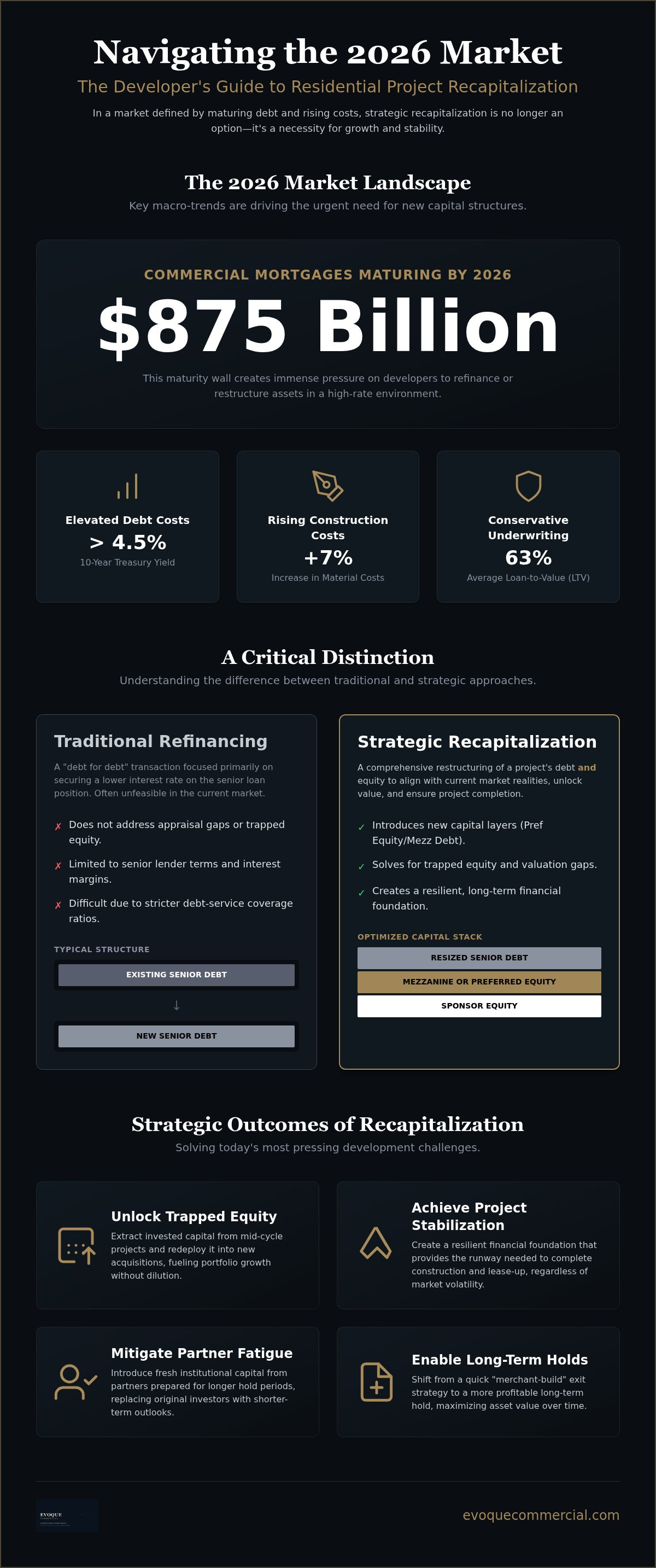
With $875 billion in commercial mortgages maturing throughout 2026, many developers find themselves holding assets structured for a market that no longer exists. If you're managing a mid-cycle development, you're likely facing the reality of trapped equity or appraisal gaps as you approach construction completion. Rising senior debt costs, with the 10-year Treasury yield staying above 4.5 percent, have made traditional refinancing a complex hurdle. In this environment, residential project recapitalization is no longer just a defensive maneuver; it's a strategic necessity for developers who want to maintain their momentum.
We understand that limited partner fatigue and shifting capital requirements can stall even the most promising projects. This analysis shows you how to use structured capital to optimize your stack for higher risk-adjusted returns. You'll discover how top-tier developers use recapitalization to unlock liquidity, mitigate risk, and fuel portfolio growth in the current 2026 market. We'll break down the mechanisms for recycling capital into new acquisitions while ensuring your current projects reach stabilization with a resilient financial foundation that respects the reality of today's rates.
Beyond Refinancing: What Residential Project Recapitalization Means in 2026
Financial flexibility is the new currency of the development world. Residential project recapitalization involves the deliberate restructuring of a project's debt and equity components to better align with current market realities. While many developers view this as a reactive tactic, sophisticated firms use it as a strategic tool for 2026 to unlock liquidity mid-cycle. It's the process of re-engineering the capital stack when original projections no longer match the 4.74 percent yield environment or current construction costs. From initial land acquisition to final construction completion, the goal remains the same: durability.
We are seeing a fundamental shift from using offensive capital for aggressive expansion to prioritizing defensive stabilization. Developers are moving from high-leverage models to structures that ensure project completion regardless of market volatility. This transition allows for a more resilient foundation. It protects the asset from the uncertainty of federal funds rate adjustments while providing the runway needed for stabilization. In a market where material costs have risen by over 7 percent, having a flexible capital base is a competitive advantage.
Recapitalization vs. Refinancing: Key Differences
The distinction between these two paths is critical for maintaining a healthy balance sheet. Traditional refinancing is typically a "debt for debt" transaction, usually aiming to capture a lower interest rate on the senior position. In contrast, What is Recapitalization? describes a broader change in the equity and debt mix. The 2026 market conditions favor recapitalization over simple rate-term refinances for several reasons:
- Recapitalization often introduces new preferred equity or mezzanine layers to fill appraisal gaps.
- Refinancing focuses primarily on the senior lender's terms and interest margins.
- Current valuations often make simple refinances impossible due to stricter debt-service coverage requirements.
The Strategic 'Why': Liquidity and Risk Mitigation
Strategic real estate capital stack optimization allows developers to solve several pressing issues simultaneously. First, it addresses the problem of trapped equity. By bringing in a fresh capital partner, you can extract invested capital from a mid-cycle project and deploy it toward new acquisitions in your pipeline. This keeps your firm agile while the original project continues toward its milestones.
Second, it mitigates "lender fatigue." Many original equity partners or bridge lenders may lack the appetite for the extended timelines seen in today's development cycles. Fresh institutional capital provides the necessary support to transition from a quick merchant-build exit to a more profitable long-term hold strategy. This approach ensures the project isn't forced into a premature sale in a bifurcated market where Class B and C properties face mounting pressure.
The 2026 Market Landscape: Macro Trends Driving Recapitalization Demand
The maturity wall of 2026 is a defining factor for the residential sector. With $875 billion in commercial mortgages set to mature, many developers are navigating a landscape where interest rates remain between 3.5 and 3.75 percent. The 10-year Treasury yield reaching 4.8 percent before settling near 4.74 percent has significantly compressed valuations. In this environment, residential project recapitalization serves as a vital bridge. It allows developers to address the mismatch between legacy debt and current market pricing without losing control of their assets.
Analysis of 2026 real estate market trends indicates that income-driven returns are now the priority. Asset selection and management have become more critical than market timing. Underwriting discipline is at an all-time high, with Fannie Mae reporting weighted-average original loan-to-value ratios of 63 percent. This conservative environment makes it difficult for developers to secure simple refinances, driving the need for more complex, structured solutions that stabilize the capital stack.
The Appraisal Gap and the Need for Gap Funding
Construction material costs rose 7.4 percent over the last year, with steel prices climbing 17.6 percent. These rising costs, combined with 25 to 30 percent tariffs on construction goods, have created a widening appraisal gap. Appraisals for luxury and multifamily sectors are often lagging behind these real-world construction expenses, leaving a hole in the financing plan. Strategic gap funding prevents these projects from stalling mid-cycle. By using tools like inventory financing for home builders, developers can recycle capital into new projects while securing the necessary funds to complete existing developments.
Institutional Capital Shifts Toward Structured Debt
Institutional investors are shifting their focus toward the middle of the capital stack. Private credit funds and family offices are favoring mezzanine debt and preferred equity over senior positions or pure common equity. They're seeking the durability of structured credit, which offers a more predictable risk-adjusted return profile. This shift is especially prominent in Build-to-Rent (BTR) communities. While a new federal housing bill has restricted large institutional purchases of single-family homes, the BTR exception remains a strong driver for residential project recapitalization demand. Professional developers can navigate these shifts by partnering with firms that offer tailored structured capital solutions designed for large-scale residential projects.
Strategic Instruments: Preferred Equity vs. Mezzanine Debt in Recapitalization
Selecting the right financial instrument is the cornerstone of effective real estate capital stack optimization. In a market where senior lenders have tightened their underwriting to a 63 percent loan-to-value average, developers must fill the remaining gap with precision. Mezzanine debt is secured by the entity, while preferred equity is an ownership interest. This fundamental distinction dictates the legal rights, tax implications, and the level of control a developer retains throughout the project lifecycle. In 2026, residential project recapitalization requires a disciplined choice between these two layers to ensure the project remains viable through completion.
The "waterfall" structure at project exit further separates these instruments. Mezzanine debt sits directly behind the senior loan in the payment hierarchy. It must be satisfied before any equity distributions occur. Preferred equity, while junior to mezzanine debt, holds a priority position over common equity. This means the preferred partner receives their principal and agreed-upon return before the developer or common shareholders see a dollar of profit. Balancing these priorities is essential for maintaining a healthy internal rate of return (IRR) while satisfying institutional capital requirements.
Preferred Equity: The Flexible Capital Solution
Preferred equity serves as a versatile tool for developers who need to avoid triggering strict senior debt covenants. Many senior lenders prohibit additional subordinate liens on the property, making mezzanine debt a non-starter. Preferred equity bypasses this by functioning as a corporate-level investment. In 2026, we see a rise in "soft" preferred equity structures, which allow for more flexible payment schedules if the project's cash flow is temporarily constrained. For developers looking for deeper technical mechanics, our analysis of preferred equity for real estate developers outlines how to structure these deals to preserve long-term upside.
Mezzanine Debt: Maximizing Leverage for Completion
Mezzanine debt remains the primary choice for maximizing loan-to-cost (LTC) without diluting the developer's ownership stake. It's often a more cost-effective solution than equity, provided the project can support the debt service. Our guide on mezzanine debt for residential development explains how this layer can bridge the gap when construction costs exceed original appraisals. Developers must carefully negotiate the Intercreditor Agreement (ICA). This document governs the relationship between the senior and mezzanine lenders, and its terms can significantly impact a developer's ability to cure a default or extend a loan term. Strategic recapitalization hinges on understanding these institutional-grade nuances before the first draw is requested.
Execution Guide: Navigating the Recapitalization Underwriting Process
Closing a residential project recapitalization deal demands more than a standard loan application. It requires a forensic level of transparency and strategic alignment. Developers must approach the underwriting process as a collaborative restructuring rather than a simple capital injection. Success in the 2026 market hinges on a methodical five-step approach that respects the current capital market's discipline.
- Perform a rigorous internal audit: Review the current project budget with a sharp focus on the 'cost-to-complete'.
- Obtain updated appraisals: Secure both 'As-Is' and 'As-Stabilized' valuations to determine the actual equity cushion in a bifurcated market.
- Structure the 'Ask': Clearly define the use of proceeds, whether you're paying down senior debt to meet LTV requirements or recycling equity for new acquisitions.
- Identify the right capital partner: Match your project with a lender specializing in your asset class, whether it's a $3M multifamily project or a $250M luxury development.
- Negotiate the Intercreditor Agreement: Finalize the hierarchy and rights between the senior lender and the new mezzanine or preferred equity layer.
Valuing Mid-Cycle Projects in a Shifting Market
In 2026, the 'Cost-to-Complete' is the most scrutinized metric in the underwriting room. Lenders are acutely aware of the inflationary pressures impacting the residential sector. Your budget must account for these shifts and include robust interest reserves to handle the current yield environment. Presenting a project as a 'Rescue and Completion' opportunity requires a detailed accounting of contingencies. It's about proving that the new capital layer provides enough runway to reach stabilization without further restructuring. Transparency regarding appraisal gaps is the fastest way to build trust with institutional partners.
The Developer's Pitch: Presenting the New Capital Stack
Your pitch should focus on de-risking the asset for the incoming partner. Highlight every milestone achieved to date, from finalized entitlements to vertical construction progress. Demonstrating market demand through pre-leasing or pre-sale data is essential for validating your 'As-Stabilized' projections. Finally, you must articulate a clear exit strategy. Whether you plan to refinance into permanent debt or pursue an asset sale, the incoming partner needs to see a logical path to liquidity. For developers seeking a strategic partner to lead this residential project recapitalization, Evoque Lending provides the institutional-grade expertise and boutique responsiveness required to finalize complex capital stacks.
Structured Success: Recapitalizing Residential Portfolios with Evoque Lending
Evoque Lending provides the structural discipline required for high-stakes residential project recapitalization. We operate at the intersection of institutional scale and boutique agility, offering funding capacity that spans from $3 million to $250 million. This range ensures we can support both middle-market developers and large-scale institutional sponsors across the United States. In a market cycle defined by shifting capital requirements, having a partner that moves with precision is a distinct advantage.
Boutique responsiveness remains our primary differentiator compared to institutional bureaucracy. We understand that every week of delay impacts your internal rate of return, especially when managing complex construction completion scenarios. Our team prioritizes efficiency, offering a streamlined decision-making process that favors logic and transparency. We don't just provide capital; we offer a strategic path toward project stabilization and portfolio growth.
National Reach, Specialized Focus
Our expertise extends across the most resilient sectors of the residential market, including luxury residential developments, multifamily complexes, and build-to-rent (BTR) communities. This specialized focus allows us to understand the technical nuances of each asset class, from entitlement hurdles to vertical construction risks. We manage the entire lifecycle of a project's needs, often facilitating a seamless transition from bridge loans to a more permanent, recapitalized structure. This continuity reduces friction and ensures your capital stack remains optimized as the project matures.
Starting the Project Review Process
We maintain a methodical approach to project intake to ensure transparency from the first meeting. To begin a review, we typically require a current project pro forma, a detailed cost-to-complete audit, and an overview of the existing capital stack. Our team performs a rapid assessment to determine the most viable path forward for your residential project recapitalization, whether that involves mezzanine debt, preferred equity, or a custom structured solution. The timeline from initial review to capital deployment is designed for efficiency. To explore how we can stabilize your portfolio and unlock equity, Request a Project Review from Evoque Lending today.
Securing Your Portfolio's Future in a Maturing Market
The 2026 development cycle favors those who prioritize financial durability over aggressive leverage. Strategic residential project recapitalization serves as the vital bridge between mid-cycle obstacles and successful exits. By effectively restructuring the capital stack, you can mitigate the impact of rising debt costs and recycle equity into new pipeline opportunities. You now have the framework to evaluate structured instruments and navigate the underwriting process with institutional precision.
Evoque Lending provides the specialized capital solutions needed to stabilize residential portfolios across the country. Our team combines institutional depth with boutique responsiveness to manage deals ranging from $3M to $250M. Whether you're addressing an appraisal gap or seeking construction completion financing, we offer the strategic partnership required to reach your project's full potential. We invite you to leverage our expertise to ensure your developments remain resilient in any market environment.
Optimize Your Project's Capital Stack with Evoque Lending
Frequently Asked Questions
What is the primary difference between residential recapitalization and a standard construction loan?
Standard construction loans provide the initial senior debt required to build a project from the ground up. In contrast, residential project recapitalization involves restructuring the existing debt and equity mix during the development cycle. It typically introduces junior capital layers, such as mezzanine debt or preferred equity, to fill appraisal gaps or unlock liquidity. While construction loans focus on build costs, recapitalization optimizes the entire stack to reflect current market valuations.
Can I recapitalize a stalled residential project that has run out of contingency funds?
Stalled projects are excellent candidates for construction completion financing through a strategic recapitalization. With construction materials becoming 7.4 percent more expensive in 2026, many developers find their original contingencies exhausted. New capital partners provide the necessary gap funding to finish vertical construction and reach stabilization. This "rescue and completion" capital prevents equity loss by providing the runway needed to complete the project despite rising labor and material costs.
How much equity can I typically pull out of a project during a mid-cycle recapitalization?
The amount of equity available for recycling depends on the project's "As-Is" appraisal and the senior lender's current requirements. In 2026, with Fannie Mae underwriting standards averaging a 63 percent loan-to-value ratio, developers often pull out equity by introducing a mezzanine or preferred equity layer. This structured approach allows you to extract a portion of your invested capital for new acquisitions while maintaining operational control over the existing development.
Does a recapitalization require the consent of my existing senior construction lender?
Consent is almost always a requirement, particularly when introducing mezzanine debt that necessitates a formal Intercreditor Agreement. Senior lenders are protective of their position and often have covenants that prohibit additional subordinate liens on the property. Preferred equity is sometimes easier to implement because it's structured as an ownership interest rather than a lien. Regardless of the instrument, institutional-grade projects require full transparency and approval from the senior lender.
What are the typical interest rates for mezzanine debt in residential recapitalization for 2026?
Interest rates for mezzanine debt in 2026 reflect the 4.74 percent 10-year Treasury yield and current private credit trends. While we don't quote specific pricing for our services, these rates generally represent a spread over senior debt to account for the junior position's risk. Developers should expect rates that are competitive with other structured credit instruments. The final cost is determined by project milestones, developer experience, and debt-service coverage ratios.
Is preferred equity or mezzanine debt better for a build-to-rent (BTR) project recapitalization?
The choice depends on your senior debt covenants and long-term tax strategy. Preferred equity is often favored for BTR projects because it doesn't create a second lien, which many senior lenders prefer for long-term holds. It also offers flexibility if cash flow is temporarily constrained. Mezzanine debt might be better if you're seeking to maximize leverage without any equity dilution. Both instruments remain effective for BTR communities despite recent federal policy shifts.
What is a 'capital call' and how does recapitalization help avoid one?
A capital call occurs when a project needs more cash than budgeted, forcing existing partners to inject additional funds. Recapitalization avoids this by bringing in an outside capital partner to fill the funding gap. By utilizing mezzanine debt or preferred equity, the developer can satisfy the project's financial needs without requiring limited partners to contribute more capital. This preserves partner relationships and provides the liquidity necessary to reach completion in high-cost environments.
How do I determine if my residential project is a candidate for structured capital solutions?
Your project is a candidate if it has a minimum deal size of $3 million and a clear path to stabilization. Ideal candidates often face appraisal gaps, trapped equity, or the need for construction completion financing. We look for projects with achieved milestones, such as finalized entitlements or vertical progress. If your current capital stack no longer supports your IRR goals in the 2026 market, a structured review is the first step.