

For a high-stakes residential development, your greatest risk isn't the interest rate; it's the liquidity trap created by traditional bank amortization. You've likely felt the pressure of rising vertical costs while a retail bank demands principal repayments before the first unit is even framed. Finding the right interest only construction loan lenders is about more than just lower monthly payments. It's a strategic move to keep your capital agile and protect your project's internal rate of return.
We understand that restrictive schedules from traditional institutions often lead to liquidity crunches during the final phases of a build. This guide shows you how to identify and vet institutional-grade partners who offer the high-leverage, interest-only structures your project requires. We'll examine the current shift toward private credit, the mechanics of SOFR-based interest reserves, and how to secure up to 85% LTC without the rigid oversight that stifles growth. By the end of this article, you'll have a clear framework for partnering with lenders who understand the nuances of the residential development lifecycle.
What Are Interest-Only Construction Loans for Developers?
In the world of ground-up residential development, capital efficiency is the difference between a project that stabilizes and one that stalls. Interest-only (IO) financing serves as the primary engine for vertical construction because it recognizes a fundamental reality: projects don't generate cash flow until they're topped out and leased or sold. Unlike retail products designed for homeowners, institutional interest-only loans are sophisticated debt instruments structured to align with the construction lifecycle.
Professional interest only construction loan lenders prioritize the project's viability over simple credit scores. While a consumer IO loan might focus on initial affordability, a developer’s IO facility focuses on preserving the project's internal rate of return (IRR). By deferring principal payments until the loan matures or the asset is refinanced, developers can keep their equity working across multiple phases or new acquisitions.
How IO Terms Impact Project Cash Flow
The pre-revenue phase of a build is the most vulnerable period for a developer's liquidity. Amortizing debt requires principal payments immediately, which increases the monthly carry cost and drains cash reserves before the first unit is framed. In contrast, IO structures only require payments on the funds actually drawn from the facility. An interest reserve is a pre-funded budget line item within the loan that capitalizes these monthly payments back into the balance, allowing the developer to focus entirely on execution without out-of-pocket debt service during the build.
IO vs. Amortizing Construction Debt
Amortizing debt typically enters the picture during the bridge-to-stabilization or permanent financing phases. During vertical construction, however, amortization can be a strategic liability. It artificially inflates the Debt Service Coverage Ratio (DSCR) requirements, making it harder for a project to meet institutional underwriting benchmarks during the lease-up period. For Build-to-Rent (BTR) or luxury spec home developers, IO terms provide the breathing room needed to achieve maximum market value. This flexibility allows the sponsor to time their exit or refinance when the asset is fully stabilized, rather than being forced into a liquidity crunch by a rigid repayment schedule.
How Institutional IO Lenders Evaluate Development Projects
Institutional capital markets have moved beyond simple credit scores. Today, interest only construction loan lenders focus on the asset's performance and the sponsor's ability to execute. This project-based underwriting shifts the risk assessment from the individual to the capital structure itself. Lenders evaluate the project's feasibility from the ground up, starting with the land's entitlement status and ending with the viability of the exit strategy.
Standard benchmarks in this environment include Loan-to-Cost (LTC) and Loan-to-Value (LTV). While regulated banks often cap LTC at 60% to 70%, private credit platforms offer stretch senior facilities up to 85% LTC. This higher leverage allows developers to preserve cash for other pipeline opportunities. Lenders look for "skin in the game," often requiring at least 15% of the project's as-completed value in cash or qualified equity to mitigate risk during the vertical build phase.
Project-Specific Underwriting Criteria
Lenders require exhaustive market feasibility studies to secure interest-only terms. They analyze the "as-stabilized" value, particularly for multifamily and Build-to-Rent (BTR) assets, to ensure the project can support a permanent takeout loan. This involves testing the project against a 10% institutional debt yield benchmark. Lenders also scrutinize entitlement risk, especially for land acquisition and development loans, ensuring the project is ready for vertical construction. Following the risk-management principles in the OCC Commercial Real Estate Lending handbook, institutional providers assess the sponsor’s track record as a primary indicator of project success.
The Role of the Draw Schedule
The mechanics of the draw schedule define the loan's actual cost. You pay interest only on the disbursed balance, not the total commitment. Each month, the developer submits a draw request, and an inspector verifies the work in place. While traditional banks might take 21 business days to process these requests, agile private lenders fund approved draws in 2 to 5 business days. Managing this "interest carry" within the budget is vital for maintaining the project's timeline and ensuring liquidity. Working with a boutique institutional lender ensures your capital structure remains responsive to these specific project milestones.
The ultimate gatekeeper for institutional capital is the exit strategy. Whether you plan to sell upon completion or refinance into permanent debt, lenders underwrite the project against projected Net Operating Income (NOI). A robust exit plan provides the certainty lenders need to offer the most competitive interest-only terms.
Comparing Interest-Only Construction Lenders: Banks vs. Private Credit
Selecting the right interest only construction loan lenders requires a clear understanding of the trade-off between the cost of capital and the flexibility of the debt. While the interest rate is often the first metric developers compare, the underlying covenants and leverage thresholds have a far greater impact on the project's overall success. Developers typically navigate four primary categories of capital providers, each serving a distinct role in structuring the capital stack for residential builds.
Traditional Banks: The Conservative Choice
Commercial and regional banks offer the lowest all-in coupon rates, currently ranging between 6.25% and 8.25%. However, this lower cost comes with rigid regulatory constraints. Under High Volatility Commercial Real Estate (HVCRE) rules, banks must hold a 150% risk-weight capital charge unless the developer contributes at least 15% of the project’s as-completed appraised value in cash equity. These lenders typically cap leverage at 60% to 70% LTC and almost universally require full personal recourse. This conservative approach is why many banks struggle to fund complex multifamily construction loans in volatile markets where appraisal values fluctuate during the underwriting process.
Private Credit and Debt Funds: The Flexible Alternative
Institutional private debt funds have captured nearly 40% of the market share in transitional development financing. These lenders aren't bound by HVCRE regulations, allowing them to offer stretch senior debt up to 85% LTC. For professional developers, the primary draw of private credit is the availability of non-recourse financing. You protect your personal balance sheet while securing the capital needed to break ground quickly. These platforms excel at funding luxury residential development loans where speed and high leverage are prioritized over the absolute lowest interest rate.
The distinction between boutique and institutional lenders often comes down to transaction size and responsiveness. Boutique platforms specialize in the middle-market segment, typically handling projects between $3 million and $50 million with high-touch service. Conversely, large institutional lenders focus on high-volume financing for $100 million plus developments. While banks may take up to 21 business days to process a single draw request, private credit providers often fund approved draws in 2 to 5 business days, keeping the job site active and the project on schedule.
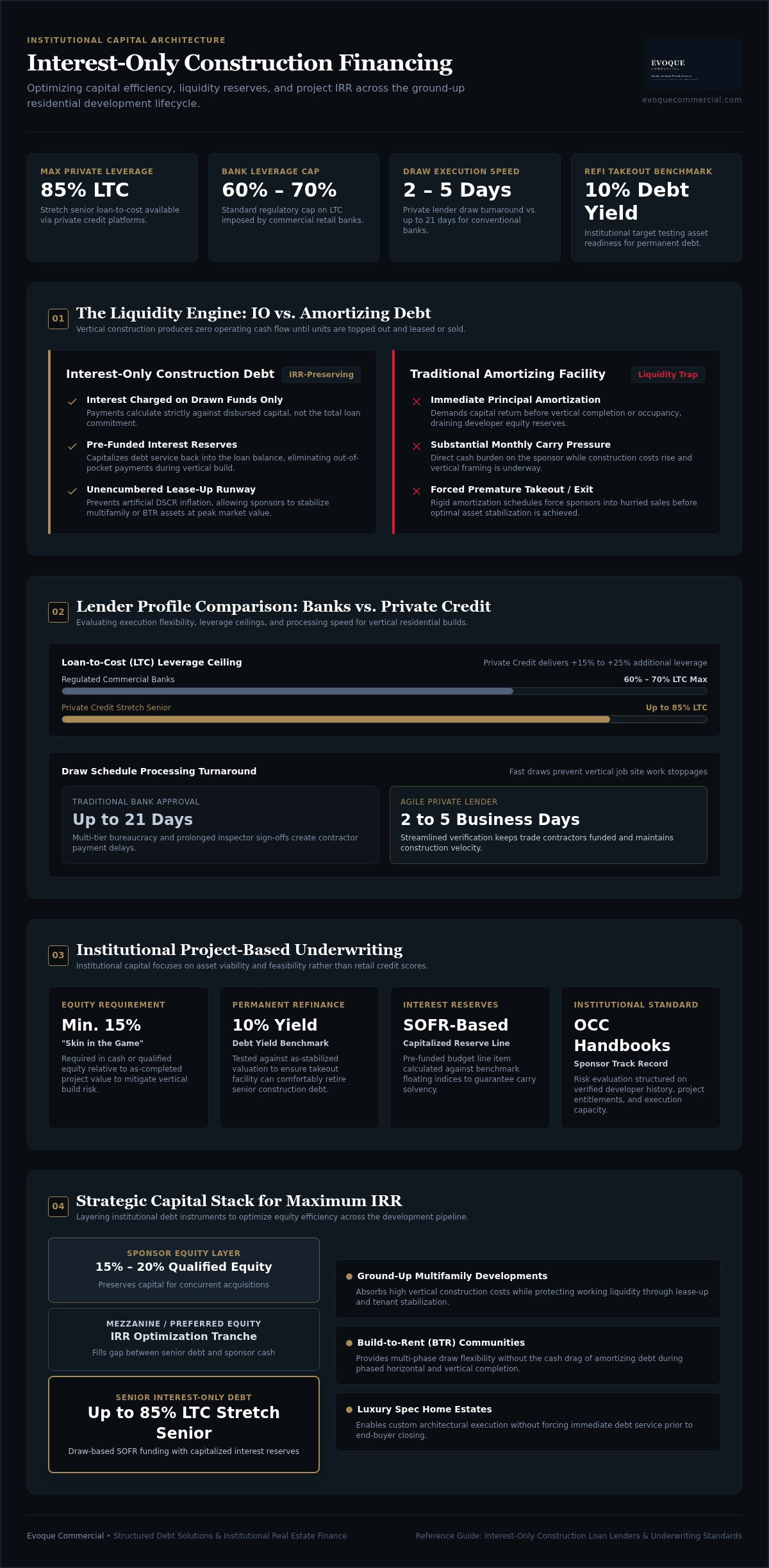
Structuring the Capital Stack for Maximum IRR
Strategic positioning of debt within the capital stack is the primary lever for enhancing a developer’s internal rate of return (IRR). For professional sponsors, interest only construction loan lenders provide the senior debt layer that dictates the feasibility of the entire project. By minimizing debt service during the vertical build, you reduce the immediate burden on the project’s cash flow. This allows your capital to remain available for unforeseen contingencies or simultaneous developments in your pipeline. High-leverage IO debt ensures that your equity isn't locked into non-productive principal payments during the pre-revenue phase.
Integrating this senior debt with subordinated layers like mezzanine loans or preferred equity creates a sophisticated high-leverage environment. While a traditional bank might require 35% cash equity, a structured capital approach can reduce that requirement to 15% or less. This layering effectively shifts the equity burden from the developer to institutional partners who are comfortable with the project's risk profile. When the project reaches stabilization, the strategy often involves transitioning from construction debt into bridge loans for residential development to provide the necessary runway for a permanent takeout or sale. This transition is a critical milestone that requires precise timing and coordination with your capital partners.
Leveraging Interest-Only Senior Debt
The Weighted Average Cost of Capital (WACC) is significantly optimized when interest-only terms are secured for the largest portion of the debt. Since principal is not being repaid during the construction phase, the developer’s equity remains unencumbered for a longer duration, which mathematically drives up the equity multiple. An interest reserve acts as a critical risk mitigant here; it ensures that interest payments are covered even if the project faces minor delays. Comprehensive real estate capital stack optimization improves equity multiples by ensuring every dollar of debt is working at its most efficient rate. Partnering with interest only construction loan lenders who understand this balance is essential for maintaining liquidity throughout the build.
Managing the Exit and Refinance
Exiting an institutional IO loan requires a disciplined timeline and a deep understanding of loan covenants. Most interest-only construction facilities include specific provisions for prepayment or yield maintenance that can impact your final net proceeds if you exit too early or too late. You must align your construction completion phase with your refinancing window to avoid costly extensions or penalties. Protecting your upside means ensuring that the transition to permanent financing happens exactly when the asset reaches its target Net Operating Income (NOI). If you're looking to maximize your project’s potential through customized debt layering, consider exploring our structured capital solutions to see how we can optimize your next build.
Partnering with Evoque Commercial for Structured Capital
Evoque Commercial operates at the intersection of institutional scale and boutique agility. As interest only construction loan lenders, we provide the structured capital necessary for complex residential and multifamily projects that require more than a standard credit box. Financing solutions range from $3 million to over $250 million, covering the full spectrum of development needs. We specialize in ground-up construction, land acquisition, and construction completion financing, ensuring that your project remains capitalized from the first draw to the final certificate of occupancy.
Our approach centers on being a strategic partner rather than a mere source of debt. We recognize that the middle-market developer often faces a capital gap; projects are too complex for small community banks but too nimble for massive investment banks. We fill this void by providing the responsiveness of a boutique firm backed by deep institutional relationships. This allows us to move with the speed your project demands while maintaining the structural integrity required for high-leverage financing.
Why Developers Choose Evoque
National reach is a cornerstone of our platform, providing developers with consistent capital regardless of the project's location. We bring deep experience in the luxury residential and multifamily Build-to-Rent (BTR) sectors, where market dynamics require a sophisticated understanding of localized demand. Structuring complex deals is our specialty. We often step in where traditional banks decline due to rigid regulatory caps or high-volatility commercial real estate (HVCRE) constraints. By focusing on the project's intrinsic value and your track record, we offer the flexibility needed to maximize your project’s potential.
Get Started on Your Next Project
A streamlined review process ensures that your project moves from submission to term sheet without unnecessary delays. We value your time and prioritize clarity in our initial assessment. To begin, we require a comprehensive documentation package that allows our underwriters to evaluate the project's feasibility and exit strategy. Documentation requirements include:
- Detailed project pro-formas and 2026 market projections.
- Current site plans and architectural renderings.
- Comprehensive builder resumes and a schedule of real estate owned (SREO).
- Entitlement status and environmental reports.
Once these materials are submitted, our team conducts a disciplined analysis to align our capital solutions with your project's specific goals. We invite you to request a project review from Evoque Commercial to discuss how we can optimize your capital stack and preserve your liquidity for your next build.
Scaling Residential Portfolios with Strategic Capital
Success in ground-up development requires a capital partner who understands that liquidity is your most valuable asset. By prioritizing interest-only terms during the vertical build, you ensure your equity stays focused on execution rather than non-productive principal repayments. The shift toward project-based underwriting and private credit has opened new doors for developers to secure higher leverage and faster funding cycles than traditional banks allow. Partnering with interest only construction loan lenders who offer structured solutions is the most effective way to protect your project's IRR while maintaining the agility to pursue new acquisitions.
Evoque Commercial provides the institutional-grade underwriting and national residential development expertise your project deserves. With capital solutions available up to $250 million, we bridge the gap between rigid bank lending and the flexible capital needed for modern builds. You're building more than just a project; you're building a legacy. Secure Your Project’s Future with Evoque Commercial Capital and experience a partnership defined by precision and strategic responsiveness. We look forward to helping you break ground on your next landmark development.
Frequently Asked Questions
What is the typical interest rate for a commercial interest-only construction loan in 2026?
In 2026, interest rates for construction facilities are typically benchmarked against 30-day SOFR, which currently averages 3.65%. Regulated commercial banks generally price these loans at SOFR plus 250 to 375 basis points, resulting in all-in coupon rates between 6.25% and 8.25%. Institutional private debt funds often charge a premium for higher leverage, with spreads ranging from 400 to 700 basis points over SOFR for transitional development projects.
Do interest-only construction loan lenders require personal recourse?
The requirement for personal recourse depends heavily on the lender type. Traditional commercial banks almost always require full personal guarantees from the project's principals. Conversely, institutional interest only construction loan lenders in the private sector frequently provide non-recourse financing. These facilities typically only include standard completion guarantees and "bad boy" carve-out agreements, which protect the lender against fraud without encumbering the developer's entire personal balance sheet.
How long do interest-only periods typically last for residential developments?
Interest-only periods for ground-up residential developments generally align with the projected construction and lease-up timeline, typically lasting between 12 and 36 months. This duration ensures that the developer is not burdened by principal repayments before the asset generates stabilized cash flow. Most institutional lenders structure these periods to include a pre-funded interest reserve, which covers debt service throughout the build cycle and provides a buffer for the initial stabilization phase.
Can I get an interest-only construction loan for a build-to-rent (BTR) community?
Yes, build-to-rent (BTR) communities are a primary focus for institutional capital providers. These projects are often structured with interest-only terms during the horizontal and vertical construction phases to maximize the developer's cash flow. Because BTR assets are valued based on stabilized net operating income, lenders prioritize project-based underwriting metrics like debt yield to ensure the construction facility can be successfully refinanced into a permanent agency or life company loan.
What is the minimum loan amount for institutional interest-only construction lenders?
Institutional capital providers typically target middle-market and large-scale projects with a minimum loan amount of $3 million. At Evoque Commercial, we structure financing for residential developments ranging from this entry point up to $250 million. This range allows us to support both boutique luxury builds and massive multifamily subdivisions. Setting these minimums ensures that the project has the necessary scale to support the sophisticated legal and underwriting requirements of structured capital.
How does an interest reserve work in an interest-only development loan?
An interest reserve is a specific line item within the total development budget that pre-funds the monthly debt service. Instead of the developer making out-of-pocket payments, the lender draws the interest due from this reserve and adds it to the outstanding loan balance. This capitalization of interest allows interest only construction loan lenders to maintain their yield while the developer preserves liquidity for vertical construction costs and other project-related expenses.
What happens if my project is delayed past the interest-only period?
If a project faces delays, developers typically negotiate a loan extension or transition into a bridge-to-stabilization facility. Most institutional loan agreements include one or two six-month extension options, which are usually contingent on the project reaching specific construction milestones and paying an extension fee. If the interest-only period expires before the project is ready for permanent financing, a bridge loan can provide the necessary runway to reach full occupancy or completion.
Are there prepayment penalties on interest-only construction loans?
Prepayment penalties are common in institutional lending but vary by the specific debt instrument. Many senior construction loans include a lockout period or a minimum interest requirement to protect the lender's anticipated yield. Some facilities use yield maintenance formulas, while others may allow for flexible exit strategies without significant penalties. It is vital to review the prepayment terms during the term sheet phase to ensure they align with your projected exit or refinance window.