

A high credit score and a shovel-ready site are no longer the primary keys to unlocking institutional capital in 2026. While many developers focus on site plans, the most successful projects are won or lost in the nuances of the capital stack and the clarity of the developer’s pedigree. You’ve likely felt the frustration of opaque underwriting processes at large banks or the difficulty of bridging the gap between land acquisition and vertical construction. Mastering the specific residential construction loan requirements for developers requires more than just a solid pro-forma; it demands a strategic alignment with institutional expectations.
This article provides a definitive checklist to move your project from a vision to a fully funded reality. You'll learn how to master the complex institutional benchmarks that credit committees demand for large-scale residential developments. We’ll show you how to optimize your equity positions to meet lender expectations and secure a strategic financing partner rather than just a vendor. From acquisition through to stabilization, we'll preview the rigorous standards you must meet to ensure your project stays on schedule and remains financially resilient through every phase of construction.
Beyond Consumer Mortgages: The Institutional Underwriting Shift
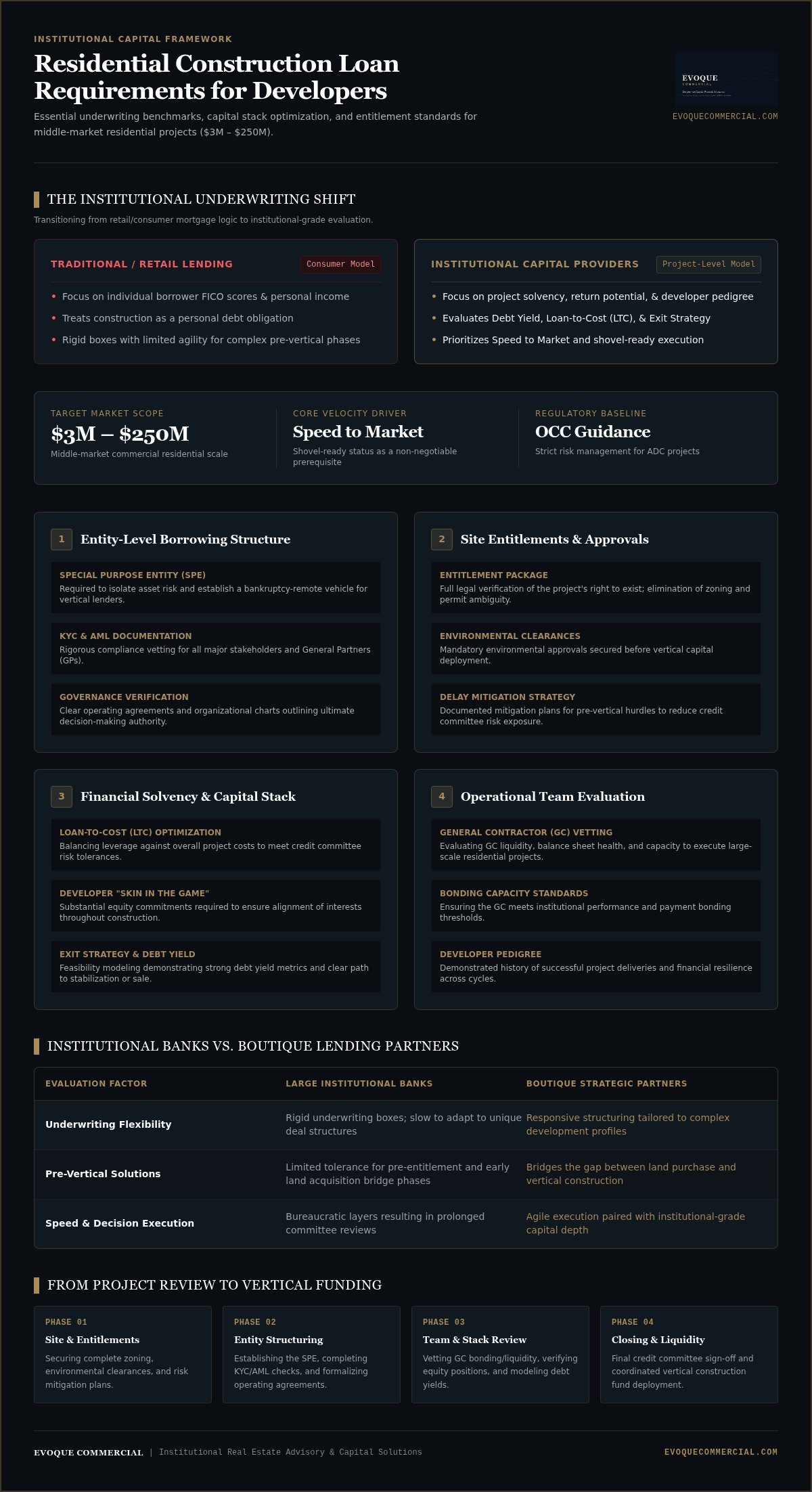
Professional developers often encounter a significant barrier when approaching retail banks for project financing. Most consumer lenders treat construction as a personal debt obligation, focusing heavily on individual credit scores and personal income. In contrast, residential construction loan requirements for developers in the institutional space operate on an entirely different plane. Here, the focus shifts from the individual borrower to the project's intrinsic value and its ability to generate returns. Institutional capital providers don't just look at who you are; they look at what the project can become.
In 2026, the lending environment prioritizes "Speed to Market" above almost all else. Capital is looking for projects that are ready to break ground immediately. This means that shovel-ready status is a non-negotiable prerequisite for vertical funding. Lenders in the middle-market space, which we define as the $3M to $250M range, rely on sophisticated commercial mortgage underwriting metrics to determine risk. They evaluate debt yield, loan-to-cost ratios, and the feasibility of the exit strategy rather than just a FICO score. This professionalized approach ensures that only the most resilient projects receive the necessary liquidity to move forward.
The Entity-Level Borrowing Structure
Institutional lenders require a clean, transparent borrowing vehicle. You'll need to establish a Special Purpose Entity (SPE) for each project to isolate risk and protect the asset. This structure is a standard part of residential construction loan requirements for developers because it provides a bankruptcy-remote environment for the lender. Alongside this, prepare for rigorous Know Your Customer (KYC) and Anti-Money Laundering (AML) documentation. Lenders will vet every major stakeholder and General Partner (GP) involved in the deal. You must provide comprehensive operating agreements and clear organizational charts that detail exactly how the partnership is structured and who holds decision-making authority.
Institutional vs. Boutique Lending Standards
Large banks often demand rigid transparency and have fixed underwriting boxes that don't always account for the complexities of a unique development. While they provide deep liquidity, their processes can be slow and impersonal. This is where the value of a boutique partner becomes evident. A boutique approach offers the responsiveness needed to structure complex deals while maintaining institutional-grade capital relationships. It's about finding a balance. You need the discipline of a major bank but the agility of a strategic partner who understands the nuances of land acquisition and development loans in the pre-vertical phase. This combination allows for more flexible capital solutions that can bridge the gap between land purchase and vertical construction without the delays typical of larger, more bureaucratic institutions.
Pre-Development & Site Entitlement Requirements
Credit committees view entitlement risk as a primary deal-killer. Before a single dollar of vertical capital is released, lenders must verify that the project is legally and physically viable. This verification process aligns with the OCC commercial real estate lending guidance, which mandates that banks maintain strict risk-management principles for acquisition, development, and construction (ADC) projects. For a developer, this means providing proof that the site is fully entitled for its intended use. Any ambiguity regarding zoning or permit status will likely stall the underwriting process. Lenders want to see that the path to ground-breaking is clear of bureaucratic hurdles.
Meeting the residential construction loan requirements for developers starts with a comprehensive entitlement package. This isn't just a folder of blueprints; it's a legal verification of the project's right to exist. Institutional partners look for site identification that includes detailed mitigation strategies for potential delays. They prioritize projects where the developer has already done the heavy lifting of securing approvals. If the site requires a rezoning or a variance, these should ideally be settled before you approach a vertical lender. This discipline reduces the lender's exposure and positions your project as a lower-risk investment.
The Entitlement Documentation Package
A complete package should be transparent and exhaustive. Lenders expect to see approved site plans and final plat maps, particularly for single-family subdivision projects where parceling is essential. You'll also need zoning verification letters that confirm the land use matches your pro-forma. If the project deviates from standard zoning, include all Conditional Use Permits (CUPs). Environmental safety is equally critical. Every institutional deal requires a Phase I Environmental Site Assessment (ESA) to rule out contamination. If the Phase I report suggests history of industrial use, a Phase II study becomes a non-negotiable requirement for funding.
Horizontal Development Milestones
Horizontal development bridges the gap between raw land and vertical construction. Lenders look closely at the budget for infrastructure, distinguishing between "on-site" work like internal roads and "off-site" requirements like utility extensions or municipal traffic signalization. This phase often utilizes land acquisition and development loans to prepare the site for building. Municipalities frequently require performance bonds or letters of credit to ensure that infrastructure is completed to code. Successfully meeting these milestones demonstrates to a lender that the project is disciplined. Structuring these early-stage requirements correctly prevents delays during the vertical funding transition. If you are currently navigating the entitlement phase, a strategic financing partner can help align your pre-development milestones with long-term capital goals.
Financial Solvency & Capital Stack Requirements
In 2026, capital is expensive; this makes the precision of your financial projections a critical gatekeeper for funding. Institutional lenders have moved away from simple debt-to-income ratios, focusing instead on the interplay between Loan-to-Cost (LTC) and Loan-to-Value (LTV). While LTC governs the actual dollars disbursed during the build, LTV determines the project's viability at stabilization. One of the most rigid residential construction loan requirements for developers is the verification of "skin in the game." Most institutional partners expect the developer to contribute 20% to 35% of the total project cost as liquid equity before any debt is drawn.
While retail banks might fixate on personal assets, institutional partners prioritize real estate capital stack optimization to ensure the senior debt is properly insulated. This approach aligns with Federal Reserve real estate lending standards, which set supervisory limits on loan-to-value ratios for tract development and professional construction projects. You must also decide between recourse and non-recourse debt. While non-recourse debt is the gold standard for large-scale residential projects, it often requires a higher equity contribution and a more seasoned development team to offset the lender's increased risk.
The Senior Debt Layer
The senior debt remains the foundation of your financing. For multifamily construction loans, typical LTC ranges fall between 65% and 75%, depending on the market and the developer’s track record. Lenders require a robust interest reserve to cover carrying costs during the construction and lease-up periods. This reserve ensures that debt service is met even before the project generates cash flow. Additionally, appraisal requirements have become more stringent. You'll need to provide both "As-Is" valuations for the land and "As-Stabilized" valuations that reflect the projected market value once the units are occupied and the income stream is consistent.
Subordinate Debt
& Preferred Equity
When the senior loan and developer equity leave a gap, subordinate debt or preferred equity fills the void. Integrating mezzanine debt into the residential capital stack allows for higher leverage, but it comes with increased complexity. Senior lenders will require a formal intercreditor agreement to define the hierarchy of repayment and the rights of each capital provider in the event of a default. It's also vital to understand how preferred equity impacts your Debt Service Coverage Ratio (DSCR). Unlike mezzanine debt, preferred equity is often treated as equity by the senior lender, which can help your project meet the primary residential construction loan requirements for developers without violating debt-level covenants.
Operational Track Record & Project Team Evaluation
Institutional lenders in 2026 prioritize execution over ambition. While the financial structure is the skeleton of a deal, the project team is its heartbeat. A core part of residential construction loan requirements for developers involves a deep dive into the "pedigree" of everyone involved. Lenders don't just ask if the project works; they ask if this specific team can bring it to completion on time and within budget. This evaluation extends beyond the developer to the architects, engineers, and market analysts who validate the project's assumptions. Capital providers want to see a cohesive unit that has survived market cycles together.
The vetting process is a rigorous filter designed to ensure project continuity. It's not enough to have a site and a pro-forma; you must prove that your operational capacity matches the scale of the debt you're seeking. This means every member of the team, from the lead architect to the environmental consultant, must meet institutional standards for experience and reliability. When the stakes involve millions in senior debt, lenders leave nothing to chance regarding the human element of the development.
Developer Experience (REO) Schedules
Your Real Estate Owned (REO) schedule is your most persuasive document. It shouldn't just list properties; it must demonstrate a consistent track record of successful exits within the same asset class. For those pursuing luxury residential development loans, the REO must reflect high-end finishes and complex site management. If you're stepping into a project that another developer abandoned, you'll face even higher scrutiny. In these cases, requirements for construction completion financing include a clear explanation of why the previous team failed and how your operational experience will correct the course to protect the lender's collateral.
The General Contractor Package
The General Contractor (GC) is often the highest risk factor in a construction loan. Lenders will vet the GC’s liquidity and bonding capacity as rigorously as they vet your own. You must provide a GC package that includes a list of completed ground-up residential projects of similar scale. Financial statements and bank references are mandatory to prove they can carry the costs between draws. The lender will also scrutinize the construction contract. While a Lump Sum contract provides more certainty, a Cost-plus arrangement might be accepted if there's a Guaranteed Maximum Price (GMP) with a healthy contingency fund. If you need to verify if your current team meets residential construction loan requirements for developers, it's time to consult with a strategic financing partner.
Finally, don't overlook third-party reports. Market studies and feasibility analyses from reputable firms are non-negotiable. These reports provide an objective second opinion on your pro-forma. For high-end projects, the reputation of your Architectural and Engineering (A&E) firm can significantly influence the credit committee's confidence. They look for firms that understand local building codes and have a history of delivering plans that don't require constant, costly revisions during the build phase.
Navigating the Closing Process: From Project Review to Funding
Closing a deal is the final hurdle where administrative friction often meets project urgency. The transition from a term sheet to a funded draw requires a level of precision that many developers underestimate. Navigating the final residential construction loan requirements for developers is less about selling a vision and more about verifying the mechanics of the transaction. Success here depends on your ability to provide a clean, exhaustive file that allows legal and underwriting teams to move with confidence. Any delay in documentation at this stage can ripple through your construction schedule, potentially pushing back your ground-breaking date by weeks or months.
The Executive Summary Checklist
The executive summary is the first document a credit committee reviews; it must be both concise and comprehensive. Your project narrative should clearly define the location, asset class, and specific market demand drivers that justify the development. Beyond the story, the committee requires a detailed "Sources and Uses" table that accounts for every dollar in the capital stack, including the equity and subordinate layers discussed previously. Finally, your exit strategy must be realistic. Whether you plan for a rapid sale-out or intend to transition into bridge loans for residential development for stabilization, the path to repayment must be supported by current market data.
Underwriting timelines vary significantly between capital providers. Large institutional banks often follow a rigid, 90 to 120 day cycle that can be detrimental to a project's speed to market. In contrast, a boutique approach offers the responsiveness needed to close complex middle-market deals in a fraction of that time. Once the loan is closed, managing the draw schedule becomes your primary operational task. Lenders require a structured flow of funds that aligns with vertical construction milestones, ensuring that the General Contractor is paid promptly while the lender’s collateral is protected through every stage of the build.
Final Underwriting
& Funding
The last mile of due diligence involves the finalization of title insurance, ALTA surveys, and formal legal opinions. These contingencies must be cleared before the first draw is released. After funding, the role of the loan servicer becomes central. They'll manage monthly draw inspections to verify that the work described in the draw request matches the physical progress on-site. This disciplined oversight ensures that the project remains in balance and that the interest reserve is sufficient to carry the debt through to completion. If you're ready to move your project from shovel-ready to funded, request a professional project review with Evoque Lending to align your development with institutional capital standards.
Secure Your Project’s Future with Institutional Precision
Mastering the modern landscape of residential construction loan requirements for developers means looking past simple debt and toward a structured partnership. Success in 2026 requires more than just a site; it demands a transparent capital stack, a vetted project team, and absolute entitlement clarity. By prioritizing project-level solvency over personal credit, you position your development for the deep liquidity of institutional markets while maintaining the agility to break ground quickly. Aligning your milestones with lender expectations early prevents the administrative friction that often stalls middle-market growth.
Evoque Lending bridges the gap between boutique responsiveness and institutional capital relationships. We provide specialized financing for projects ranging from $3M to $250M, offering national reach across all US residential markets. Whether you're navigating ground-up multifamily construction or seeking construction completion financing for a complex site, our team ensures your project meets the highest underwriting standards. Don't let opaque bank processes stall your progress. Request a Strategic Project Review for Your Residential Development today and move your vision from shovel-ready to fully funded. Your project deserves a partner who values precision as much as you do.
Frequently Asked Questions
What is the minimum loan amount for professional residential construction loans?
The minimum loan amount for professional residential construction loans at Evoque Lending is $3 million. We specialize in the middle-market segment, providing financing that scales up to $250 million for large-scale developments. This threshold ensures that projects have the necessary complexity and volume to benefit from institutional capital structures. For developers working on smaller projects, retail or local community banks are often a more appropriate fit than institutional capital providers.
Can I get a construction loan for a residential project without being shovel-ready?
While vertical funding requires shovel-ready status, you can secure acquisition and land financing before permits are finalized. Institutional residential construction loan requirements for developers typically mandate that all entitlements and environmental clearances are in place before the vertical draw begins. If your project isn't yet shovel-ready, we often structure a pre-development loan to bridge the gap while you finalize zoning and site plans with the local municipality.
What is the difference between recourse and non-recourse construction debt?
Recourse debt requires the developer to provide personal guarantees, allowing the lender to pursue personal assets if the project fails. Non-recourse debt limits the lender's recovery strictly to the property and its cash flow, though it usually includes carve-outs for specific bad acts like fraud. Because non-recourse debt carries higher risk for the lender, it often demands a more seasoned development team and a stronger equity position within the capital stack.
How much liquidity does a developer need to show for a $10M project?
For a $10 million project, lenders typically look for liquid cash reserves equal to 10% of the loan amount, which is $1 million in this scenario. This liquidity is separate from the 20% to 35% equity contribution required for the total project cost. Lenders want to see that the developer has enough dry powder to handle unexpected cost overruns or delays without immediately defaulting on interest payments during the build.
What happens if my residential construction project stalls mid-build?
If a project stalls mid-build due to cost overruns or partner disputes, developers can seek construction completion financing. This specialized capital acts as a rescue vehicle to pay off existing liens and finish the remaining work. Lenders will conduct a forensic audit of the project's current status and the remaining budget. It's a complex process that requires a strategic partner capable of restructuring the debt to protect the asset’s long-term value.
Do I need a signed construction contract before applying for financing?
You don't necessarily need a signed contract for an initial project review, but a fully executed construction contract is mandatory before closing. Lenders prefer a Guaranteed Maximum Price (GMP) or Lump Sum contract to mitigate the risk of fluctuating material costs. The general contractor’s experience and financial health are vetted alongside the contract terms to ensure the residential construction loan requirements for developers are fully met before any funds are disbursed.
How do lenders evaluate market feasibility for luxury spec homes in 2026?
In 2026, lenders evaluate luxury spec homes using detailed third-party market studies and current absorption rates for high-end inventory. They focus on the as-stabilized appraisal value rather than just the construction cost. Credit committees also look at the developer’s specific experience in the luxury asset class. A project must demonstrate a clear competitive advantage in its local market to justify the higher risk associated with speculative residential builds.
What are the typical interest rate benchmarks for residential development bridge capital?
Residential development bridge capital is typically priced at a spread over the Secured Overnight Financing Rate (SOFR). While exact rates depend on the project's risk profile and leverage, spreads often range from 300 to 600 basis points. These benchmarks reflect the short-term, flexible nature of bridge financing, which is designed to carry a project through a specific transition period, such as the gap between construction completion and long-term stabilization.