

In the 2026 market, the most successful developers aren't necessarily those with the largest balance sheets; they're the ones with the most agile capital. While traditional lenders remain cautious, savvy firms use residential development bridge capital as a tactical offensive tool to seize opportunities before they vanish. You've likely felt the frustration of watching a prime acquisition slip away because a bank's approval process moved at a glacial pace. It's a common pain point: your capital is tied up in a stalled project, and the cost of bringing in an equity partner feels like giving away the farm.
We recognize that maintaining momentum is the difference between a profitable exit and a costly delay. This guide will help you master the mechanics of bridge financing to accelerate your project timelines and optimize your entire capital stack. You'll learn how to secure higher leverage than traditional institutions offer while building a clear, disciplined path to permanent financing. We'll examine the specific 2026 landscape, from SOFR-linked rates to the impact of new California housing regulations, ensuring your next move is backed by institutional-grade strategy.
What is Residential Development Bridge Capital in 2026?
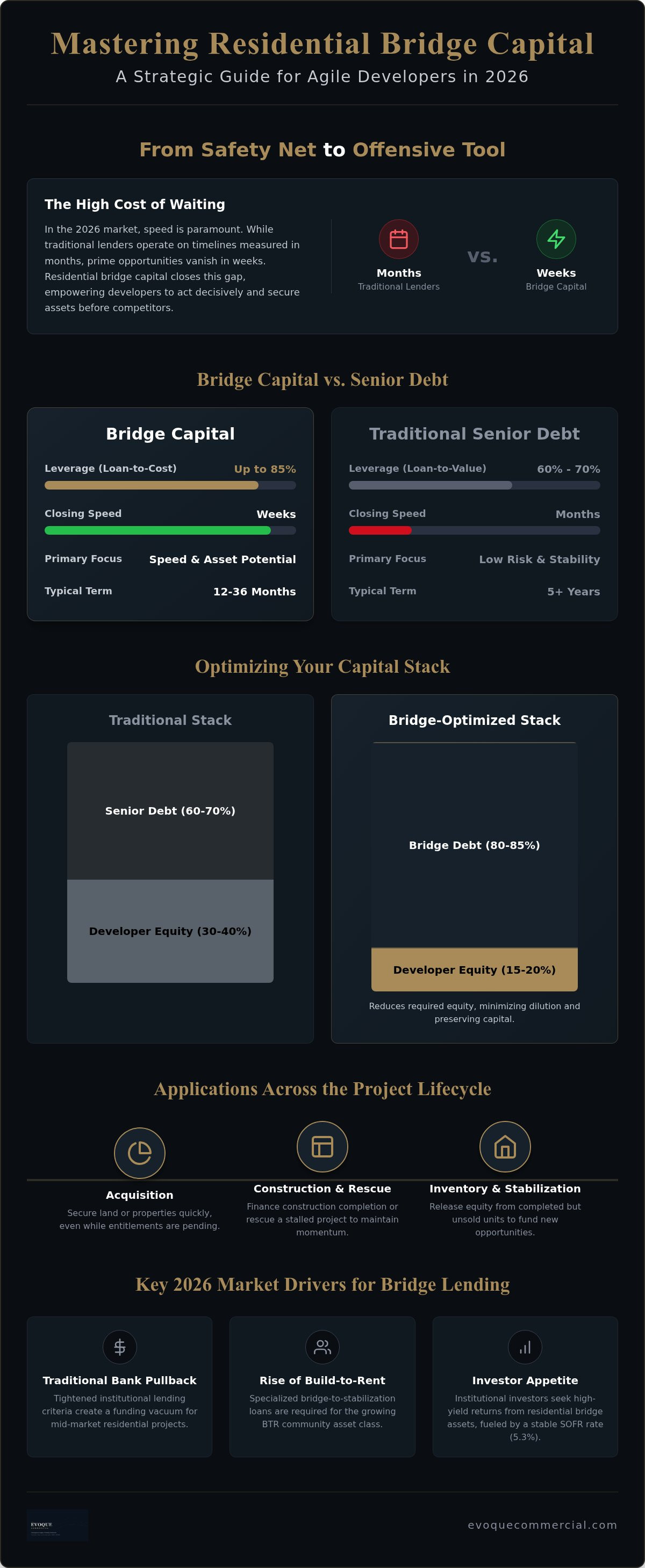
In the current credit environment, residential development bridge capital represents a specialized, high-leverage financing solution designed to cover the gap between immediate capital needs and long-term liquidity. Unlike permanent financing, which prioritizes low interest rates and long amortization, bridge capital focuses on speed and flexibility. These loans typically span 12 to 36 months. Developers often ask, What is a bridge loan? in a general sense, but in the 2026 residential sector, it's a tactical instrument that allows a project to move forward when traditional bank timelines would otherwise cause a deal to fail.
We categorize these instruments into two primary phases based on the project lifecycle. Acquisition bridge financing secures land or properties while entitlements are still pending or during the early stages of site preparation. Post-construction bridge financing, often referred to as inventory financing, releases equity from completed but unsold units. This distinction is vital for a healthy capital stack. One secures the future of the project; the other protects its current equity and liquidity, allowing for a more efficient allocation of resources across a developer's portfolio.
The 2026 market has seen a decisive shift toward non-bank private credit. Traditional institutions have tightened their lending criteria, creating a vacuum that boutique lenders now fill. Residential developers prioritize speed over cost in high-demand markets because the opportunity cost of a stalled project far outweighs the spread on a bridge loan. If a developer can close in weeks rather than months, they can secure prime land before a competitor or keep a construction crew on-site without interruption. This responsiveness is essential in a year where the median sales price for existing homes remains high at $417,800.
The Role of Bridge Debt in the Capital Stack
Bridge debt occupies a critical space between senior debt and developer equity. By increasing leverage beyond what a traditional bank offers, it reduces the amount of expensive equity a developer must commit. This structure minimizes equity dilution and preserves ownership for the sponsor. A clear exit strategy is always the final milestone. This typically involves transitioning the residential development bridge capital into permanent financing once the project reaches stabilization or begins its sales phase.
Key 2026 Market Drivers for Bridge Lending
Several factors drive the current demand for structured bridge solutions. Traditional bank pullbacks have left many residential construction projects underfunded, particularly in the mid-market space. Simultaneously, the rise of build-to-rent (BTR) communities requires specialized bridge-to-stabilization loans that traditional mortgage products don't accommodate. Institutional investors now have a significant appetite for high-yield residential bridge assets. They recognize the security of residential real estate when combined with the attractive returns of structured private credit, especially with the SOFR rate holding at 5.3%.
Bridge Capital vs. Senior Debt: A Strategic Comparison
Traditional senior debt serves as the foundation of most projects, yet its rigid requirements often create friction during the acquisition or construction phases. In 2026, the primary differentiator between these two paths is the tolerance for risk and the speed of capital deployment. Senior lenders typically cap their exposure at 60% to 70% Loan-to-Value (LTV), whereas residential development bridge capital providers look at the total project potential, providing the agility needed to move before a site is fully entitled.
Leverage and LTV: Pushing the Boundaries
The financing gap left by traditional banks is widening. While institutional banks remain constrained by regulatory oversight and internal risk committees, bridge lenders frequently provide up to 80% or 85% Loan-to-Cost (LTC). This higher threshold allows developers to preserve their liquid capital for other ventures or to manage unexpected 2026 cost fluctuations. For a deeper look at how this applies to the early stages of a project, see our Land Acquisition & Development Loans: Developer's Guide. While some state programs fill the financing gap for specific affordable housing initiatives, private bridge capital remains the most reliable solution for market-rate and luxury developments that require rapid scaling.
Recourse and Personal Guarantees
One of the most significant strategic advantages of bridge capital is the availability of non-recourse structures. Large-scale developers often prefer non-recourse loans to shield their personal assets and other portfolio holdings from project-specific risks. In the volatile 2026 market, where interest rate spreads and material costs can shift mid-cycle, avoiding personal guarantees is a disciplined risk-management move. While senior debt often carries lower interest rates, it almost always requires full recourse, tying the developer's personal net worth to the project's performance.
The true cost of capital isn't just the interest rate; it's the opportunity cost of lost time. A traditional bank loan can take four to six months to close, potentially causing a developer to miss a critical construction window or lose a purchase contract. Bridge capital can often be secured in 10 to 20 days. This speed allows for immediate execution, ensuring project momentum remains uninterrupted. If you're currently evaluating your capital stack, our team can help you structure a tailored financing solution that balances leverage with long-term stability.
Core Applications: From Acquisition to Project Rescue
Strategic use of residential development bridge capital extends far beyond simple gap coverage. In the 2026 market, these loans function as a versatile tool for developers to maintain momentum across the entire project lifecycle. Whether you're securing land in a competitive bidding environment or releasing equity from a finished phase to fund the next, the application of bridge debt determines your project's agility. While nonprofit sectors often rely on innovative financing strategies to secure affordable housing bonds, market-rate and luxury developers utilize private bridge capital to bypass the slow underwriting cycles of institutional banks.
Inventory financing has become a vital application for developers with completed, unsold units. Instead of waiting for individual closings to recoup capital, developers can use a bridge loan to pull equity out of the finished inventory. This liquidity can then be deployed into new acquisitions or vertical construction on subsequent phases. Additionally, rescue capital has emerged as a necessity for projects facing mid-construction hurdles. If a primary lender pulls back or a budget overrun occurs due to 2026 material costs, a bridge-to-stabilization loan can provide the necessary infusion to reach completion. You can find more on this in our Bridge to Stabilization: Guide for Developers.
Financing for Shovel-Ready and Entitled Land
Securing land before vertical financing is in place is a high-stakes phase of development. Bridge capital allows you to close on a property while entitlements are still being finalized. This prevents you from losing a site to a cash buyer while you wait for a traditional construction loan. Managing entitlement risk requires a lender who understands the technical milestones of land development. For those focusing on residential communities, our Single-Family Subdivision Financing Guide provides a deeper framework for structuring land and horizontal development debt.
Construction Completion and Recapitalization
Stalled projects are a significant drain on resources and reputation. We often step in to provide construction completion financing when a project's original capital stack is no longer sufficient. This might involve recapitalizing the project to buy out an equity partner who needs an early exit or simply providing the funds to cross the finish line. The 'Bridge-to-Exit' strategy is especially effective for luxury residential developments. It allows the developer to finish the build, stabilize the asset, and then transition into a lower-cost permanent loan or move directly into the sales phase with maximum leverage.
Structuring the Loan: Terms, Costs, and Covenants
Structuring residential development bridge capital requires a disciplined focus on the project's terminal value rather than just its current state. Lenders in 2026 prioritize the "Projected Net Sell-Out" value as the primary underwriting metric. This figure represents the total anticipated revenue from unit sales minus commissions, closing costs, and marketing expenses. Most bridge loans are structured with terms ranging from 12 to 36 months. We typically include one or two six-month extension options. These extensions act as a vital safety net for developers facing unexpected permitting delays or labor shortages during the vertical phase.
Draw schedules and reporting requirements are more rigorous than those found in permanent financing. Capital is released in tranches tied to specific construction milestones, verified by third-party site inspections. This ensures the loan remains in balance with the project's physical progress. Covenants often include minimum interest clauses and exit fees, which are standard mechanisms to protect the lender's yield. These fees ensure the financing remains viable even if a developer chooses to refinance or sell the asset earlier than originally projected.
The Cost of Speed: Interest and Fees
The 2026 market utilizes floating rates typically tied to the Secured Overnight Financing Rate (SOFR). With SOFR currently at 5.3%, spreads for residential bridge loans generally fall between 3% and 6%, leading to effective rates of 8% to 14%. Origination fees usually range from 1% to 3% of the total loan amount. While these costs are higher than traditional bank debt, they reflect the speed of execution and the higher leverage provided. Using bridge debt often proves more profitable than taking on an equity partner, as it allows the developer to retain a significantly larger portion of the project's upside.
Managing the Exit Strategy
A bridge loan is a temporary bridge, not a destination. Defining a clear "takeout" strategy is the most critical part of the initial term sheet. Developers must identify whether the exit will be a transition to permanent debt, a full project sale, or a strategic refinancing. Our Bridge to Permanent Financing Guide outlines the documentation and stabilization milestones required for a seamless transition. You'll need to weigh the benefits of open-ended structures against those with prepayment penalties, depending on your anticipated sales velocity. If you're currently evaluating your project's capital stack, our team can provide a structured analysis of your financing options to ensure your exit is as efficient as your entry.
Securing Bridge Capital: The Evoque Lending Approach
Effective 2026 financing requires a lender that understands technical milestones and the mounting pressure of a construction schedule. Evoque Lending provides residential development bridge capital by combining institutional-scale capital with boutique responsiveness. We handle structured solutions from $3 million up to $250 million. This flexibility supports various project types, from ground-up luxury subdivisions to build-to-rent stabilization. Our flat organizational structure removes the bureaucratic layers that often slow down bank committees. This agile setup means you're speaking directly with decision-makers who respect the value of your time.
Our methodology focuses on the full lifecycle of the asset. We don't just look at the immediate need; we analyze how the bridge debt facilitates the eventual transition to permanent financing or a successful sale. This forward-looking perspective is why developers trust us with complex recapitalizations and construction completion scenarios. We understand that in a high-demand market, the ability to pivot quickly is your greatest competitive advantage. Speed isn't just a convenience; it's a structural requirement for profitability.
The Project Review and Underwriting Process
Our underwriting is built for speed without sacrificing the precision needed for large-scale projects. While traditional institutions may take months to issue a commitment, our process moves from initial intake to a firm term sheet in a matter of days. We require a concise package to begin our review. This includes a detailed pro-forma, a current site plan, and a summary of the sponsor's track record. This documentation allows our team to quickly assess the "Projected Net Sell-Out" and verify the feasibility of the construction timeline. For developers operating specifically in the apartment sector, our Bridge Loans for Multifamily Projects: 2026 Guide offers a deeper dive into sector-specific underwriting requirements and stabilization milestones.
Your Strategic Partner in Residential Development
We don't view ourselves as a mere source of funds. We're a strategic partner. Every project undergoes a rigorous review where we look for opportunities to optimize the capital stack and mitigate execution risks. Our national reach allows us to fund projects across the United States, yet we maintain the localized market intelligence necessary to understand specific 2026 zoning or labor challenges. This dual approach ensures that your project has the momentum it needs to reach a successful exit. Whether you're rescuing a stalled development or securing land for a new project, our team is ready to analyze your capital needs. By utilizing specialized residential development bridge capital, you protect your equity and maintain control over your project's timeline. You can Request a Project Review with Evoque Lending to begin the intake process and secure the capital your development deserves.
Accelerating Your Residential Pipeline
The 2026 residential landscape demands a shift from passive funding to active capital management. Success no longer depends solely on site selection; it requires the agility to secure land and rescue stalled timelines with precision. By mastering the mechanics of residential development bridge capital, you transform financing from a hurdle into a competitive advantage. High-leverage structures and rapid closing cycles allow you to maintain project momentum when traditional banks hesitate. A clear exit strategy ensures that this speed doesn't come at the expense of long-term stability.
Evoque Lending provides the institutional capital relationships and national US presence necessary to scale your operations effectively. Whether you're navigating a complex acquisition or stabilizing a new multifamily community, our team offers structured solutions ranging from $3 million up to $250 million. We invite you to Request a Project Review for Your Residential Development to see how our strategic approach can optimize your capital stack. Your next milestone is within reach, and we're here to provide the bridge that gets you there.
Frequently Asked Questions
What is the typical interest rate for residential bridge capital in 2026?
Typical interest rates for residential development bridge capital range from 8.0% to 14.0% in 2026. Most loans are floating, tied to the SOFR rate plus a spread of 3% to 6%. The final rate depends on factors like Loan-to-Value (LTV), property type, and the borrower's experience. While higher than permanent financing, this pricing reflects the speed and flexibility required for time-sensitive projects that traditional banks cannot accommodate.
Can I use bridge capital for ground-up construction or only for acquisition?
You can use bridge capital for both acquisition and ground-up construction. While it's often used to secure land quickly, bridge structures are equally effective for vertical development phases. These loans provide the initial capital needed to start construction while you wait for a traditional bank loan or until the project reaches a specific level of pre-sales or stabilization. It is a versatile tool for the entire development lifecycle.
How fast can a residential development bridge loan be closed?
Speed is a primary advantage in this sector. Closings typically occur within 10 to 20 days. This timeline is significantly faster than the four to six months often required by traditional banks. Rapid closing allows developers to meet tight purchase contract deadlines or capitalize on immediate market opportunities without the risk of project delays. It's the ideal solution for developers who value execution over low-cost, slow-moving debt.
Is bridge capital usually recourse or non-recourse for developers?
Bridge capital can be structured as either recourse or non-recourse. In the 2026 market, many large-scale developers prioritize non-recourse loans to protect their personal assets. While senior debt almost always requires full personal guarantees, boutique bridge lenders offer non-recourse options for projects with strong fundamentals. This allows developers to isolate risk to the specific project being financed, providing a layer of protection for their broader portfolio holdings.
What is the difference between bridge capital and mezzanine debt?
The primary difference lies in the lien position and the capital stack level. Bridge capital is typically a first-lien, senior debt position that replaces or gap-funds the primary loan. Mezzanine debt is subordinate to the senior loan and sits between debt and equity. Bridge loans provide a comprehensive solution for the entire project, while mezzanine debt is used specifically to increase leverage on top of a primary senior loan already in place.
Can bridge loans be used to rescue a stalled residential project?
Yes, bridge loans are a common tool for rescuing stalled projects. We often provide construction completion financing when an original lender pulls back or budget overruns occur. Using residential development bridge capital allows developers to finish the project, buy out exiting partners, or recapitalize the development. It provides the liquidity needed to reach stabilization and eventually transition to a lower-cost permanent exit strategy without losing the project's equity.
What are the typical exit strategies for a bridge loan?
A clear exit strategy is essential for any bridge loan. The three most common paths include refinancing into a permanent, lower-interest loan once the project is stabilized, selling the completed project to a third party, or using sales proceeds from individual units to pay off the balance. Lenders evaluate the feasibility of these takeout options during the initial underwriting process to ensure a disciplined transition from short-term debt to long-term capital.
Do I need a signed takeout commitment to qualify for bridge capital?
You don't necessarily need a signed takeout commitment to qualify for bridge capital. However, you must demonstrate a clear and viable path to permanent financing or a sale. Lenders look for a disciplined exit strategy, such as meeting specific leasing milestones or sales targets. A well-documented pro-forma and a strong sponsor track record are often more important than a pre-arranged commitment in the current 2026 credit market.