
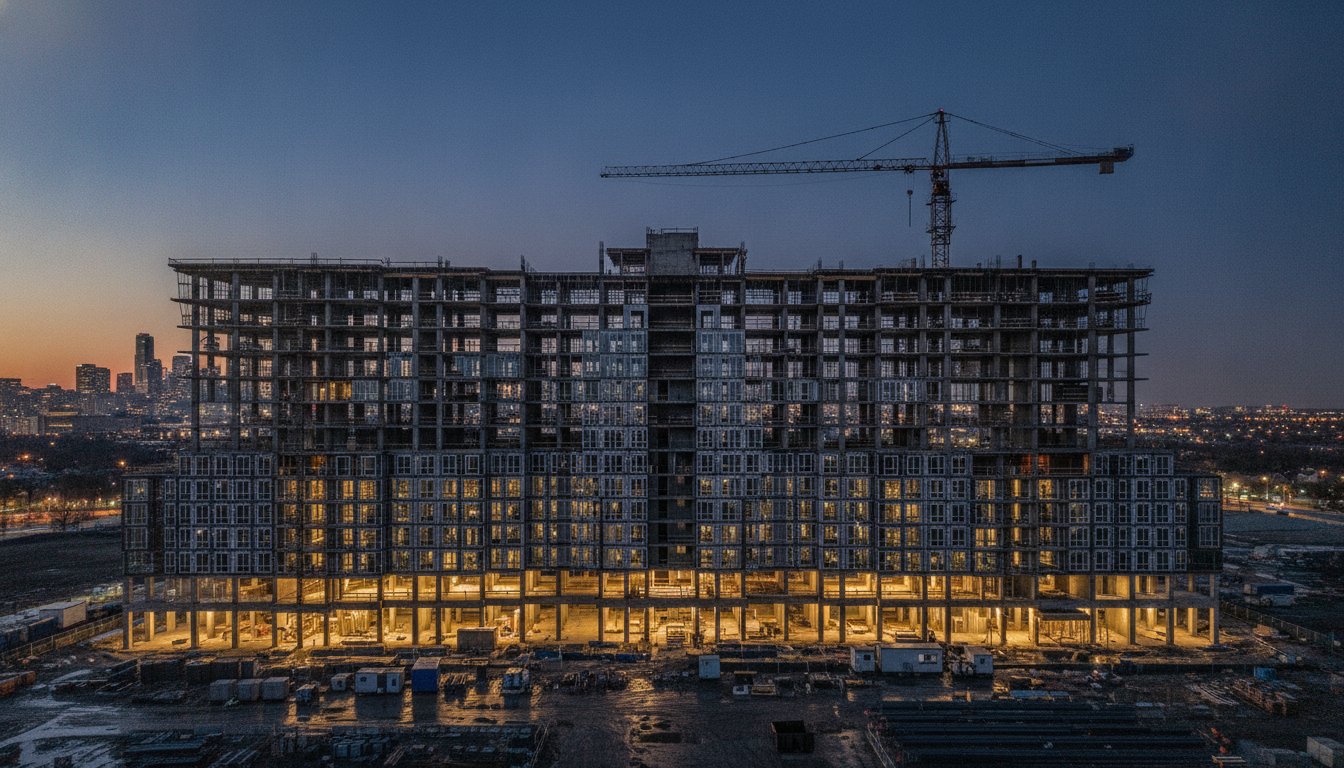
A $200 million residential development cannot survive on a financing structure designed for a small-scale build. In 2026, the gap between traditional bank rigidity and the agility required for institutional-scale projects has never been wider. Securing large construction loans for developers now requires more than just a strong balance sheet; it demands a sophisticated approach to the entire capital stack. You've likely felt the pressure of rising input prices, which rose 8.4% year-over-year by mid-2026, or the frustration of a project stalling because a lender couldn't bridge the gap to stabilization.
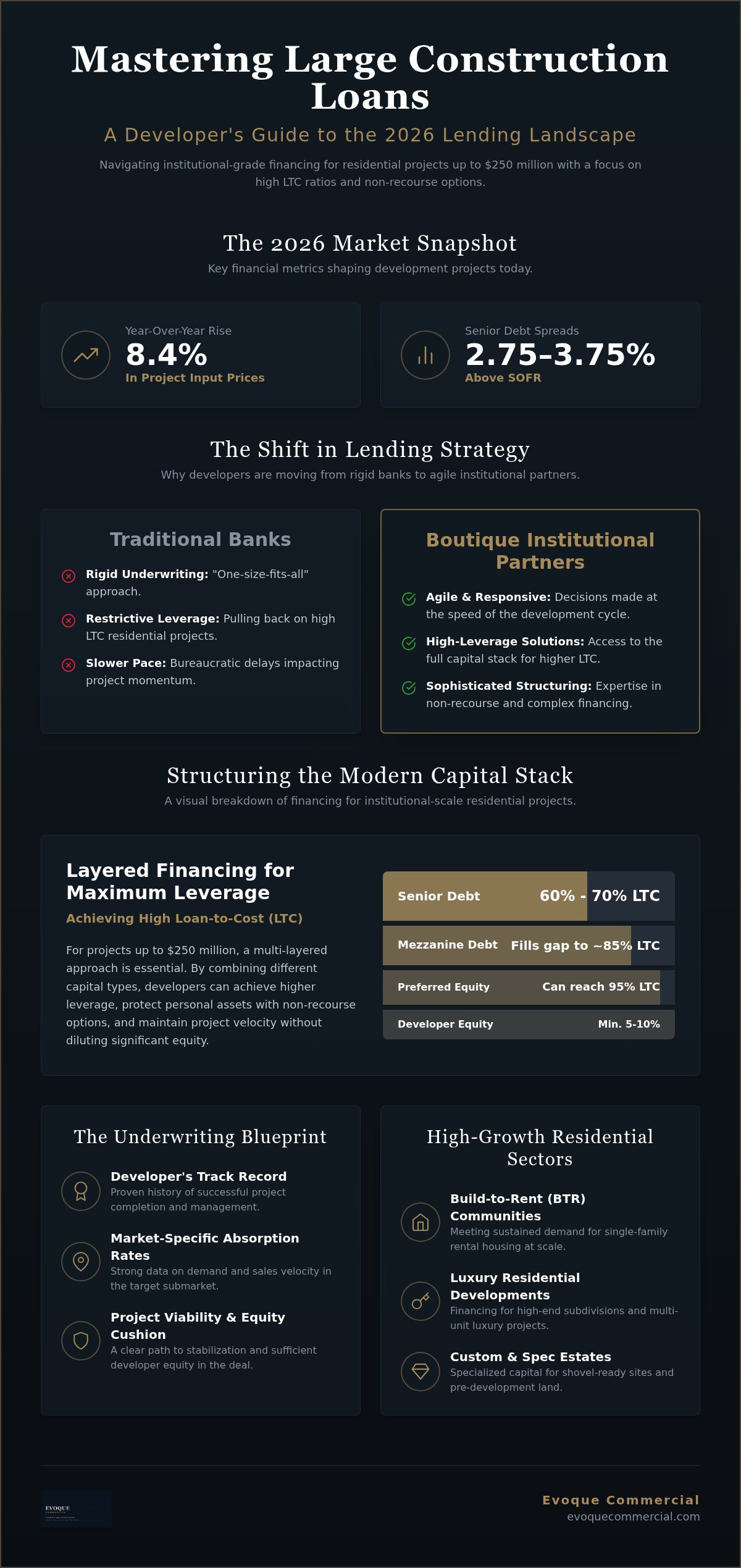
We recognize that your priority is maintaining project momentum while protecting your equity. This guide provides the strategic framework to master these complexities, focusing on how to achieve high LTC ratios and secure non-recourse options for projects up to $250 million. We'll examine the current lending environment, where senior debt spreads often sit 2.75% to 3.75% above SOFR, and outline the exact steps to ensure a seamless transition from construction to bridge financing.
The Landscape of Large Construction Loans for Developers in 2026
Large-scale construction financing in the current market is defined by a flight to quality and a reliance on structured flexibility. For developers managing projects with budgets exceeding $10 million, the traditional banking route has become increasingly restrictive. Regulatory pressures and capital reserve requirements have forced many national banks to pull back on high-leverage residential projects. This retreat leaves a significant gap for those seeking large construction loans for developers who require more than just a standard senior debt facility.
The shift toward non-bank institutional lenders and boutique firms isn't merely a trend; it's a structural necessity. These lenders provide the responsiveness that massive institutional bureaucracies lack. They understand that a $50 million multifamily build or a $150 million luxury subdivision requires a partner who can move at the speed of the development cycle. By prioritizing the sponsor's experience and the project's specific feasibility, these firms offer a viable alternative to the rigid, "one-size-fits-all" underwriting found in traditional retail banking.
The Evolution of Institutional Construction Lending
The 2026 economic environment, characterized by stabilized but elevated interest rates, has fundamentally changed how capital is deployed. Private credit has emerged as the dominant force in residential development financing. Boutique institutional lenders now serve as the primary bridge for middle-market developers who need sophisticated capital without the friction of a large bank. These lenders often utilize a strategy that combines Bridge and Construction Loans to ensure the project remains funded from the initial land purchase through to the final certificate of occupancy. This approach focuses on the total lifecycle of the asset, rather than just the vertical construction phase.
Targeting High-Growth Residential Segments
Institutional capital is currently gravitating toward specific high-yield residential sectors. There is sustained interest in Build-to-Rent (BTR) communities, which offer a compelling alternative to traditional multifamily assets. We also see an underserved demand for luxury residential development and custom estate financing at scale. While many lenders shy away from luxury spec projects, boutique partners recognize the value in high-end subdivisions and custom estates. Financing for these projects requires a deep understanding of market-specific absorption rates and the unique needs of shovel-ready sites versus pre-development land acquisitions. Securing large construction loans for developers in these sectors depends on presenting a meticulous capital stack that mitigates the risks of volatile input costs.
Structuring the Capital Stack: Beyond Senior Construction Debt
Institutional-scale residential projects demand institutional-grade financial structures. For a development with a total cost basis exceeding $50 million, a single-source loan is rarely sufficient or efficient. Developers must assemble a sophisticated capital stack that balances cost, control, and risk mitigation. Most large construction loans for developers are now structured with a senior debt piece that covers approximately 60% to 70% of the total loan-to-cost (LTC). The remaining portion of the budget is filled through a combination of mezzanine debt, preferred equity, and the developer's own capital. This tiered approach allows for non-recourse options, which are vital for protecting a developer's broader portfolio from project-specific liabilities.
Lenders in 2026 have become more disciplined regarding leverage. While a senior lender might provide the bulk of the capital, they often require a significant equity cushion. Current analysis of Commercial Real Estate Financing indicates that lenders are prioritizing debt-yield and debt service coverage ratios over simple appraisal values. Managing these ratios requires a precise understanding of how each layer of the stack interacts. A strategic capital partner can help you structure these layers to minimize cash outlays while satisfying the senior lender's stringent requirements.
Mezzanine Debt and Preferred Equity Strategies
When senior debt hits its ceiling, mezzanine debt and preferred equity become the primary tools for filling the gap. Mezzanine debt sits behind the senior lender but ahead of common equity. It's an effective way to increase total leverage without diluting ownership. In the current high-interest environment, many sponsors use real estate capital stack optimization to determine if preferred equity offers a more sustainable path. Preferred equity often carries a higher cost than mezzanine debt, but it typically provides more flexible repayment terms and less restrictive covenants, allowing the developer to maintain operational control during the critical vertical phase.
Leveraging Land Equity for Vertical Financing
A common friction point for developers is the transition from raw land to a vertical build. Smart developers use land acquisition and development loans to secure the site and complete essential horizontal improvements. Once grading, utilities, and infrastructure are in place, the appraised value of the land often sees a significant "lift." This increased value can be converted into project equity. By using land equity to satisfy a portion of the lender's capital requirement, developers can significantly reduce their out-of-pocket cash needs. This strategy is particularly effective for large-scale luxury subdivisions and multifamily projects where horizontal development represents a substantial portion of the initial investment.
Comparing Financing Paths: Ground-Up vs. Completion Financing
Large construction loans for developers generally follow one of two distinct paths: a linear ground-up progression or a strategic rescue recapitalization. While most institutional financing targets the inception of a build, the 2026 market has seen an increased demand for capital that can enter mid-cycle. Whether you're launching a new multifamily site or finishing a stalled luxury subdivision, the financing structure must match the project's current state of completion. A disciplined approach ensures that capital is available when milestones are met, preventing the liquidity crunches that often derail institutional-scale developments.
For ground-up projects, the focus is on the transition from land acquisition to vertical completion. Many developers utilize HUD 221(d)(4) multifamily financing for its high-leverage, non-recourse benefits, although the lengthy approval process often necessitates a bridge-to-construction strategy. Conversely, construction completion financing serves as a vital tool for projects that have hit a wall due to cost overruns or lender fatigue. This path allows developers to recapitalize and push through to the certificate of occupancy without sacrificing their entire equity position.
Ground-Up Construction Lifecycle Management
Success in ground-up development depends on how effectively you manage the vertical phase through draw schedule administration. Institutional lenders prioritize a transparent, milestone-based deployment of capital. This is particularly complex when coordinating single family subdivision financing for phased builds. You must maintain flexibility in these schedules to mitigate ongoing supply chain and labor volatility. By structuring the loan with robust contingency reserves, you protect the project from the mid-construction delays that can erode your profit margins.
Rescue Capital and Project Completion Solutions
Stalled projects often result from capital gaps or a sudden change in a lender's risk appetite. When a project hits a wall, securing large construction loans for developers focused on completion is more effective than trying to stretch existing equity. This rescue capital recapitalizes the project, allowing you to finish the vertical build and move toward a strategic exit. Once the build is complete, the focus shifts to transitioning from construction to bridge loans for residential development. This bridge period provides the necessary time for stabilization or a controlled sell-out of inventory. For home builders, inventory financing acts as a release valve, letting you extract equity from completed units while the remaining subdivision is still under construction.
The Underwriting Blueprint: What Lenders Look for in Large Loans
Underwriting at the institutional level is a forensic exercise in risk mitigation. When evaluating large construction loans for developers, lenders prioritize the sponsor's track record above all other variables. A project's success isn't solely dependent on the market or the architecture; it hinges on the developer’s ability to execute a complex vision under pressure. Lenders look for a history of successful exits on projects of similar scale and complexity. For a $100 million development, a sponsor generally needs to demonstrate significant liquidity and a net worth that often equals or exceeds the loan amount. While baseline requirements typically include a credit score of at least 680, institutional programs for larger projects often look for scores above 720 to secure the most competitive non-recourse terms.
Evaluating the Sponsor and Development Team
The strength of your development team is as critical as your own financial standing. Lenders scrutinize the general contractor’s bonding capacity, safety record, and experience with high-density or high-end builds. This is especially true for luxury residential development loans, where the quality of finishes and specialized construction techniques require a higher level of technical expertise. A lender-ready package must include a detailed resume of the GC’s past five years of completed projects to prove they can manage the labor and supply chain challenges inherent in the 2026 market.
Due Diligence and Entitlement Risk
Project feasibility is measured through market-specific absorption rates and "shovel-ready" status. Lenders rarely provide large construction loans for developers on land that isn't fully entitled. Entitlement risk is the primary reason projects stall before they even break ground. Your due diligence file should be comprehensive, covering everything from environmental Phase I reports to final zoning approvals and utility capacity letters. A "lender-ready" package should include:
- A detailed pro forma analysis with conservative absorption and exit cap rate assumptions.
- Executed contracts or letters of intent from key subcontractors.
- A third-party feasibility study confirming demand for the specific residential asset class.
- Clear evidence of all necessary municipal permits and architectural drawings.
For developments exceeding $100 million, the pro forma must account for potential price escalations and carry a robust contingency of at least 10% to 15%. If your project is shovel-ready and backed by a strong development team, you're positioned to move through the underwriting process with speed and precision. Submit your project for a preliminary capital stack review to see how our structured finance solutions can meet your development goals.
Strategic Partnerships: Why Developers Choose Boutique Institutional Lending
The 2026 credit environment has fundamentally redefined the relationship between sponsors and their capital sources. For projects of significant scale, a lender who merely provides a term sheet isn't enough. You need a strategic capital partner who understands the nuances of the residential development cycle. Choosing a partner for large construction loans for developers involves looking past the interest rate. It requires evaluating how that partner will respond when a project hits a milestone or faces a supply chain delay. Boutique institutional firms bridge the gap between massive, bureaucratic banks and the agile, high-stakes world of middle-market development.
Institutional bureaucracy often slows down the very projects that require the most momentum. Large banks operate with rigid committees that don't always value the specific context of a luxury subdivision or a build-to-rent community. In contrast, a boutique approach prioritizes direct access to decision-makers. This structure ensures that large construction loans for developers are managed with a level of precision and speed that traditional retail institutions cannot match. Every project receives a tailored financing path rather than a standardized product, allowing for exit strategies that align with actual market absorption rather than arbitrary bank timelines.
Agility in the Middle Market
Speed to market is a developer's most valuable asset. When a time-sensitive acquisition arises, you don't have months to wait for a bank's internal review process. Boutique firms deliver the agility needed to secure land and launch vertical construction without delay. We customize loan terms to match your specific exit strategy, whether that involves a transition to bridge financing or a phased sell-out of inventory. One of the most significant advantages is having a single point of contact for draw administration. This eliminates the friction of dealing with multiple departments, ensuring that your contractors are paid on time and your vertical progress remains uninterrupted.
Securing Your Project’s Future with Evoque Lending
Evoque Lending provides the institutional scale your project requires with the personal responsiveness of a boutique firm. Our financing solutions range from $3 million to $250 million, covering the full spectrum of residential development from ground-up builds to construction completion. We leverage deep institutional relationships to offer lower blended costs while maintaining the flexibility that middle-market developers need to thrive. Our project review process is thorough, disciplined, and focused on the realities of the 2026 market. We don't just look at the numbers; we look at the strategy behind the build. If you're ready to move beyond the limitations of traditional banking, the next step is a comprehensive project review. Let's discuss how we can structure a capital stack that protects your equity and ensures your project's successful completion.
Executing Your 2026 Residential Vision
The landscape of institutional development has shifted toward a more nuanced, structured approach. Success no longer depends on simple senior debt but on a meticulously organized capital stack that balances risk and leverage. We've seen how track record and shovel-ready status dictate the terms of large construction loans for developers, and how the right partnership can bridge the gap between initial acquisition and final stabilization. Whether you're managing a ground-up build or seeking rescue capital for a stalled development, your project's momentum depends on capital that moves at the speed of your vision.
Evoque Lending delivers institutional scale for projects up to $250 million, paired with the boutique responsiveness your team deserves. Our expertise in complex structured capital ensures your project remains resilient against market volatility. Request a Project Review from Evoque Lending Today to secure a strategic partner who values your time and respects the scale of your ambition. We're ready to help you bring your next major residential project to life with precision and confidence.
Frequently Asked Questions
What are the typical interest rates for large construction loans in 2026?
In 2026, interest rates for senior debt on large-scale projects typically range from 7.30% to 8.30% for national bank financing. These rates are often priced at a spread of 2.75% to 3.75% over the Secured Overnight Financing Rate (SOFR). Private lenders and debt funds generally price their facilities between 10.50% and 11.75%. Rates vary based on the sponsor's track record and the project's specific risk profile.
Do large-scale construction loans require personal guarantees (recourse)?
Institutional-scale financing for projects exceeding $20 million often provides non-recourse or limited recourse options. While traditional community banks typically require full personal guarantees, boutique institutional lenders prioritize the asset's value and the developer's experience. Limited recourse structures usually include "bad boy" carve-outs and completion guarantees. This protects the sponsor's broader portfolio while ensuring the project remains capitalized through the final certificate of occupancy.
How long does the underwriting process take for a $50 million construction loan?
The underwriting process for a $50 million facility generally takes between 45 and 60 days from the initial project review to closing. This timeline includes third-party reports, environmental assessments, and a deep dive into the development team's track record. Boutique firms often provide a preliminary term sheet within 5 to 7 business days. This allows developers to move quickly on acquisitions while the formal institutional due diligence process runs in parallel.
What is the maximum Loan-to-Cost (LTC) for a ground-up multifamily project?
Senior lenders typically cap ground-up multifamily leverage at 65% to 75% of the total project cost. However, by utilizing structured capital solutions, developers can achieve a blended loan-to-cost (LTC) of 85% or higher. This often involves layering mezzanine debt or preferred equity behind the senior construction loan. These higher leverage points are generally reserved for well-capitalized sponsors in markets with strong absorption rates and proven demand.
Can I get financing for a project that has already started construction?
Yes, developers can access construction completion financing for projects that are already mid-build. This is often necessary when a project faces cost overruns or a previous lender reaches their exposure limit. Lenders specializing in large construction loans for developers can recapitalize the build, providing the rescue capital needed to finish the vertical phase. This path requires a detailed audit of the remaining budget and a clear timeline for stabilization.
What is the difference between mezzanine debt and preferred equity in a construction project?
Mezzanine debt is a loan secured by a pledge of the developer's ownership interest, sitting directly behind senior debt. Preferred equity is an ownership position that receives a fixed return before common equity holders. While mezzanine debt is technically a liability on the balance sheet, preferred equity is often viewed as equity by the senior lender. Both tools are essential for optimizing the capital stack and reducing the developer's initial cash requirement.
Are land acquisition costs included in the construction loan?
Land acquisition costs are typically integrated into the initial phase of the capital stack. Developers can secure acquisition and land financing to purchase the site, which is then refinanced into the vertical construction loan once entitlements are secured. If the developer already owns the land, the current appraised value can often be used as equity credit. This land lift reduces the amount of cash the sponsor must contribute to the construction phase.
How do draw schedules work for large-scale vertical developments?
Draw schedules for vertical developments are milestone-based and typically operate on a monthly cycle. The developer submits a draw request covering completed work and stored materials, which is then verified by a third-party inspector. Funds are released to the developer or general contractor to pay subcontractors. This disciplined process ensures that large construction loans for developers are deployed in alignment with the project's physical progress and the approved budget.